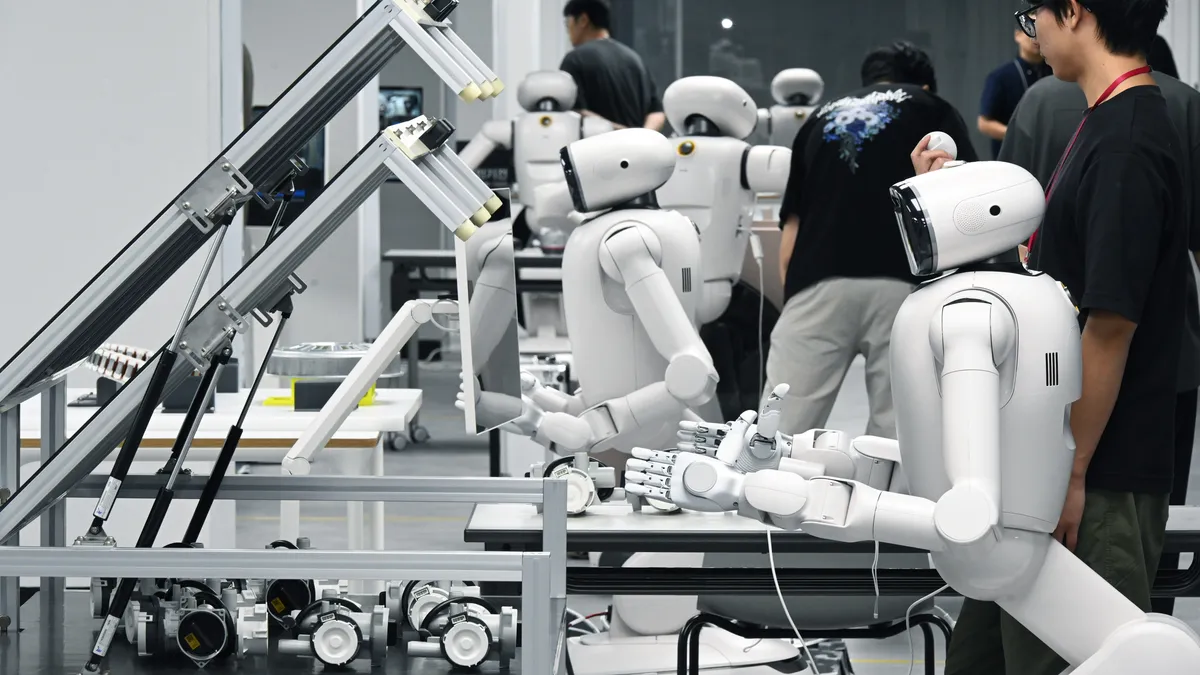
LG Electronics is moving physical AI governance ahead of hardware commercialization. On November 16, 2026, the South Korean manufacturer announced a memorandum of understanding (MOU) with the Korea Institute for Robot Industry Advancement (KIRIA), signed on November 13 at LG Twin Towers in Seoul by KIRIA President Cho Young-hun and Kim Chang-min, executive vice president and head of LG Electronics’ Quality Management Center.
Under the agreement, LG will help build evaluation systems for KIRIA’s Humanoid Robot Safety Certification Center, contribute to national and international robotics standards, and pursue domestic pilot safety certification for its flagship wheeled robot, the LG CLOiD. Crucially, the initiative establishes formal collision-avoidance, usability, and motion-stability benchmarks just ahead of LG’s planned public unveiling of a new NVIDIA-powered bipedal humanoid in Q1 2027.
Inside LG CLOiD: Dual 7-DoF Dexterity and Low-Center-of-Gravity Safety
While much of the robotics sector rushes straight into dynamic bipedal legs, LG engineered CLOiD specifically around human-environment safety. Rather than walking legs, the platform mounts a tilting upper torso onto an autonomous wheeled base derived from LG’s robot vacuums and Q9 home hub. This low-center-of-gravity chassis lowers tipping risk if children, pets, or factory operators make accidental physical contact.
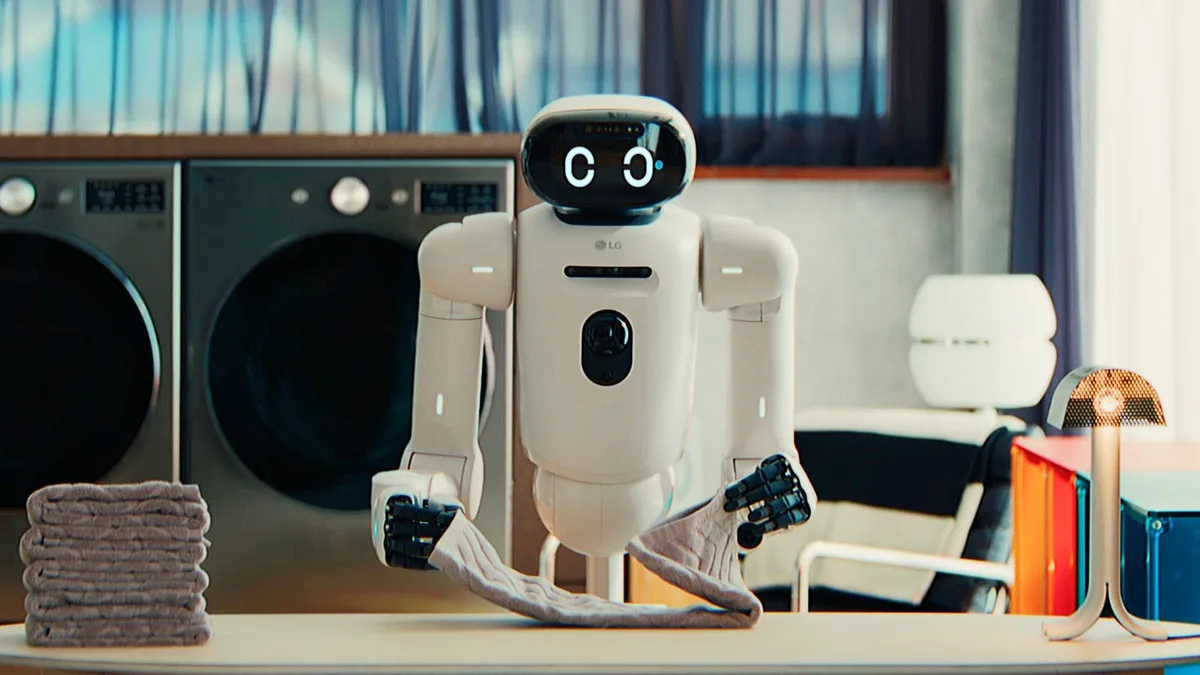
The tilting torso dynamically adjusts the robot’s height between 105 cm and 143 cm (3 ft 5 in to 4 ft 8 in), enabling its dual 87 cm arms to reach from knee level up to kitchen counters, washing machines, and factory workbenches. Each arm packs 7 degrees of freedom (DoF) matching human shoulder, elbow, and wrist mobility, terminating in hands equipped with 5 independently actuated fingers capable of folding laundry, unloading refrigerators, and handling delicate parts.
Its rounded head acts as a Mobile AI Home Hub housing the onboard brain chipset, cameras, proximity and spatial sensors, speakers, voice generative AI, and an expressive digital display. At the software layer, LG pairs Vision-Language Models (VLM) and Vision-Language-Action (VLA) models trained on tens of thousands of household task hours with native LG ThinQ and ThinQ ON smart appliance orchestration. Weight, battery capacity, and retail pricing remain undisclosed while pilot validation continues.
LG Actuator AXIUM: Thermal Stability Under 95 °C and Energy Recovery
Hardware reliability under KIRIA scrutiny relies heavily on LG’s proprietary robotics components. Alongside CLOiD, LG launched LG Actuator AXIUM, an integrated joint-drive brand combining electric motor, drive electronics, and speed/torque reducer into compact modular housings.
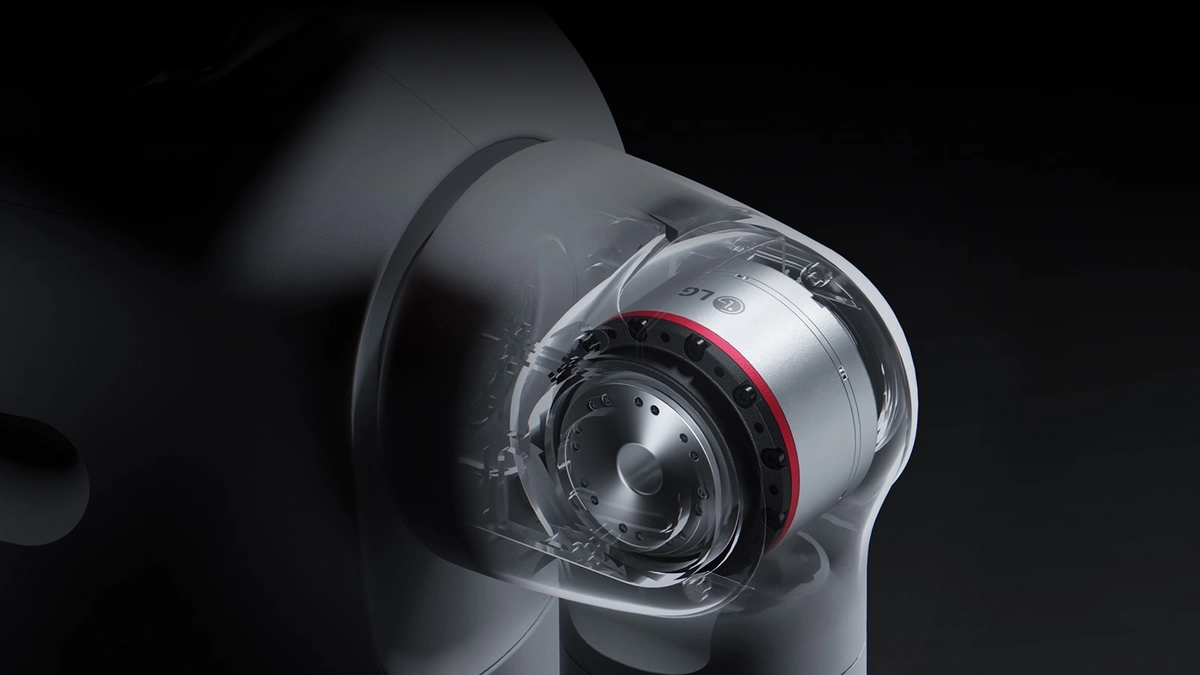
To avoid the thermal throttling that commonly degrades robotic limbs during sustained factory shifts, AXIUM introduces an unrolled segmented stator core for higher torque density in a slimmer footprint and a multi-layer aluminum 3D Heat-Dissipation Design engineered to keep internal component temperatures below 95 °C. Built-in regenerative braking harvests energy during deceleration to extend runtime. LG scales the lineup across seven Joint Drive diameters (40 mm to 120 mm: Φ40, Φ50, Φ60, Φ80, Φ100, Φ110, and Φ120) alongside 5.0-inch and 6.5-inch (127 mm and 165.1 mm) Wheel Drive units.
Seoul Data Factory, NVIDIA Isaac GR00T, and the Q1 2027 Bipedal Roadmap
The KIRIA MOU connects directly to LG’s deep physical AI alliance with NVIDIA formalized in August 2026. At LG’s Data Factory inside the Yangjae R&D Campus in Seoul, fleets of CLOiD robots already practice both replicated household chores and washing machine manufacturing sequences. Combined with synthetic training data generated through NVIDIA Cosmos world models and LG CNS PhysicalWorks, LG targets 100,000 hours of training data by the end of 2026, alongside live validation of CLOiD units on LG Electronics’ washing machine line in Tennessee.
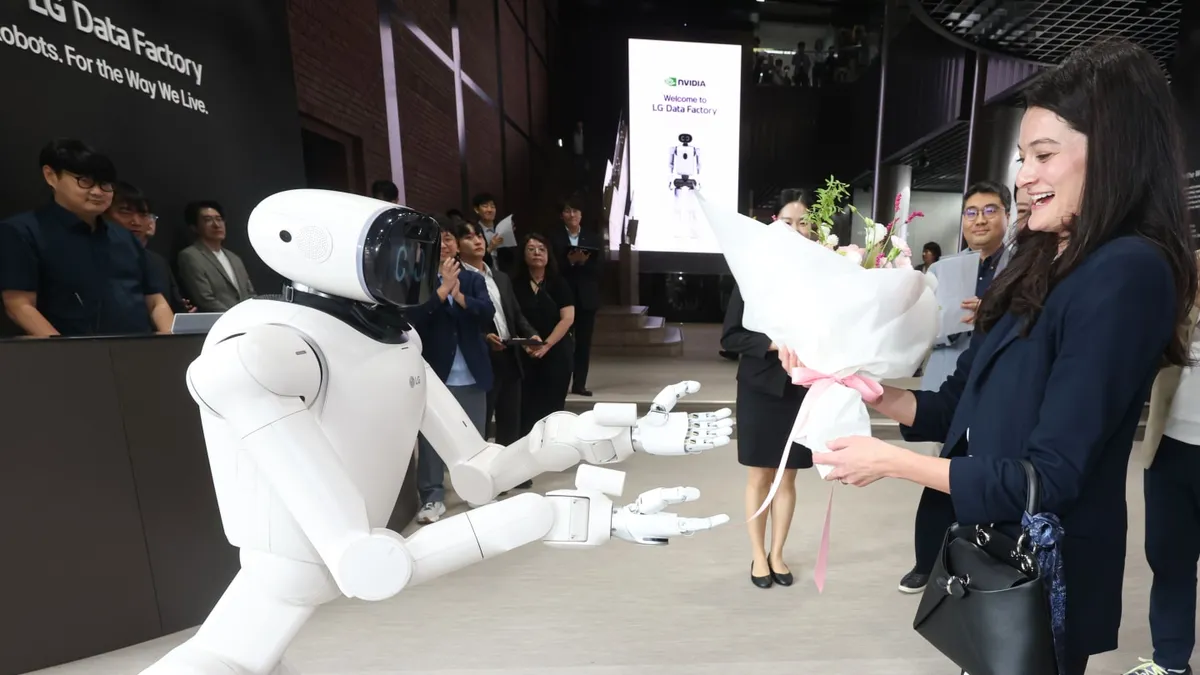
All of this wheeled telemetry is preparing LG’s next major hardware step: a next-generation bipedal humanoid scheduled for unveiling in Q1 2027. Built on NVIDIA Jetson Thor compute, the Isaac GR00T open reasoning foundation model, and the NVIDIA Halos robotics safety framework, the bipedal unit will unite “One LG” components across LG Electronics actuators, LG Innotek sensors, and LG Energy Solution batteries.
Why Safety Standards Dictate Commercial Speed
By co-authoring KIRIA’s evaluation protocols now, LG addresses the primary bottleneck holding back home and brownfield factory humanoids: formal certification for unguarded human coexistence. Testing stability, emergency braking, and collision avoidance early gives LG an actionable regulatory path across both residential ThinQ homes and assembly floors.
Explore full verified engineering specifications and direct head-to-head comparisons on SpecsLib:
- LG CLOiD Verified Hardware Profile: Complete dimensions, 7-DoF kinematics, AXIUM actuators, and KIRIA roadmap.
- Compare LG CLOiD vs 1X Neo: Wheeled ThinQ home-and-plant robot against 1X’s bipedal domestic assistant.
- Compare LG CLOiD vs Galbot G1: Korean household/appliance validation versus China’s commercial retail wheeled platform.
- Compare LG CLOiD vs Embodied AI AIR: Proprietary AXIUM joint drives against Swiss tendon-driven cobot safety architecture.
Browse all indexed bipedal and wheeled platforms in the SpecsLib Humanoid Robot Database.