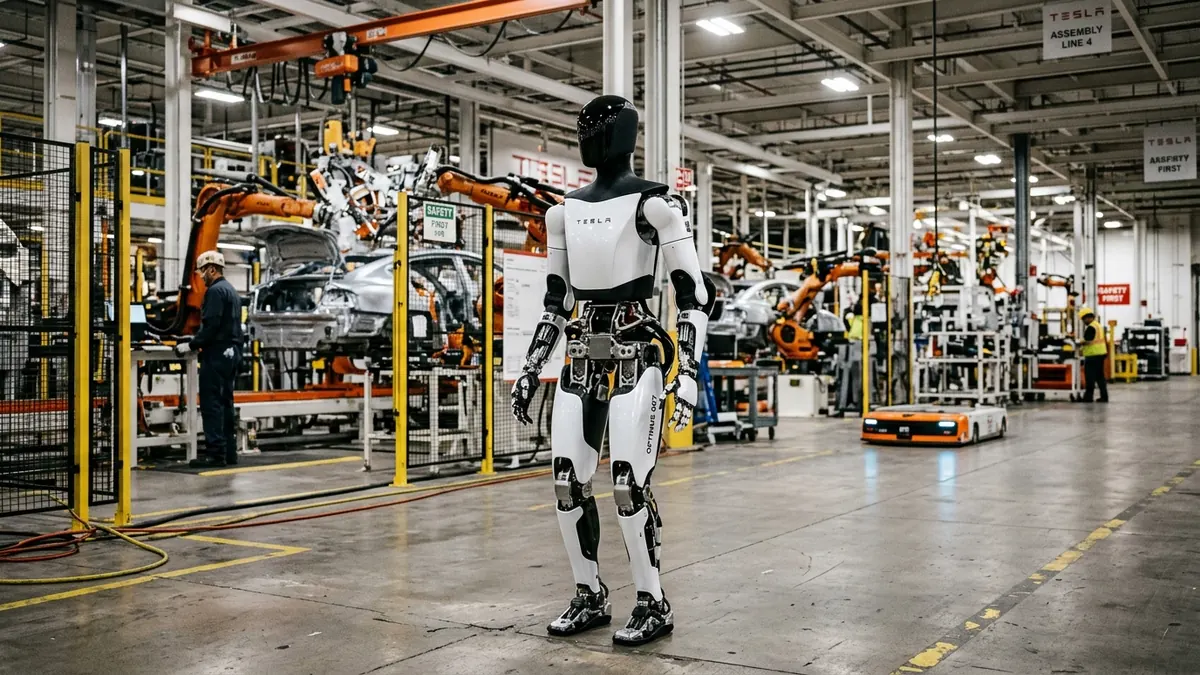
In its Q3 2026 financial disclosures and shareholder update, Tesla officially confirmed that series manufacturing of the Optimus humanoid robot has commenced inside its Fremont factory in California. The transition marks a watershed moment in physical AI: shifting bipedal robotics from low-rate engineering prototypes into validated high-volume manufacturing lines.
Tesla explicitly disclosed in its shareholder letter that the humanoids rolling off the newly operational line represent the “first production-quality bots that we have manufactured,” verifying that the underlying mechanical, thermal, and electrical architectures are now suitable for standardized commercial manufacturing.
From Model S and X Bays to Bipedal Production
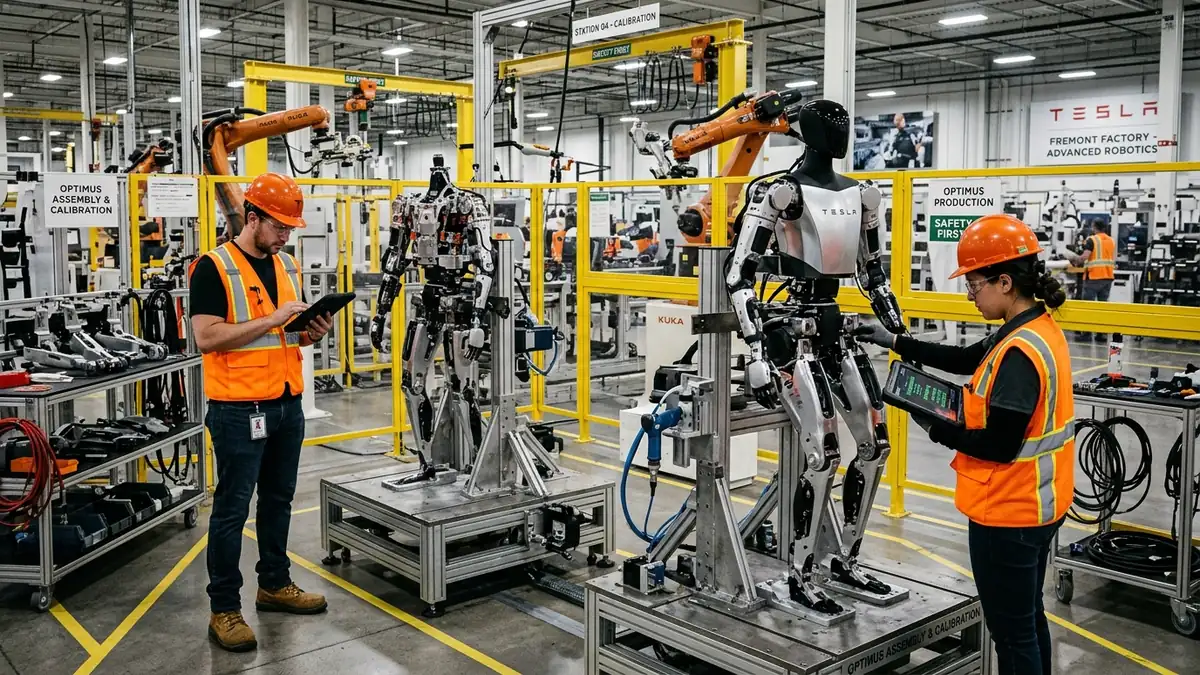
The physical setup of the Optimus assembly line reveals how Tesla leverages its automotive manufacturing heritage to outpace pure-play robotics laboratories. Rather than constructing a greenfield facility, Tesla cleared out legacy manufacturing space in Fremont previously dedicated to the Model S and Model X.
The retooled production floor incorporates structural alignment jigs, automated planetary actuator torque dynos, and robotic wire-harness routing cells. Unlike hand-assembled laboratory bipeds, every Optimus unit manufactured on this line undergoes automated sensor calibration:
- Actuator Calibration: Dynamic load testing of the 29 structural body degrees of freedom (arms, legs, torso and neck) and 44 degrees of freedom across the synthetic tendon-driven hands (yielding 73 total DoF across the entire biped).
- Vision Harmonization: Optical calibration of the 8-camera surround vision suite, aligning depth perception and extrinsic transforms to the central neural processing unit.
- Zero-Point Joint Balancing: Automated mass-distribution checks ensuring the 57 kg chassis adheres to tight center-of-mass tolerances before walking off the staging rig.
Tesla stated that the factory layout was planned with the structural headroom to scale toward an annual capacity of up to one million humanoid units over time.
Solving the Physical Data Bottleneck: The Optimus Academy
In automotive autonomy, Tesla built its competitive moat on billions of real-world driving miles collected by customer vehicles running Full Self-Driving (FSD). In humanoid robotics, that crowdsourced data loop does not exist: a newly minted robot cannot simply be shipped to consumers to figure out physical dynamics on carpet or kitchen tiles.
To overcome this training data bottleneck, Tesla unveiled the Optimus Academy.
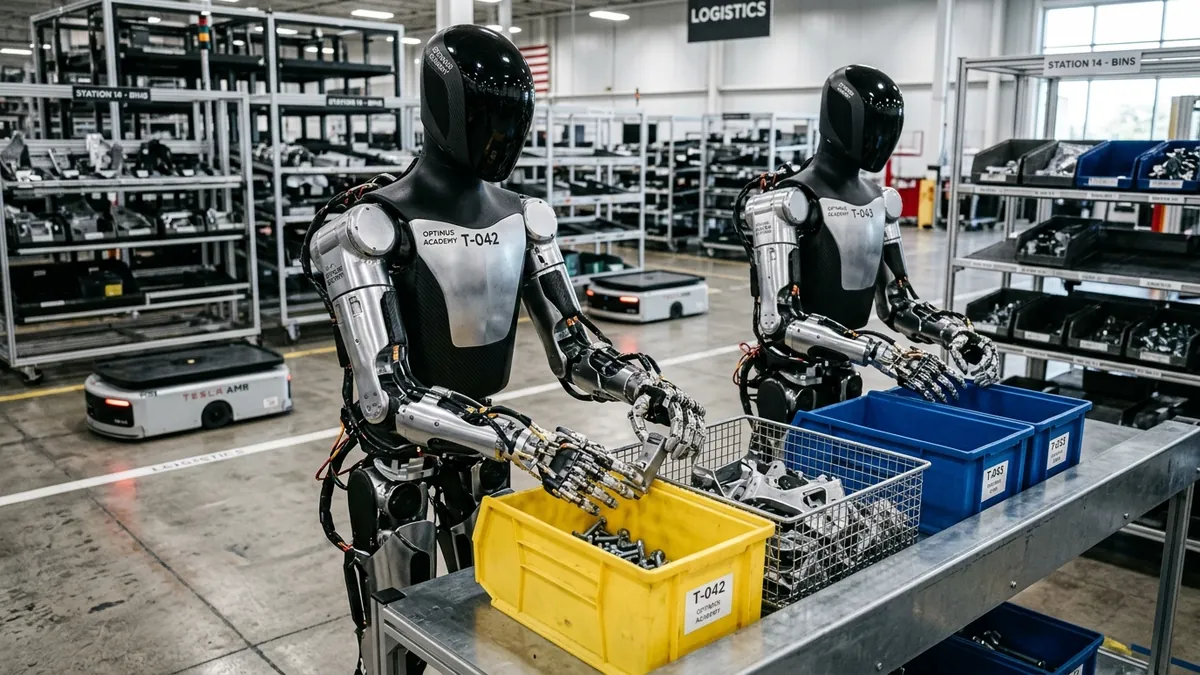
Under this initiative, Tesla is deploying an internal cohort of 10,000 to 20,000 production-grade Optimus robots across its own Gigafactories (including Fremont, Giga Texas, and Giga Nevada). These robots are not merely passive showroom displays:
- Real Industrial Workloads: The robots are assigned active manufacturing duties, such as handling 4680 battery cells, sorting stamped sheet-metal brackets into logistical tote bins, and tending CNC milling stations. Powered by a 2.3 kWh onboard pack delivering roughly 6 hours of continuous operation, units recharge autonomously via floor-mounted conductive pads between shifts.
- Pushing the MTBI Horizon: The core metric tracked in the Optimus Academy is Mean Time Between Interventions (MTBI). When an Optimus encounters an edge case (such as an irregular part orientation or slip during grasp), human operators intervene via VR teleoperation rigs. The correction is ingested directly into Dojo and cluster training pipelines, generating updated weights for the vision-to-action foundation model.
- Multi-Agent Diversity: By running thousands of machines in parallel across varying lighting, floor textures, and part geometries, the Optimus Academy generates millions of hours of rich multimodal manipulation telemetry daily.
Automotive Rivalry and Hardware Scaling
Tesla is not operating in a vacuum. The global automotive sector has become the primary proving ground for embodied AI: Figure AI has deployed Figure 02 and Figure 03 at BMW Spartanburg, Apptronik’s Apollo is trialing parts kitting at Mercedes-Benz, and UBTECH’s Walker S1 is running chassis inspection across Nio and Geely assembly plants.
Elon Musk cautioned during the earnings call that the Fremont manufacturing ramp will follow a characteristic shallow S-curve. High-precision dexterous hands, featuring 22 active degrees of freedom per hand and tactile sensor arrays operating at 1,000 Hz, remain the most intricate subassembly to scale reliably.
On the compute front, production units rolling off the line are slated to integrate Tesla’s next-generation AI5 silicon (formerly Hardware 5), delivering up to five times greater neural compute density than vehicle-grade HW4 modules while maintaining a thermal envelope suited for active convective cooling inside the robot torso.
Commercial deliveries to external enterprise customers remain targeted for the end of 2027. Until then, virtually all Fremont output will be absorbed internally by the Optimus Academy to solidify autonomous reliability across factory logistics.
You can inspect complete kinematic dimensions, actuator torque ratings, and battery runtimes on our dedicated Tesla Optimus Gen 3 specification profile, or evaluate comparative engineering trade-offs in our interactive head-to-head duels: