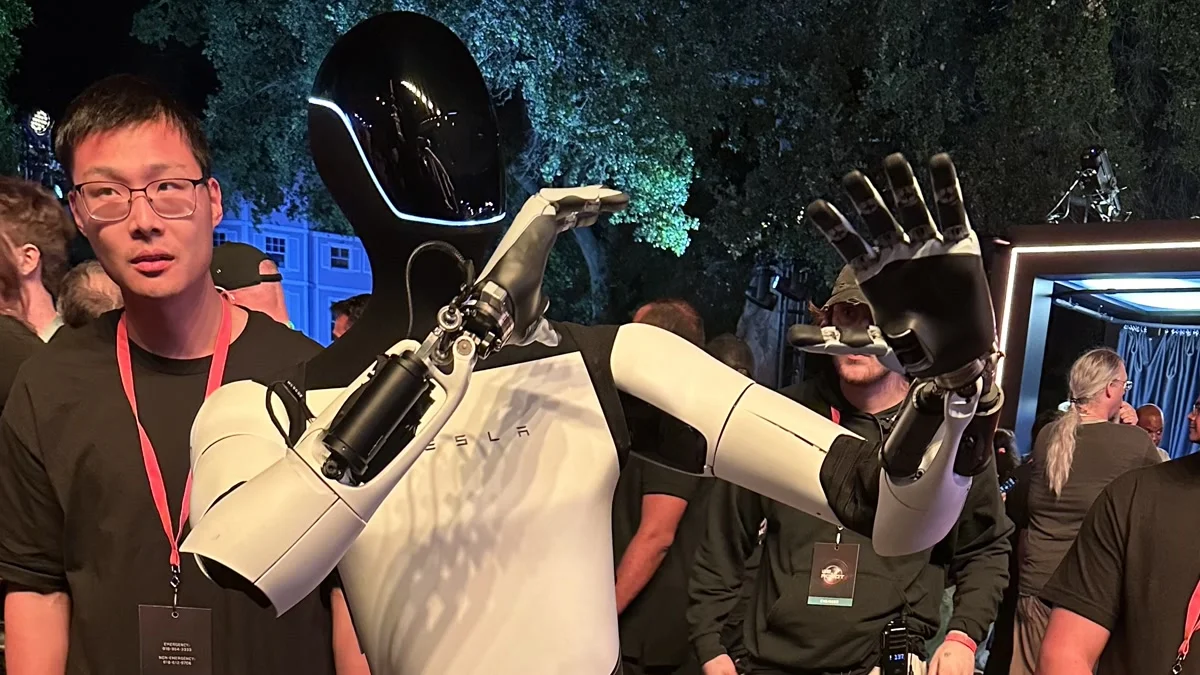
As Tesla scales internal operations across its Fremont and Austin Gigafactories, the engineering blueprint for Tesla Optimus Gen 3 has come into sharp focus.
While earlier Gen 1 and Gen 2 prototypes proved bipedal balance and self-calibration, Gen 3 addresses the decisive industrial bottleneck of general-purpose robotics: human-level manipulation dexterity and high-throughput factory integration.
Dexterous 22-DoF Hands: The Forearm Tendon Redesign
The human biological hand features 27 degrees of freedom, governed by intrinsic muscles in the palm and extrinsic muscles in the forearm. Early Optimus iterations utilized an 11-DoF hand architecture with micromotors packed inside the palm. While adequate for gross grasping, this design introduced thermal limits, restricted wrist range, and produced high finger inertia that impeded reactive grip adjustments.
For Optimus Gen 3, Tesla completely re-engineered the kinematic chain:
- Actuators Relocated to Forearms: 25 independent electric actuators per forearm (50 actuators dedicated exclusively to both hands) drive finger motion remotely via high-tensile synthetic tendon routing.
- 22 Degrees of Freedom per Hand: With 22 actuated DoF, each finger gains independent abduction, adduction, and multi-joint flexion, allowing individual phalanges to wrap around complex industrial tooling.
- Mass Reduction at the Extremities: By removing motor mass from the palm, distal finger inertia drops sharply, enabling rapid dynamic micro-adjustments within milliseconds.
- 1,000 Hz Capacitive Tactile Arrays: High-density tactile sensor matrices are embedded across every finger pad and palm contact surface. Operating at a 1 kHz polling rate, the control loop detects shear slip and micro-vibrations before visual cameras register object movement.
Review the complete comparison between iterations in the Optimus Gen 3 Dossier and the earlier Optimus Gen 2 Spec Sheet.
End-to-End Vision-to-Action via Tesla HW4 / AI5
Unlike legacy factory automation that relies on pre-mapped spatial coordinates and hardcoded Inverse Kinematics (IK), Optimus Gen 3 runs end-to-end neural networks onboard.
The robot processes 2D video feeds from its 8 surround-view cameras directly into an embodied foundation model running on internal Tesla HW4 / AI5 silicon. Actuator torques are synthesized directly from neural network weights, enabling the platform to adapt dynamically to misaligned battery trays, varying component orientations, and human co-workers in active production cells.
Training data is collected via virtual reality teleoperation rigs deployed across Tesla facilities, with millions of operational hours logged into Tesla’s Dojo supercomputing clusters to refine autonomous motor policies.
The Captive Gigafactory Proving Ground
Tesla possesses an operational asset that pure-play robotics research firms cannot match: captive manufacturing facilities with thousands of repetitive material handling tasks.
Optimus Gen 3 units are currently staged on 4680 battery cell production lines and component staging zones in Fremont. Every hour of physical operation supplies high-fidelity edge-case telemetry back into the training loop, accelerating the transition from low-rate pilot trials to full volume manufacturing.