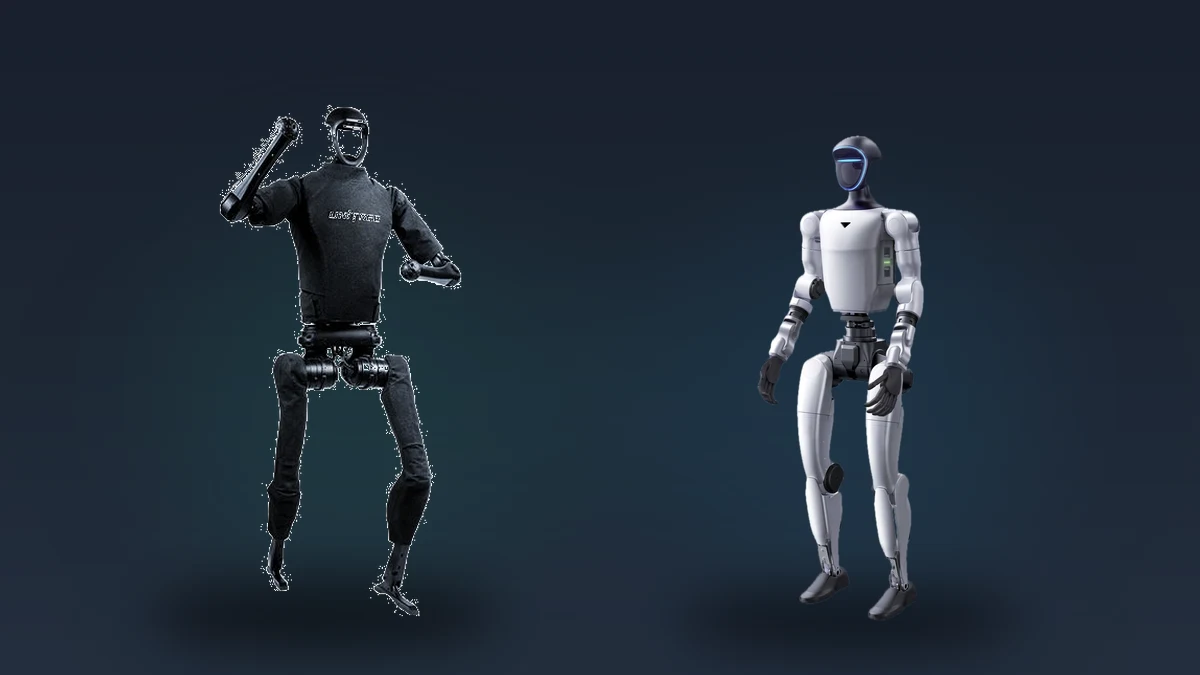
The global landscape of humanoid robotics is experiencing a profound architectural divergence. While American and European initiatives have largely focused on closed corporate partnerships and premium research prototypes, Chinese manufacturers led by Unitree Robotics and UBTECH are pursuing an aggressive industrial strategy: rapid component verticalization, sub-$20,000 commercial pricing, and direct factory floor integration.
This shift marks the transition of embodied artificial intelligence from laboratory demonstration videos to physical manufacturing economics.

The Unitree Disruption: Commercial Accessibility at Scale
Unitree Robotics fundamentally altered market dynamics with the release of the Unitree G1. Priced from $16,000 for the base unit, the G1 represents the first mass-produced bipedal humanoid available for direct online purchase by universities, research institutions, and private enterprises without commercial non-disclosure agreements or restrictive pilot contracts.
Measuring 127 cm in stature and weighing 35 kg, the compact platform delivers 23 to 35 degrees of freedom depending on hand configuration. Its high-torque brushless actuators generate up to 120 Nm of peak joint torque at the knees and hips, enabling dynamic balance recovery, sprint locomotion at 7.2 km/h (2 m/s), and controlled backflips.
By providing full URDF digital twins, native ROS2 support, and complete Sim2Real pipelines for NVIDIA Isaac Gym and Isaac Sim, Unitree has positioned the G1 as the default physical testing rig for embodied foundation models worldwide.
Foundation Models Meet Physical Actuation: UnifoLM and NVIDIA Isaac GR00T
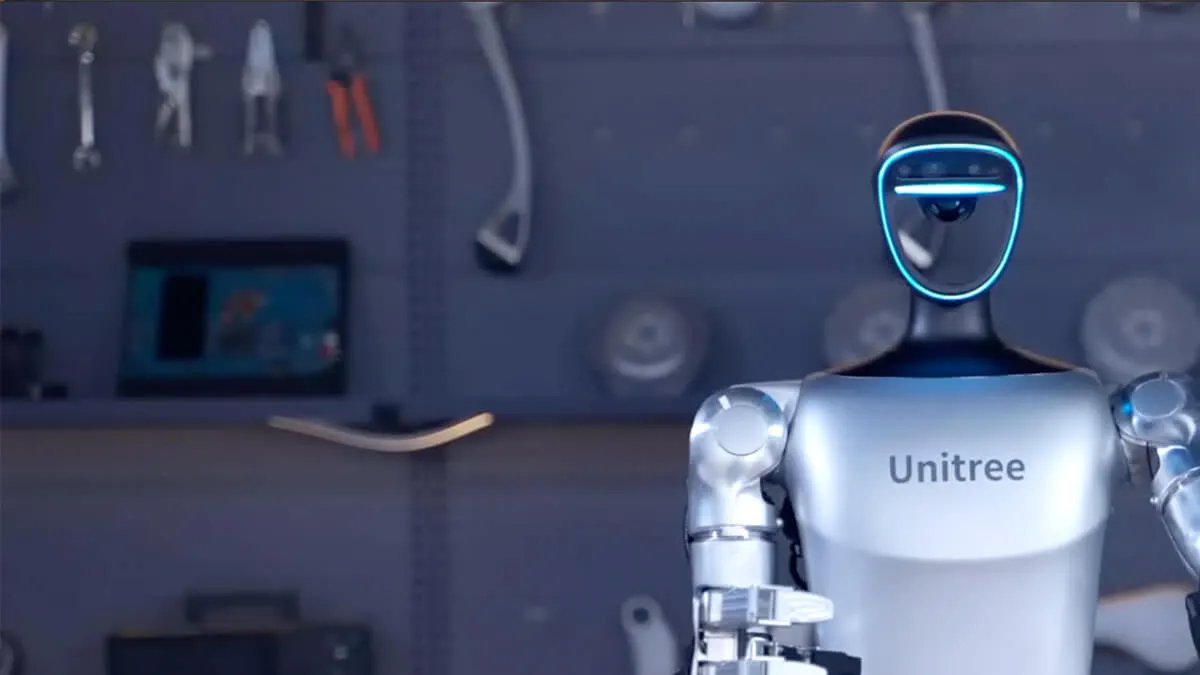
The acceleration of Chinese humanoid hardware is closely synchronized with software advances. Unitree has deployed its proprietary UnifoLM (Universal Foundation Locomotion Model) architecture, including the 6-billion parameter UnifoLM-WLA-1.0 vision-language-action model. This framework enables end-to-end policy training, allowing robots to generalize grasping trajectories and bimanual manipulation across previously unseen objects.
Concurrently, Unitree announced the H2 Plus bipedal platform, developed as an official reference hardware vehicle for NVIDIA’s Project GR00T. With 360 Nm peak torque actuators, 14-DoF five-finger dexterous hands, and integrated dual NVIDIA Jetson Orin compute modules, the platform bridges the gap between simulated reinforcement learning and physical dexterity.
Factory Deployments: UBTECH and the Automotive Assembly Line
Beyond academic research platforms, Chinese industrial manufacturers are deploying full-size humanoids directly into automotive manufacturing facilities. UBTECH Robotics has deployed its Walker S1 humanoid across assembly plants operated by BYD, Nio, Geely, and FAW-Volkswagen.
Standing 172 cm tall with a 76 kg mass and 41 degrees of freedom, the Walker S1 collaborates directly with autonomous mobile robots (AGVs). It handles material transfer, component bin sorting, and automated quality control scanning along active car assembly lines, demonstrating measurable productivity gains in structured manufacturing settings.
What This Means for the Global Robotics Market
The aggressive pricing and high deployment cadence of Chinese robotics companies present a formidable challenge to Western counterparts. While platforms like Tesla Optimus, Figure 02, and Boston Dynamics Atlas showcase cutting-edge dexterity and engineering precision, their deployment models remain tied to exclusive pilots or proprietary ecosystems.
By treating humanoid robots as standardized industrial hardware rather than experimental moonshots, China is building the supply chain density, actuator scaling, and operational data loop necessary to dominate the emerging embodied AI era.