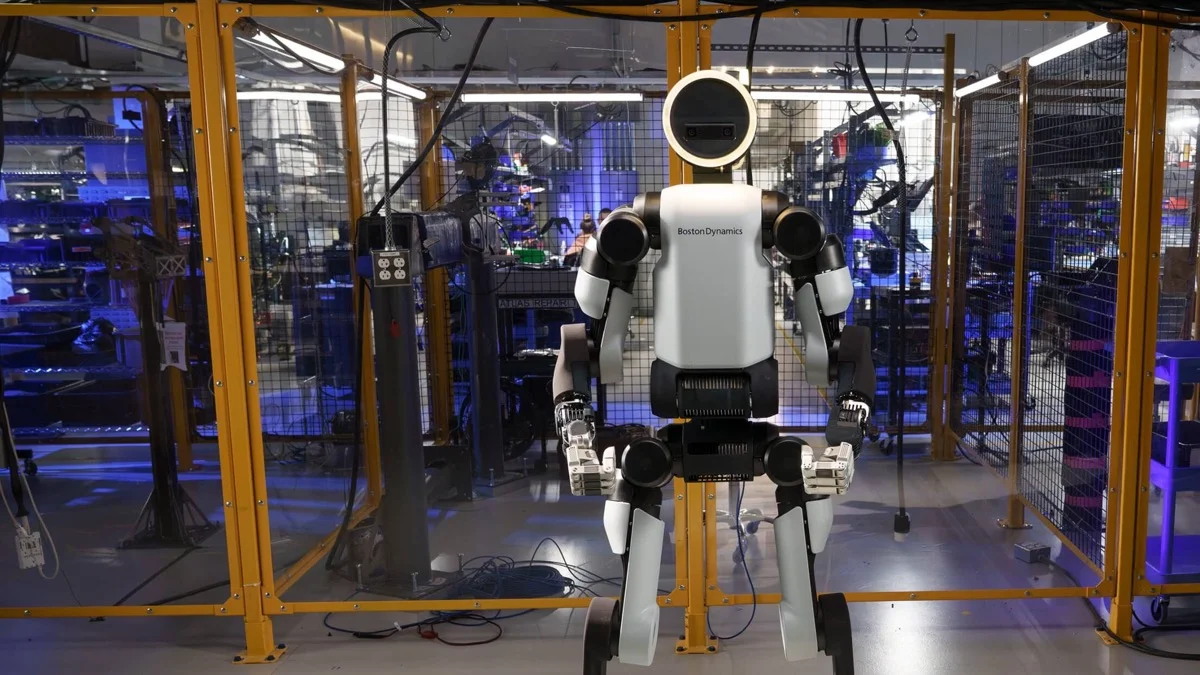
Boston Dynamics and parent company Hyundai Motor Group have formally locked down the Tier-1 component supply chain for the commercial, all-electric Atlas humanoid robot. In an industrial milestone for physical AI, procurement pre-notifications have been dispatched to South Korean automotive component manufacturers to support an initial manufacturing volume target of 10,000 Atlas units, laying the hardware foundation for an annual production capacity of 30,000 units by 2028.
While robotics companies have historically relied on boutique laboratory machine shops and bespoke servo builders, Hyundai Motor Group is executing an automotive-scale play. By leveraging its global manufacturing infrastructure, Hyundai is converting automotive parts manufacturing lines into precision humanoid assembly pipelines.
Hyundai Mobis Takes Center Stage: The Actuator Backbone
In bipedal humanoid robotics, actuators represent the single most expensive and technically demanding subsystem, regularly accounting for 50% to 60% of the total bill of materials (BOM). Under the finalized supply architecture, Hyundai Mobis, the group primary Tier-1 automotive parts affiliate, has been designated as the sole supplier of all continuous rotary body actuators across the entire Atlas chassis.
Automotive steering columns, drive-by-wire motors, and brake-by-wire electromechanical systems share between 60% and 70% technical overlap with robotic joint actuators. Hyundai Mobis is utilizing its dedicated R&D facilities at Uiwang and production tooling in South Korea to mass-produce these high-torque rotary units. Each joint combines:
- High-Torque Density: Custom cycloidal and planetary gearing delivering up to 400 Nm of peak torque to absorb severe dynamic impacts during locomotion and lifting.
- Continuous 360° Rotation: Slip-ring and brushless DC motor assemblies enabling complete infinite rotation across torso, hip, and shoulder axes, eliminating human kinematic constraints.
- Integrated In-House Silicon: Beyond mechanical housings, Hyundai Mobis is developing specialized motor driver integrated circuits (ICs) and power management semiconductors to control multi-axis synchronization with microsecond latency.
An Automotive-Grade Industrial Ecosystem
The finalized supplier roster extends far beyond actuators, establishing a comprehensive industrial supply network:
- Energy Storage (Samsung SDI & LG Energy Solution): Custom modular lithium-ion battery packs engineered for high discharge rates and rapid thermal dissipation. The packs deliver approximately 3.5 hours of continuous industrial runtime with autonomous inductive docking capabilities.
- Structural Chassis and Kinematics (CTR & Hwashin Precision): Specialized high-tensile lightweight aluminum control arms and structural links, designed using automotive crash-energy dissipation principles to maintain structural integrity under heavy payloads.
- Perception and Optical Sensors (Namuga, MCNEX, SOS Lab): A wrap-around 360-degree sensor head integrating Time-of-Flight (ToF) cameras, high-definition RGB-D modules, and solid-state LiDAR sensors for spatial mapping in low-contrast warehouse aisles.
- Compute Platform: NVIDIA Jetson Thor silicon powering the robot edge inference engine, running real-time Model Predictive Control (MPC) and multimodal vision-language-action policies developed in collaboration with Google DeepMind.
From RMAC Georgia to Global Gigafactories
The timing of this supply chain finalization directly matches operational milestones on the factory floor. Following the recent opening of the Robotics Metaplant Application Center (RMAC) at the Hyundai Motor Group Metaplant America (HMGMA) in Bryan County, Georgia, Atlas humanoids are already undergoing live validation.
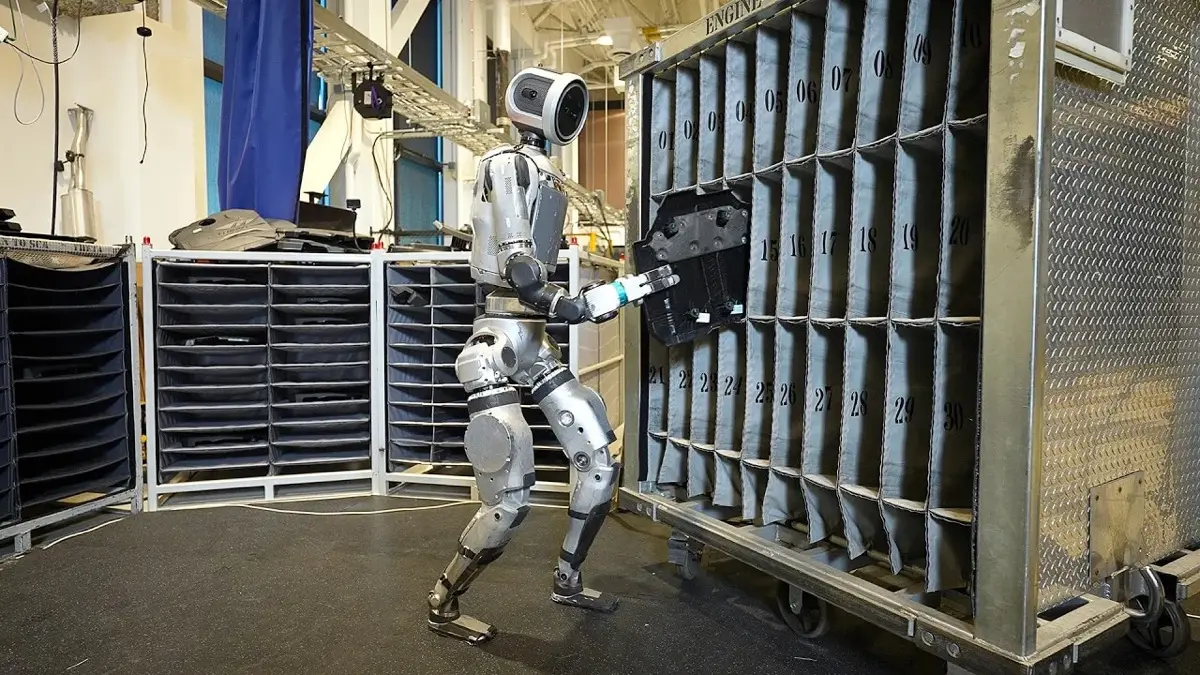
At RMAC, Atlas humanoids work alongside automotive assembly teams, handling heavy sequenced part bins exceeding 10 kg, transferring stamped sheet metal brackets, and autonomously navigating busy logistics aisles. Under newly appointed CEO Rohit Prasad, former head of Amazon Artificial General Intelligence, Boston Dynamics is focused squarely on repeatable commercial deployment rather than viral research demos.
The battle for humanoid manufacturing supremacy is now drawn along two opposing models: Tesla in-house vertical integration at its Fremont pilot line versus Boston Dynamics and Hyundai Tier-1 automotive supply chain. With 10,000 units targeted for procurement, the electric Atlas is transitioning from an engineering showcase into an automotive-grade industrial workhorse.
You can inspect full kinematic dimensions, actuator torque ratings, and battery runtimes on our dedicated Boston Dynamics Atlas specification profile, or evaluate comparative engineering trade-offs in our interactive head-to-head duels: