
Boston Dynamics has revealed a major hardware upgrade for its next-generation electric Atlas humanoid robot: a highly dexterous, fully articulated hand designed specifically for rigorous industrial environments and tool use. This development marks a clear transition from the robot’s origins in dynamic locomotion toward concrete manipulation tasks.
The 13-DOF Four-Fingered Design
The new end-effector features 13 degrees of freedom (DOF) distributed across a four-finger configuration - one opposable thumb and three primary fingers. Engineers at Boston Dynamics actively chose to omit the pinky finger to reduce complexity and mechanical failure points while maintaining the dexterity required for human-centric tasks.
Unlike the simple grippers of the previous hydraulic Atlas, this hand is fully actuated without the use of fragile cables crossing the joints. It is equipped with dense, pressure-based tactile sensors that provide the critical feedback necessary for sim-to-real reinforcement learning. This allows Atlas to execute complex in-hand manipulation, such as reorienting heavy objects or smoothly rolling items in its palm.
Tool Operation and the Factory Floor
The primary objective behind this increased dexterity is autonomous tool operation. The new hands are designed to handle triggered tools - including power drills, torque drivers, and welding torches - without requiring specialized end-effector attachments.
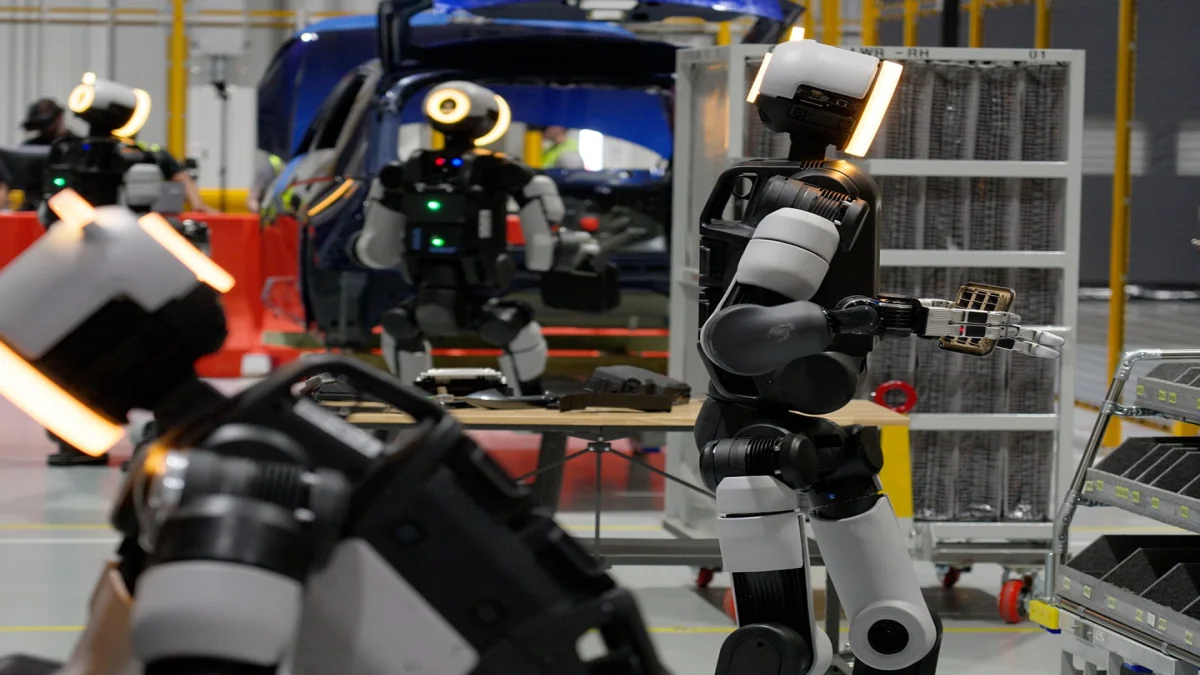
This hardware announcement coincides with the deployment of Atlas units at the newly opened Robotics Metaplant Application Center (RMAC) within Hyundai’s Georgia manufacturing campus. At RMAC, the robots are actively training to integrate into automotive workflows, validating the commercial ROI of general-purpose humanoids in heavy industry.
By prioritizing reliability, dense sensing, and a simplified four-finger architecture, Boston Dynamics is pushing Atlas beyond mobility demonstrations and directly into the competitive arena of industrial embodied AI. As foundation models and sim-to-real reinforcement learning mature in these complex humanoid platforms, the technological trickle-down effect will inevitably accelerate the capabilities of consumer autonomous robotics, including the next generation of vision-based robot mowers facing unpredictable outdoor environments.