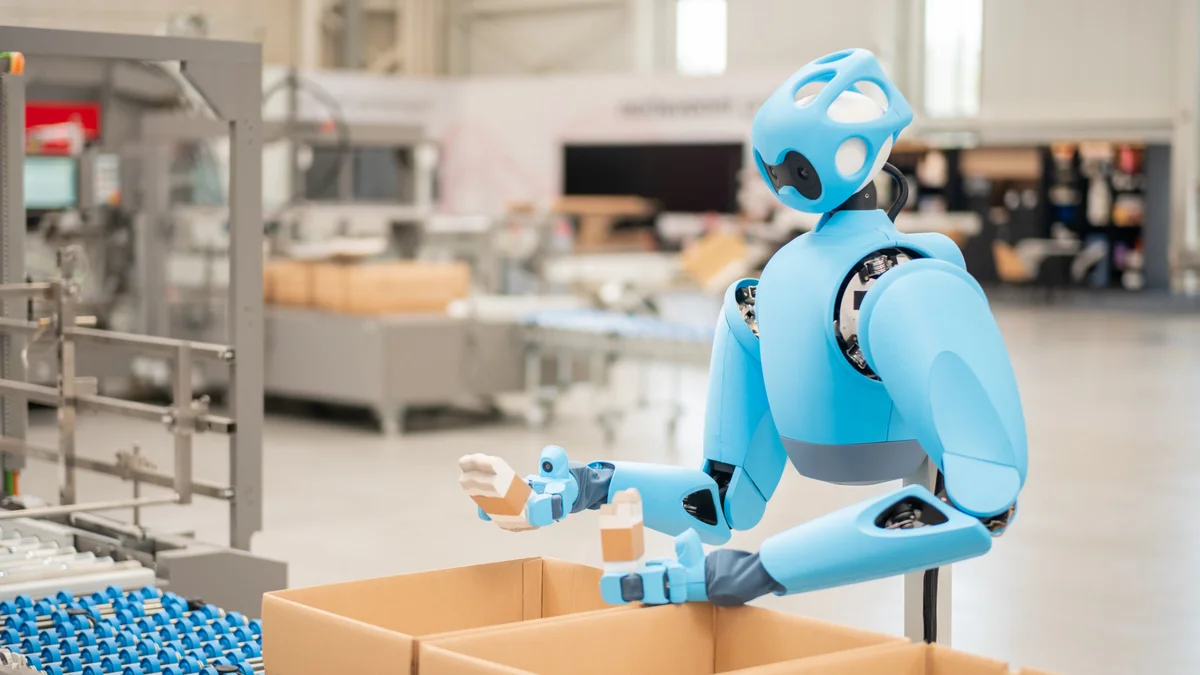
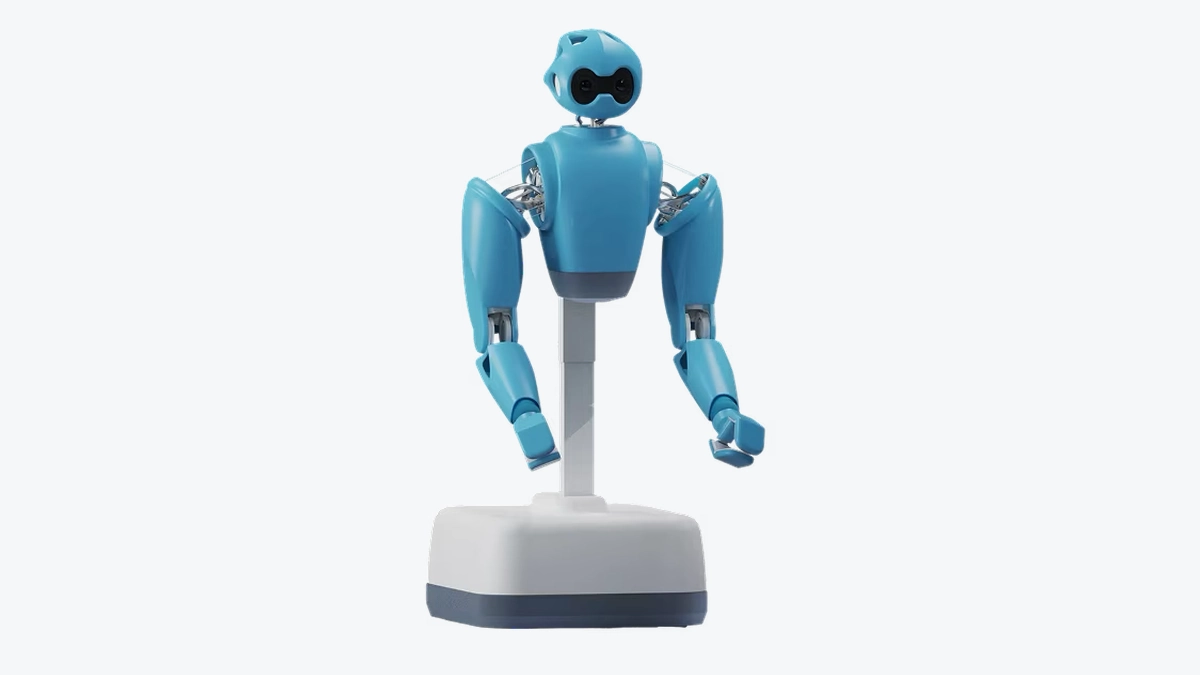
At the Humanoid Europe 2026 summit in Munich, Swiss robotics startup Embodied AI officially unveiled AIR, a dual-arm collaborative humanoid robot built on a mobile wheeled base. Spun out of the Swiss Federal Institute of Technology Lausanne (EPFL), the 25-person company founded by CEO Francesco Stella, CTO Kai Junge, and COO Max Polzin is targeting a critical operational bottleneck in modern industrial automation: deploying dexterous physical intelligence directly alongside human workers without requiring safety fences, optical curtains, or restricted work cells.
While high-profile humanoid developers such as Tesla, Boston Dynamics, and Unitree concentrate heavily on dynamic bipedal locomotion, Embodied AI has deliberately adopted a wheeled mobile base paired with a biological torso architecture. By keeping the moving mass of the limbs minimal and engineering mechanical compliance directly into the joint hardware, AIR provides an immediate, pragmatic answer to the rigorous safety requirements of European manufacturing floors.
Tendon-Driven Kinematics: 2 kg Arms Lifting 5 kg Payloads
Conventional industrial robotic arms and heavy collaborative cobots carry their high-torque electric motors, harmonic drives, and transmission gearboxes within each limb segment. When an unexpected contact occurs, the accumulated kinetic inertia of these rotating masses can inflict severe impact trauma, forcing facilities to enclose them behind rigid protective barriers.
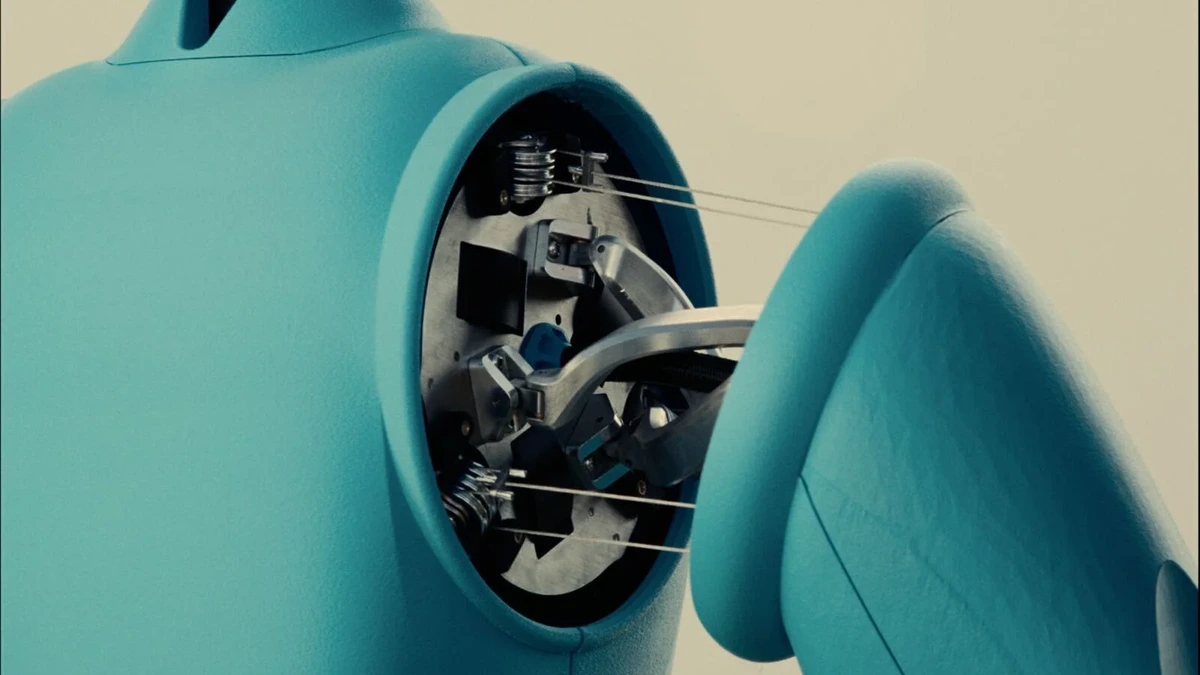
Embodied AI eliminates this hazard through a centralized tendon-driven actuation system developed from CEO Francesco Stella’s doctoral research at EPFL’s CREATE Lab and MIT CSAIL:
- Centralized Actuation Architecture: Heavy brushless DC motors, strain-wave reduction gears, power conversion electronics, and battery modules are consolidated deep inside the robot’s central torso.
- Tendon Cable Transmissions: Mechanical torque is transferred to the shoulder, elbow, and wrist joints through high-tensile synthetic tendon cables routed along low-friction guide pulleys.
- Unprecedented Strength-to-Weight Ratio: Each articulated arm weighs just 2 kg yet delivers an active lifting payload of 5 kg. This 2.5:1 payload-to-weight ratio allows the robot to handle automotive parts, circuit boards, and packaging containers without presenting pinch-point or crushing hazards.
- Passive Physical Compliance: The arm structures yield elastically upon physical contact with external objects or human operators, allowing the system to absorb kinetic shocks harmlessly before software safety overrides even engage.
Teleoperation to Autonomy: The 30-Day Policy Transfer
Rather than waiting for a universal foundation model to master every factory floor variable before installation, Embodied AI employs a structured human-in-the-loop deployment workflow:
- Immediate Production via Remote Teleoperation: On day one, an operator teleoperates the AIR platform remotely using immersive vision tracking and master-slave manipulation fixtures. The customer’s production line starts moving immediately without requiring pre-recorded trajectories.
- Shift Data Capture: Every teleoperated grasping action, object alignment, and sorting trajectory is logged as high-resolution multimodal demonstration data.
- Task-Specific Imitation Learning: The company trains localized policy networks directly on customer datasets rather than relying on brittle, general-purpose simulation transfer.
- Autonomous Execution within 30 Days: Across active commercial pilot programs, Embodied AI reports that AIR platforms take over routine operations autonomously within approximately four weeks of initial deployment, sustaining an average task success rate of 95%.
Commercial Traction and the 2027 EU Machinery Regulation
Backed by Faber VC alongside Look AI Ventures, Techshop Capital, Vento, and Plug and Play, Embodied AI has already deployed AIR in paid industrial pilots with a major European automotive and industrial technology supplier as well as a leading consumer electronics manufacturer. Depending on the density of repetitive handling, the company estimates that one AIR unit can absorb the workload of up to three full operator shifts in kitting and packaging cells.
Furthermore, Embodied AI is preparing AIR for full CE marking in 2027, precisely aligning with the implementation of the European Union’s updated Machinery Regulation. By proving that mechanical softness and intrinsic torque limits can achieve certifiable functional safety without physical cages, AIR provides a realistic commercial blueprint for European manufacturing automation.