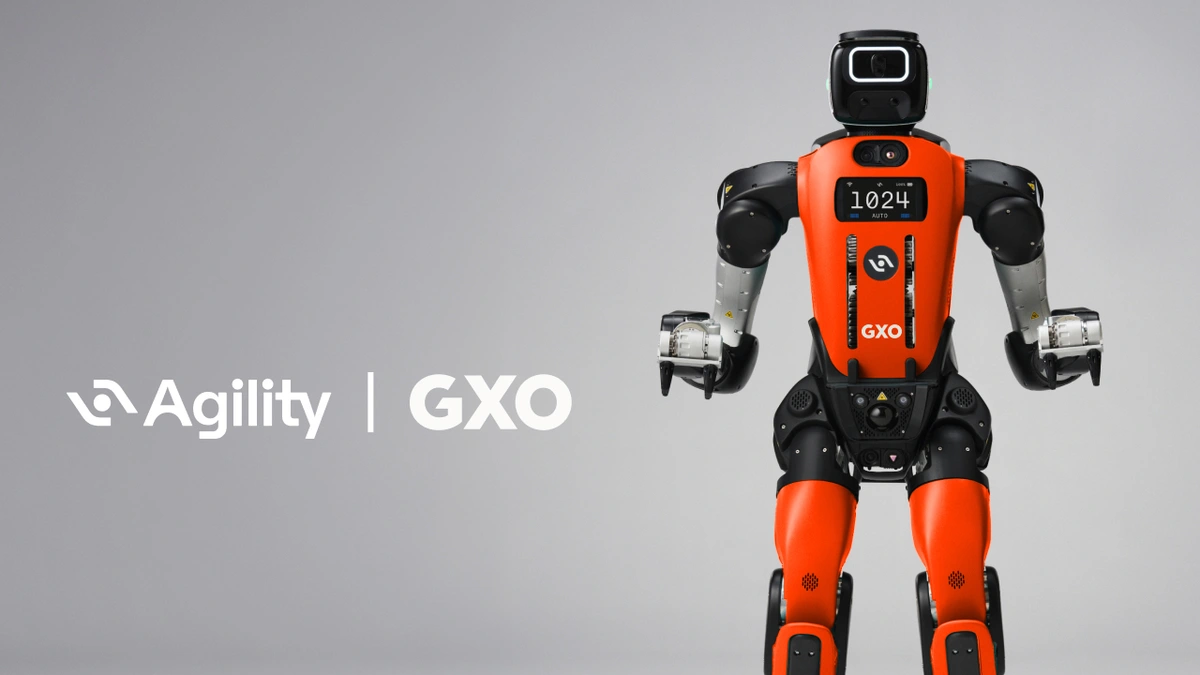
The commercialization of bipedal humanoid robotics has crossed an undeniable operational threshold. GXO Logistics, the world’s largest pure-play contract logistics provider with over 150,000 employees and 200 million square feet of facility space, has officially signed a multi-facility expansion agreement with Agility Robotics. Under this landmark deal, fleets of Digit humanoid robots will be deployed to major e-commerce fulfillment hubs in Statesville, North Carolina, and Lebanon, Tennessee, starting in early 2027.
This expansion represents the largest commercial footprint increase for bipedal warehouse robotics to date, moving beyond single-site pilot validations into a structured multi-state operational network.
The 100,000-Tote Proof of Concept in Flowery Branch
The expansion directly follows an extensive, multi-year deployment at GXO’s facility in Flowery Branch, Georgia. Originating as a proof of concept in late 2023, the collaboration formalized in June 2024 as the industry’s first commercial Robots-as-a-Service (RaaS) contract for bipedal humanoids.
In live production, Digit was integrated alongside traditional automated conveyor belts, autonomous mobile robots (AMRs), and human workers to tackle highly repetitive material-handling workflows:
- Tote Induction and Transfer: Digit navigates narrow warehouse aisles, picks standard totes weighing up to 16 kg (35 lbs) from shelving units, and places them onto induction conveyors.
- Continuous Operational Telemetry: Over 100,000 totes have been successfully handled and transported at Flowery Branch without human safety incidents.
- Accumulated Run Time: Across all customer programs, Agility’s Digit fleet has now surpassed 65,000 hours of real-world commercial operation, generating critical physical AI training datasets for Sim2Real reinforcement learning loops.
According to GXO Chief Executive Officer Patrick Kelleher, the decision to scale was driven purely by measured unit economics rather than exploratory experimentation:
“Innovation is most powerful when it delivers practical solutions that create value for our customers and our people. Our partnership with Agility Robotics has been defined by a shared commitment to turning emerging technologies into real-world operational advantage. Together, we have helped pioneer the use of humanoid robotics in the warehouse, and this expansion reflects our confidence in the technology’s ability to create measurable value.”
Hardware Roadmap: Launching on Digit 4, Transitioning to Digit 5
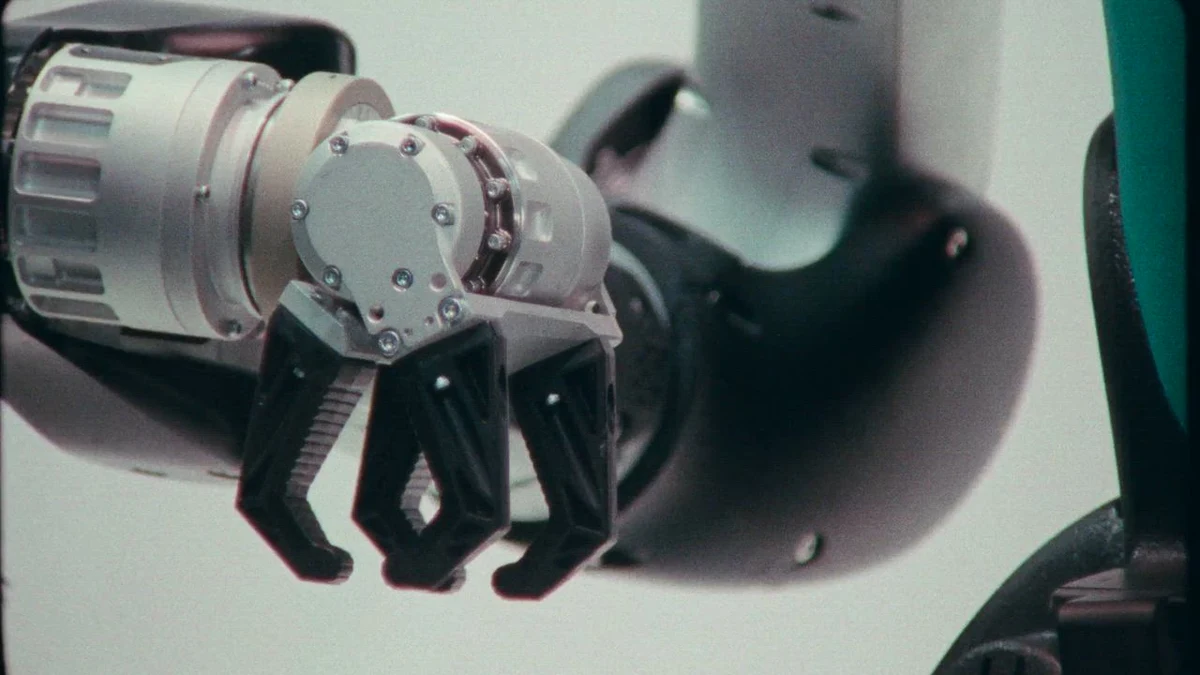
Under the contract terms, the initial deployments in Statesville and Lebanon will utilize Agility’s battle-tested Digit 4 hardware base before transitioning to the newly unveiled Digit 5 humanoid robot as commercial production ramps.
Digit 5 introduces substantial mechanical and electrical improvements tailored directly for continuous multi-shift warehouse execution:
- Cooperatively Safe Articulation: Certified compliant with advanced industrial safety standards, Digit 5 features soft outer cladding, compliant force-limited joints, and integrated safety-rated proximity monitoring, allowing it to operate directly alongside warehouse personnel without protective cages.
- Payload Upgrade: The maximum payload capacity increases to 22.7 kg (50 lbs), accommodating a wider range of automotive parts containers and standard high-density logistics totes.
- Continuous Duty Cycle: Digit 5 incorporates an automated fast-docking conductive charging system. A 12-minute rapid top-up charge provides over 2.5 hours of continuous tote manipulation, enabling a 20+ hour active working day across double shifts.
- Agility Arc Fleet Orchestration: Both facilities will manage robots through Agility Arc, a cloud-native platform that interfaces directly with GXO’s proprietary warehouse management systems (WMS). Arc assigns tote pickup tasks, optimizes routing through dynamic traffic corridors, and balances robot charging states automatically.
For teams comparing industrial bipedal options, see how Digit 5 compares with other high-payload factory humanoids in our Agility Digit 5 vs Figure 02 comparison and the Apptronik Apollo 2 vs Agility Digit 5 analysis.
Physical AI at the Edge: NVIDIA Jetson Thor Integration
A crucial pillar enabling Agility’s multi-site scaling is its expanded physical AI computing partnership with NVIDIA, announced earlier this month. As Digit moves from structured conveyor loading to complex pallet deconstruction and mixed-SKU handling, edge computing power becomes the governing factor.
Agility has ported its real-time perception and whole-body locomotion stacks to the NVIDIA Jetson Thor system-on-chip:
- Zero-Shot Object Segmentation: Combining depth stereo cameras and wide-angle RGB sensors, onboard vision models identify distorted, damaged, or unaligned totes in 85 milliseconds.
- Dynamic Terrain Adaptation: Locomotion policies adapt foot placement and center-of-mass trajectory when walking over uneven concrete expansion joints, dropped packing materials, and ramp inclines up to 8 degrees.
- Sim2Real Isaac Lab Pipeline: Thousands of corner-case warehouse layouts are simulated inside NVIDIA Isaac Sim, validating task policies synthetically before over-the-air deployment to live robots in Tennessee and North Carolina.
Manufacturing and Financial Scale: RoboFab and Nasdaq Listing
While many humanoid robotics ventures remain constrained by single-digit prototype manufacturing, Agility Robotics has spent two years building the industrial supply chain needed for commercial volume.
Agility’s RoboFab in Salem, Oregon, spans 70,000 square feet and is engineered for an annual production capacity of up to 10,000 robots. Supported by an expanded engineering hub in Pittsburgh, Pennsylvania, the manufacturing line utilizes automotive-grade testing cells to burn in harmonic drive gearboxes and high-voltage battery modules before shipment.
Financially, Agility Robotics is on the cusp of completing its business combination with Churchill Capital Corp XI (Nasdaq: CCXI), with the SEC declaring its Form S-4 registration statement effective on October 13, 2026. The transaction is slated to close in the fourth quarter of 2026, after which Agility will trade on Nasdaq under the ticker symbol AGLT.
Technical Specifications: Digit 4 vs. Digit 5
| Parameter | Digit 4 (Flowery Branch) | Digit 5 (Statesville & Lebanon) |
|---|---|---|
| Height | 175 cm (5 ft 9 in) | 178 cm (5 ft 10 in) |
| Weight | 65 kg (143 lbs) | 68 kg (150 lbs) |
| Degrees of Freedom | 16 active DoF | 22 active DoF (dexterous wrist) |
| Max Payload | 16 kg (35 lbs) | 22.7 kg (50 lbs) |
| Runtime per Charge | 2.0 hours | 2.5+ hours (rapid dock) |
| Safety Certification | Monitored perimeter zone | ISO 3691-4 & ANSI/RIA R15.08 cooperative |
| Onboard AI Compute | Custom industrial x86/GPU | NVIDIA Jetson Thor edge processor |
| Fleet Software | Agility Arc v1.2 | Agility Arc v2.0 with native WMS API |
The Broader Impact on Contract Logistics
The expansion with GXO demonstrates that the commercial value proposition of bipedal humanoid robots in supply chains is crystallizing around human-designed brownfield spaces. Unlike stationary robotic arms or rigid gantry systems that require millions of dollars in warehouse retrofits, bipedal robots step into existing mezzanine walkways, navigate around human order pickers, and interact with standard conveyor shelves out of the box.
With GXO expanding Digit across multiple states and Agility backed by public capital and factory-scale production, 2027 is shaping up as the definitive year when humanoid robotics transitions from novelty demonstrations into routine industrial operations.