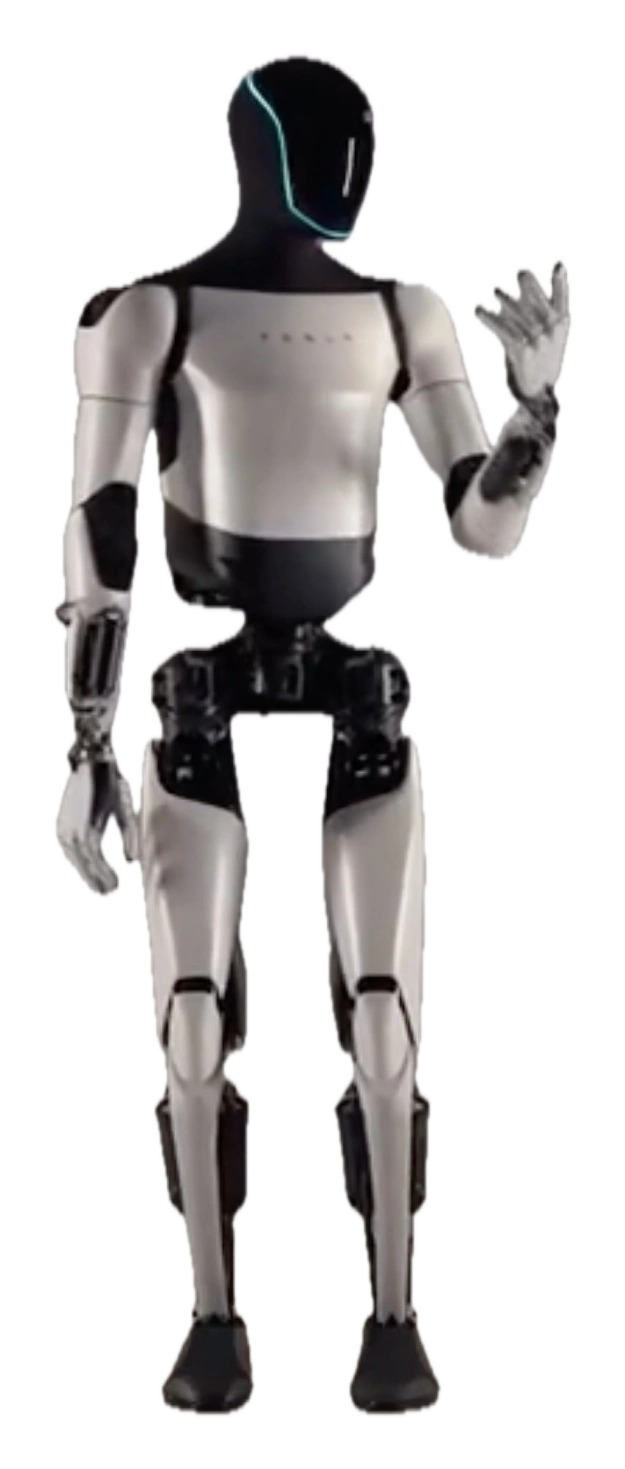
Within Tesla’s sprawling Fremont vehicle manufacturing plant in California, a dedicated pilot cell operates continuously without producing cars: the 4680 battery cell production line. This facility serves as the active testing proving ground for a fleet of Tesla Optimus Gen 2 humanoid robots.
These units handle sorting, staging, and autonomous transport of cylindrical battery trays, providing continuous stress-testing for Tesla’s in-house actuators and neural network vision stacks.
Dexterous 22-DoF Hand Architecture
The core engineering bottleneck in bipedal robotics has never been locomotion, but human-level manipulation. The biological human hand features 27 degrees of freedom, enabling micro-force compliance governed by dense tactile feedback.
While early Optimus Gen 2 prototypes employed an 11-DoF hand sufficient for gross grasping and egg-handling demonstrations, complex automotive assembly tasks demand far higher finger articulation.
Tesla’s latest hand revision introduces 22 degrees of freedom per hand:
- Forearm-Mounted Tendon Actuation: Drive motors are relocated from the palm into the forearm housing. Power is routed through high-tensile synthetic tendons, reducing distal mass and finger inertia for rapid finger adjustments.
- Dense Tactile Sensing Arrays: Each finger pad integrates high-frequency capacitive pressure sensors operating at 1,000 Hz, detecting slippage and shear force dynamically before visual confirmation occurs.
End-to-End Autonomous Control via Tesla HW4
Unlike conventional industrial automated cells governed by inverse kinematics and hard-coded spatial waypoints, Optimus runs entirely on an onboard Tesla HW4 (Hardware 4) compute node.
Visual camera streams feed into a unified vision foundation model, which outputs actuator torques directly. Training data is captured through virtual reality teleoperation by Tesla technicians, logging millions of precise pick-and-place trajectories into the Dojo supercomputer cluster.
The Captive Factory Floor Advantage
Tesla maintains a distinct competitive edge in humanoid deployment: internal Gigafactories containing thousands of repetitive material handling tasks. Every operational hour at Fremont supplies edge-case telemetry directly into Tesla’s model training pipeline, accelerating the timeline toward fully autonomous industrial task execution.