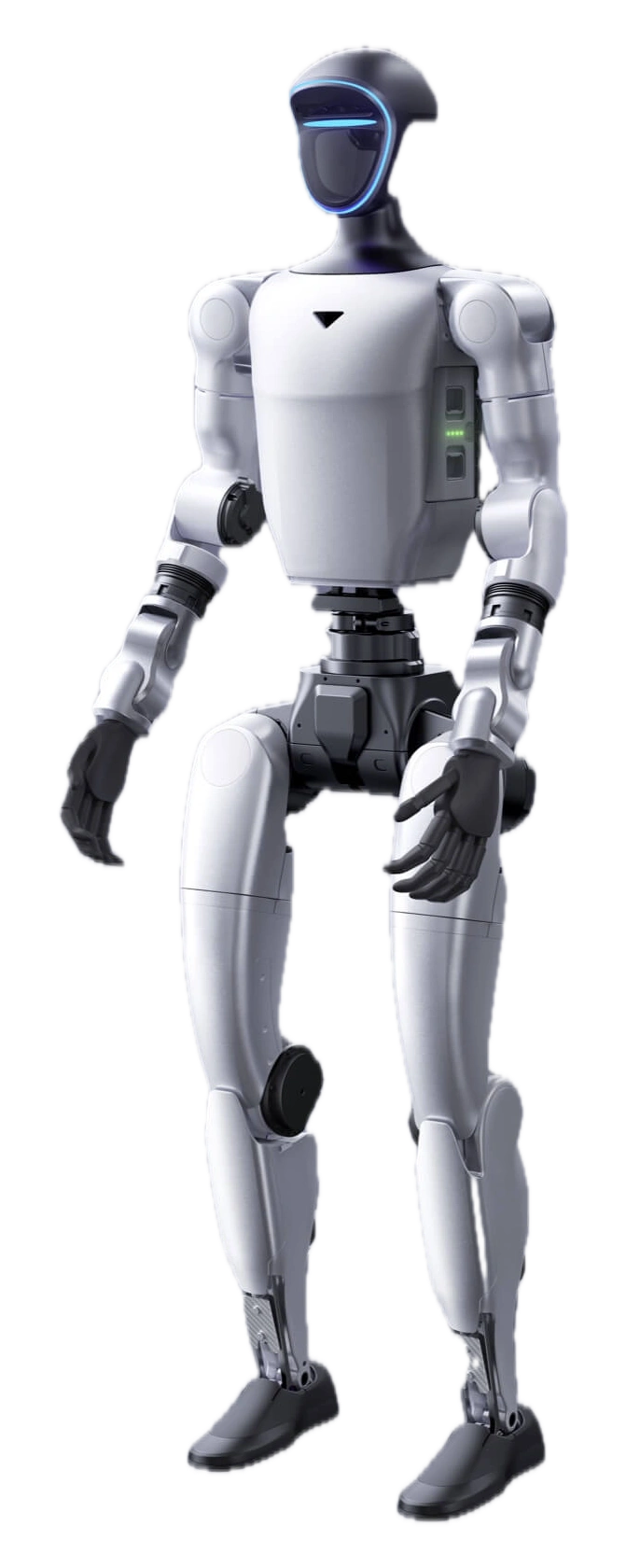
Humanoid robotics has long been constrained by high capital barriers, with research prototypes routinely demanding upwards of $150,000 or enterprise Robot-as-a-Service (RaaS) leases out of reach for academic departments. Unitree Robotics has disrupted that dynamic with the start of commercial mass shipments of the Unitree G1.
With an entry price of $16,000, the G1 represents the first bipedal humanoid platform to enter true series assembly and global customer delivery.
High Torque Density in a 35 kg Lightweight Chassis
Unitree’s primary mechanical achievement is compact packaging: standing 1.32 meters (4’4”) and weighing just 35 kg (77 lbs), the G1 dramatically reduces kinetic risk during sim-to-real locomotion algorithm development.
Despite this compact footprint, proprietary in-house rotary actuators output a peak torque of 120 Nm at the hip and knee joints. This enables dynamic walking and running at 7.2 km/h (2.0 m/s), aggressive balance recovery under lateral impact, and controlled aerial acrobatics.
360-Degree 3D LiDAR Perception and Hand Modularity
Unlike pure visual-only architectures, the G1 integrates a panoramic 3D LiDAR sensor array paired with an Intel RealSense depth camera into its head module. This provides instant, lighting-invariant volumetric point clouds of immediate terrain and obstacles.
Manipulation capabilities are available in two trims:
- Standard Trim: Tri-finger force-sensing grippers capable of lifting up to 3 kg per hand.
- Dex3-1 Option: Dexterous 7-DoF multi-finger hands equipped with dense tactile sensors across fingertips for fine object manipulation.
Impact on the Robotics AI Ecosystem
Delivering the Unitree G1 to hundreds of robotics laboratories, engineering universities, and embodied AI startups accelerates the transition from simulation to real-world reinforcement learning.
Until now, training complex locomotion and manipulation policies relied almost exclusively on virtual physics simulators like Isaac Sim or MuJoCo. With accessible physical hardware deployed at scale, the sim-to-real feedback loop shortens significantly.