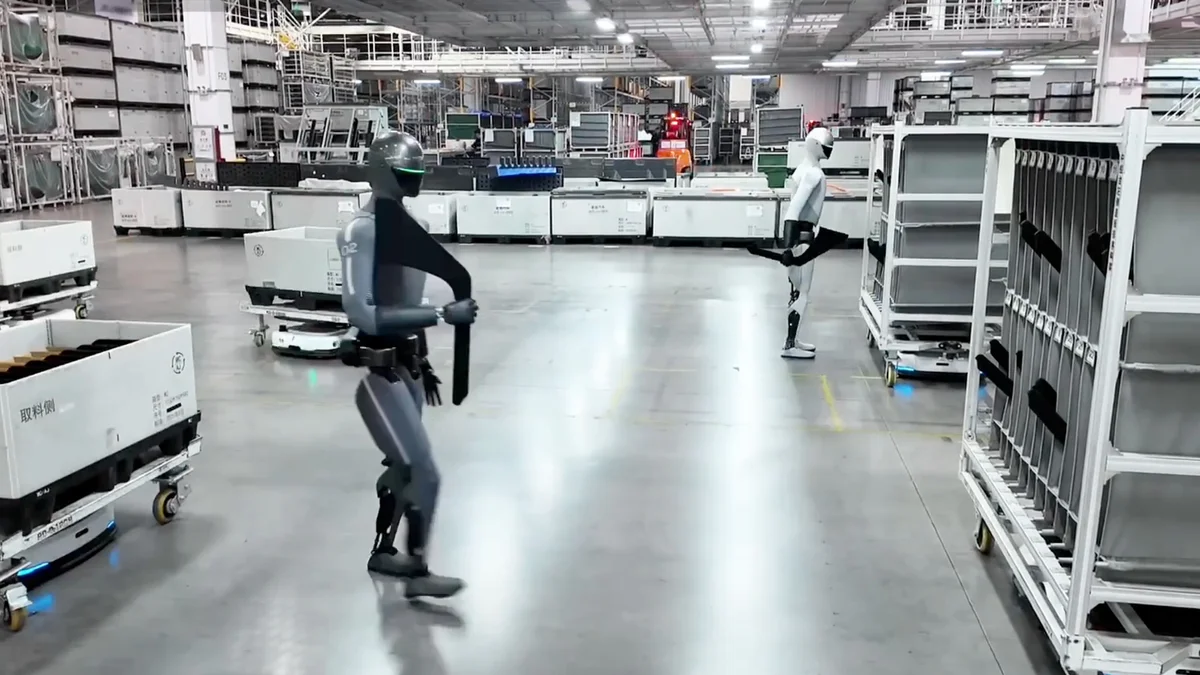
The deployment of general-purpose humanoid robots in automotive manufacturing has reached a significant operational benchmark. During the World Internet Conference in Wuzhen, Xiaomi released comprehensive video records demonstrating its full-size humanoid robotics platform operating continuously for an uninterrupted 8-hour shift (officially logged at 8 hours and 5 minutes) on an active production line at the Xiaomi Auto Factory in Beijing. Stationed in the final assembly logistics zone, the robots handled parts sorting for the Xiaomi SU7 electric vehicle, marking a tangible transition from structured research laboratory demonstrations to real-world industrial shift work.
While earlier humanoid demonstrations across the industry frequently relied on heavily scripted choreographies or covert teleoperation, Xiaomi positioned this milestone as a rigorous stress test of endurance, autonomous anomaly recovery, and fleet synchronization.
The Center Console Side-Cover Sorting Workstation
Industrial automation has historically struggled with components that lack absolute mechanical rigidity. The workstation assigned to Xiaomi’s humanoid robots handles vehicle center-console side trim covers. These parts are long, flexible, irregularly contoured plastic panels delivered in bulk containers with unconstrained postures, rendering standard rigid robotic arms ineffective without expensive custom feed mechanisms.
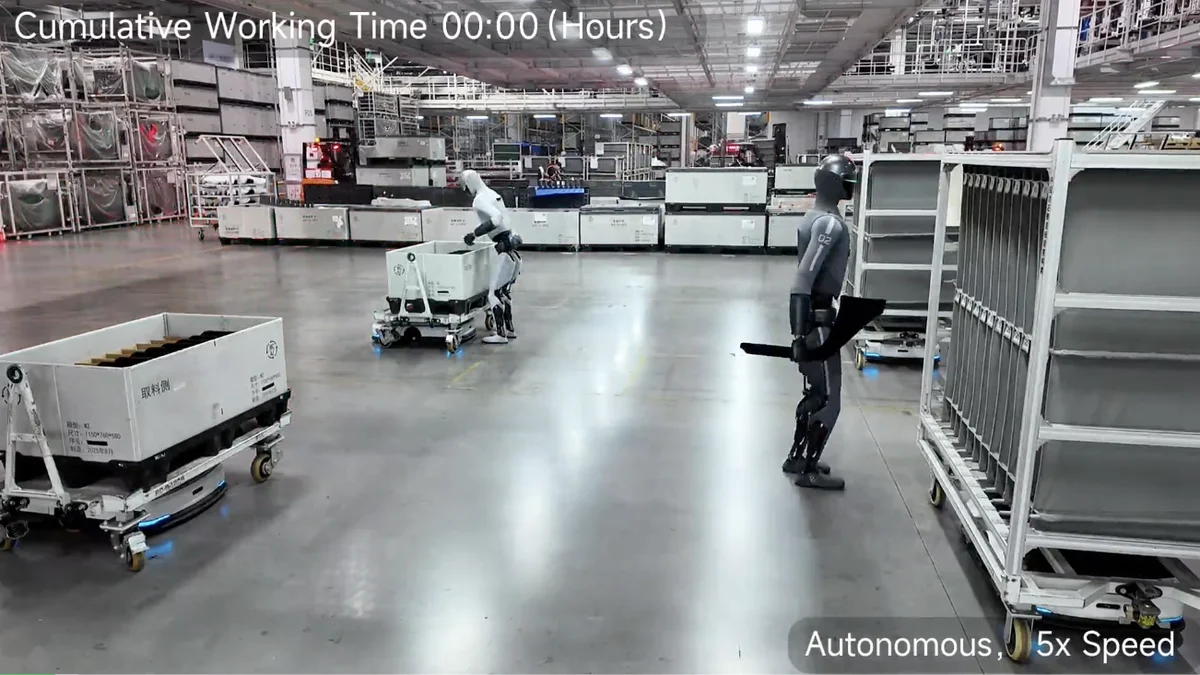
The operational sequence required the robots to:
- Extract flexible side panels from bulk mobile totes brought directly to the station by Autonomous Mobile Robots (AMRs).
- Read the part orientation in three dimensions using real-time stereo depth vision.
- Transport each panel across the work cell while maintaining dynamic bipedal balance on the polished factory floor.
- Insert each cover into tight vertical storage rack slots matching the takt time of the final vehicle assembly line (roughly one component cycle per minute).
According to Xiaomi, the two humanoid units sustained the complete single-shift production demand of that station without halting the downstream line.
Autonomous Anomaly Recovery and Multi-Robot Collaboration
A crucial limitation of factory robotics is downtime caused by minor physical errors, such as dropped workpieces or misaligned insertions. In traditional automation, an unexpected dropped component triggers an emergency line halt requiring manual technician intervention.
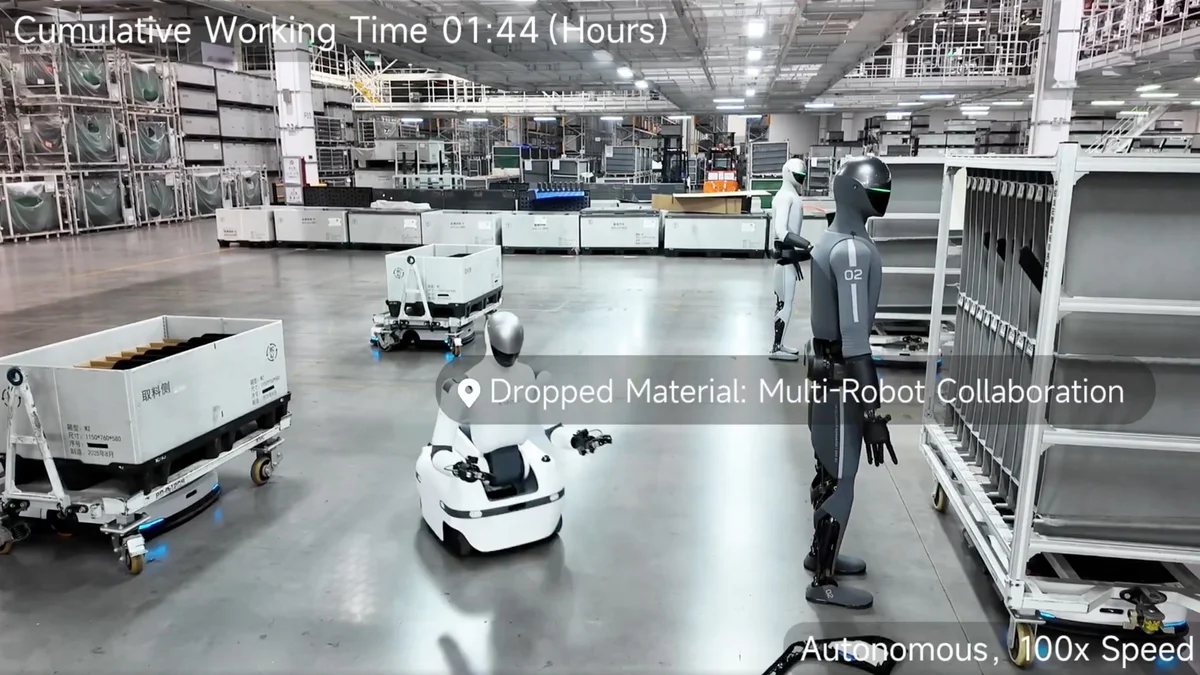
During the 8-hour deployment, Xiaomi showcased an automated recovery sequence labeled “Dropped Material: Multi-Robot Collaboration.” When a panel slipped from a grasp, the bipedal unit detected the missing component through sensory feedback, held its position, and communicated with a mobile wheeled humanoid upper-body robot. The wheeled platform navigated into the cell, collected the dropped workpiece, and restored normal flow.
This hybrid approach highlights a practical engineering compromise: wheeled bases offer superior energy efficiency and stability on flat factory floors, while legged bipedal humanoids provide upper-body reach and human-scale ergonomics around existing assembly fixtures.
The Xiaomi-Robotics-1 Embodied Foundation Model
Behind the mechanical execution lies Xiaomi-Robotics-1, a proprietary Vision-Language-Action (VLA) foundation model. Pre-trained on over 100,000 hours of real-world multi-modal robotics telemetry, the architecture utilizes a two-stage training paradigm combining large-scale simulation with real-world reinforcement learning.
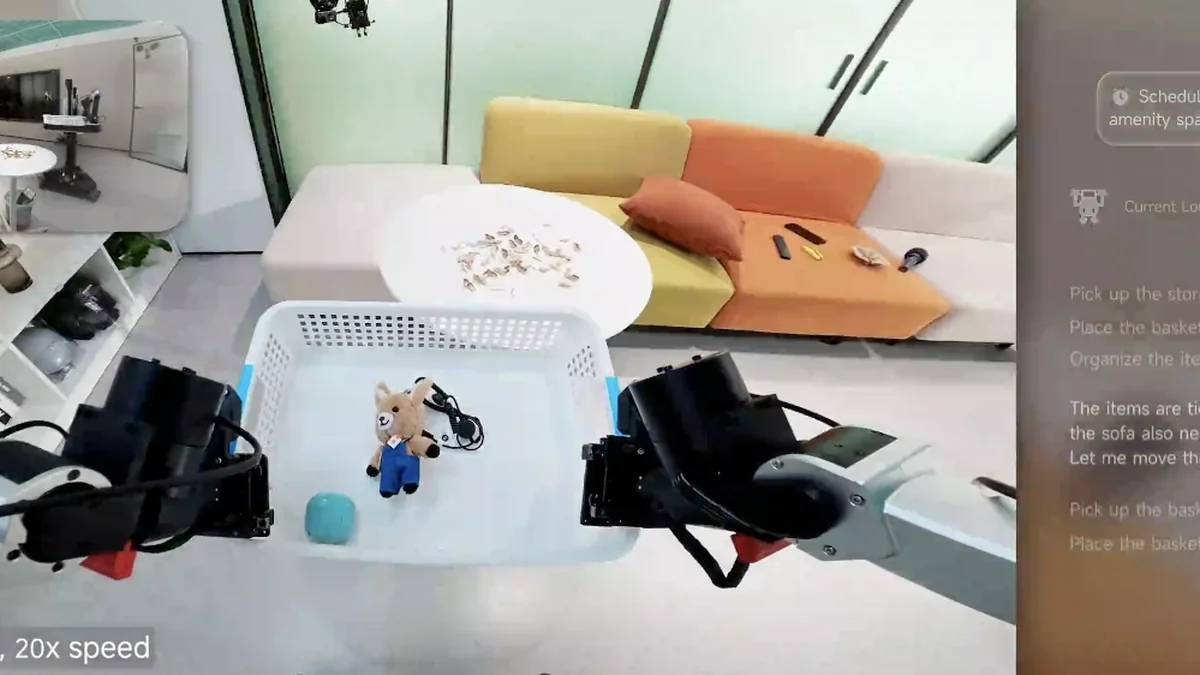
Beyond the industrial automotive floor, Xiaomi demonstrated the model’s cross-domain generalization inside Xiaomi Youth Apartments. In a 30-minute domestic evaluation, the system autonomously parsed natural language goals, decomposed unstructured household scenes, and completed over 50 consecutive task chains across three rooms without human intervention.
Engineering Perspective: What Remains to Be Verified
Xiaomi’s progression throughout 2026 has followed a methodical trajectory: an initial March trial with self-tapping nut installation achieving 90.2% success over three hours, a July refinement climbing to 98%, and now an 8-hour continuous sorting shift. Unlike competitors who restrict demonstrations to brief edited clips, Xiaomi has committed to real production environments.
However, several critical engineering questions remain unanswered in the published release:
- Net Throughput and Error Frequency: Xiaomi has not published the total piece count sorted across the 485-minute window or the exact number of autonomous self-corrections required.
- Power Management: Sustaining an 8-hour bipedal shift requires substantial energy. It remains undisclosed whether the robots utilized hot-swappable battery packs, rapid overhead micro-charging sessions, or tethered power links during stationary cycles.
- Cycle Time vs Human Baseline: While matching the workstation’s basic takt time, general-purpose humanoids still operate with visibly slower dynamic motions than specialized pick-and-place gantry systems.
Even with these caveats, Xiaomi’s automotive test proves that general-purpose bipedal humanoids are transitioning from speculative lab experiments to functional industrial tools capable of working alongside AMRs on active factory floors.