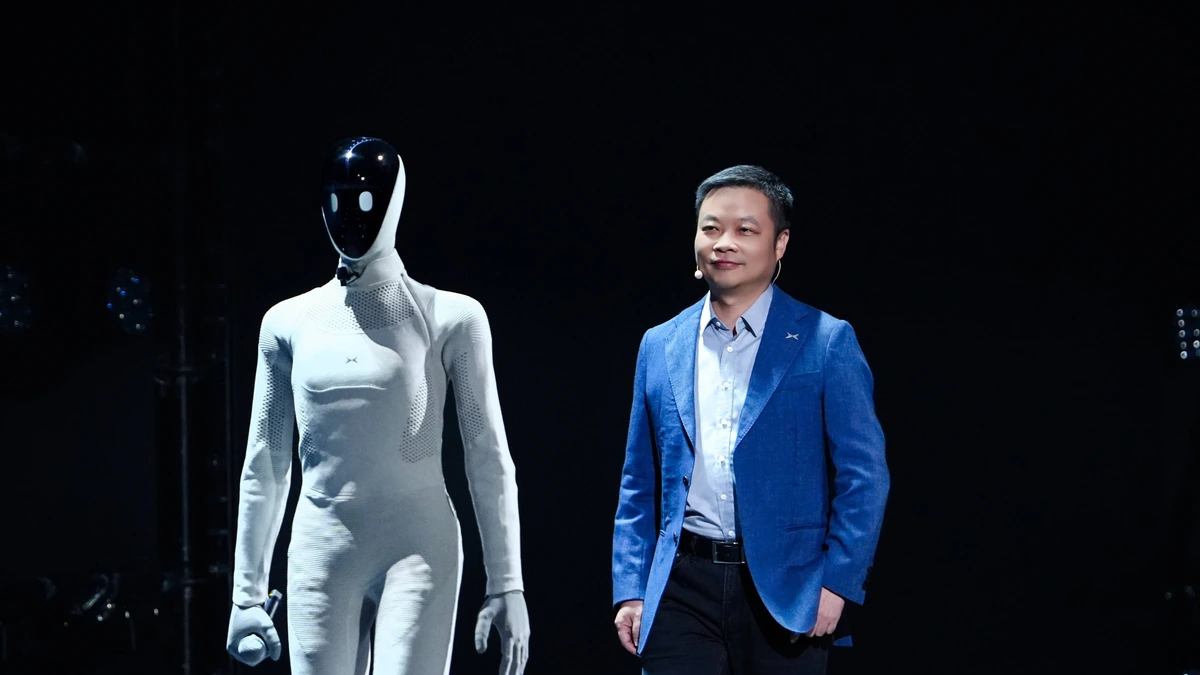
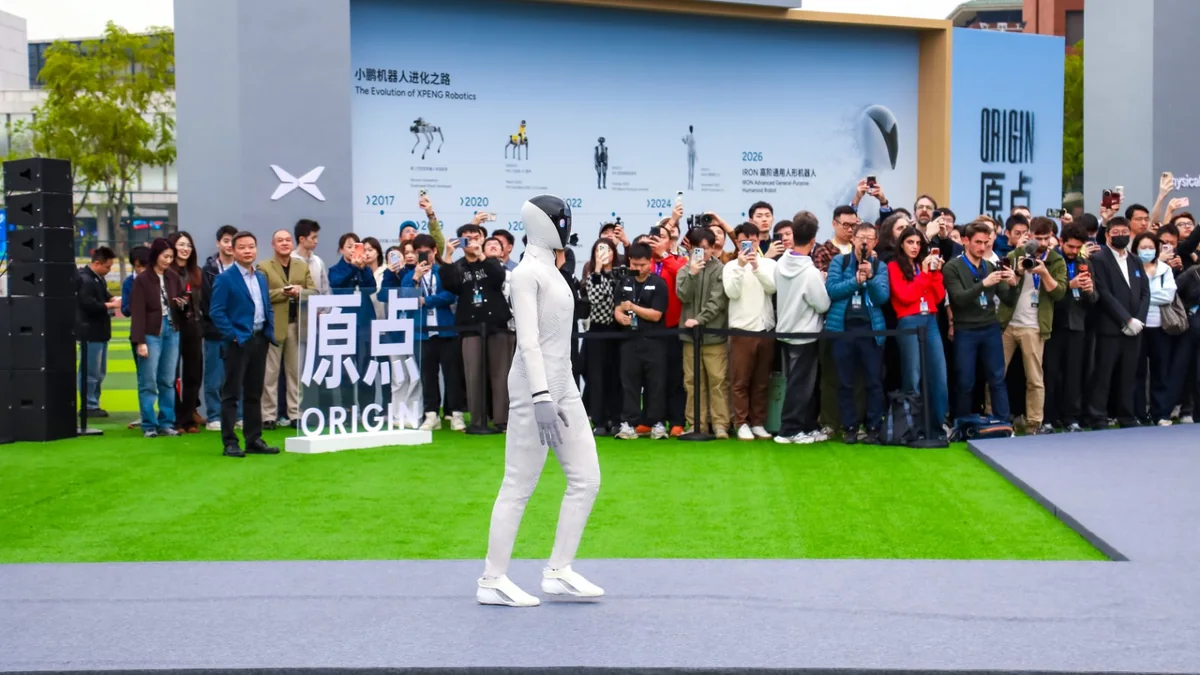
At its eighth annual XPENG AI Day (“ORIGIN”) in Guangzhou on November 25, 2026, XPENG unveiled its Turing Physical AI Architecture (VLA 3.0) and brought the commercial-specification XPENG IRON humanoid robot onto the stage for an unassisted walk, live bilingual Q&A session with Chairman and CEO He Xiaopeng, and autonomous return to its charging dock.
Seven IRON units appeared for the Tech Day presentation, signaling XPENG’s transition from prototype demonstrations toward scheduled factory output: hardware mass production is slated to begin in January 2027 (on an automated line designed for one completed robot every 2.5 minutes at full capacity), followed by retail store assistant training in China in Q1 2027 and an official public release targeted for Q2 2027. Ahead of those milestones, IRON is scheduled to host XPENG’s vehicle launch press conference at the Guangzhou Auto Show on November 27, 2026.
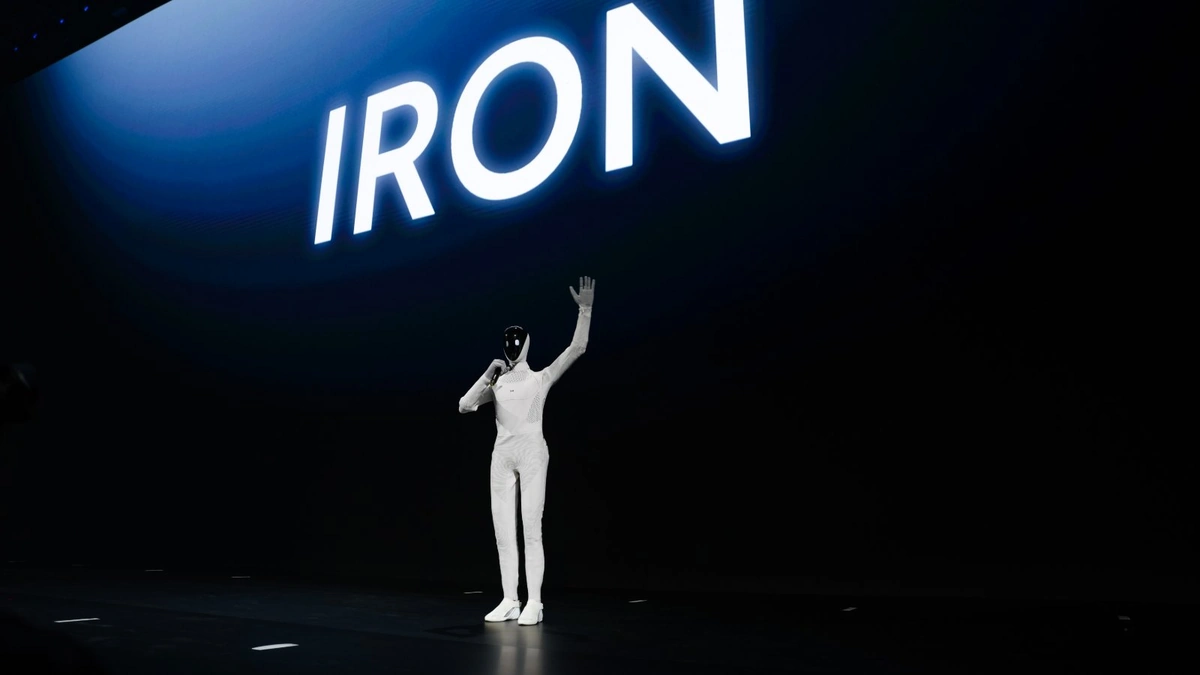
Updated IRON Hardware: 170 cm, 62 kg, and >=300 Wh/kg Solid-State Pack
Compared with the 178 cm and 70 kg dimensions reported for the first-generation IRON unveiled at the 2024 AI Day, the November 2026 pre-production specification trims stature and weight while retaining full-body articulation and expanding tactile instrumentation:
| Specification | AI Day 2026 Disclosure (XPENG / CnEVPost / Unite.AI / Tech Edition) |
|---|---|
| Stature & Weight | 170 cm (5 ft 7 in), 62 kg (136.7 lb); magnesium-aluminum alloy & steel frame |
| Degrees of Freedom (DoF) | 76 total DoF (21 DoF per hand, 33 everyday manipulation categories) |
| Tactile Sensing | >1,500 body tactile points (>80% key-area coverage); 375 sensors per hand |
| Onboard Compute & Software | 3 proprietary Turing AI chips (2,250 TOPS effective); IRON OS & IRON VLM |
| Battery & Runtime | All-solid-state battery pack (>=300 Wh/kg); 1.5 hours of work per 20-min autonomous charge |
| Manufacturing & Safety | Dedicated line (1 unit / 2.5 min design rate, >600 holographic checks, 5-layer safety / 50 N stop) |
Each hand integrates 21 DoF and 375 tactile sensors under full-coverage bionic skin and flexible muscles. According to XPENG’s reliability and safety disclosures reported by Unite.AI and Tech Edition, pre-production testing spans roughly 50 million assembly durability cycles, over 20 million leg-and-foot impact tests, and over 10 million dexterous-hand grasp cycles, backed by a 50,000-square-meter Robot Data Factory covering over 250 scenarios and 15 job categories. To support public retail operation, IRON’s five-layer physical safety system triggers a motion stop above 50 N of contact force, integrates millisecond joint pinch detection and under-1-second pedestrian autonomous emergency braking (AEB), and includes three independent emergency-stop methods alongside an independent fail-safe balance controller.
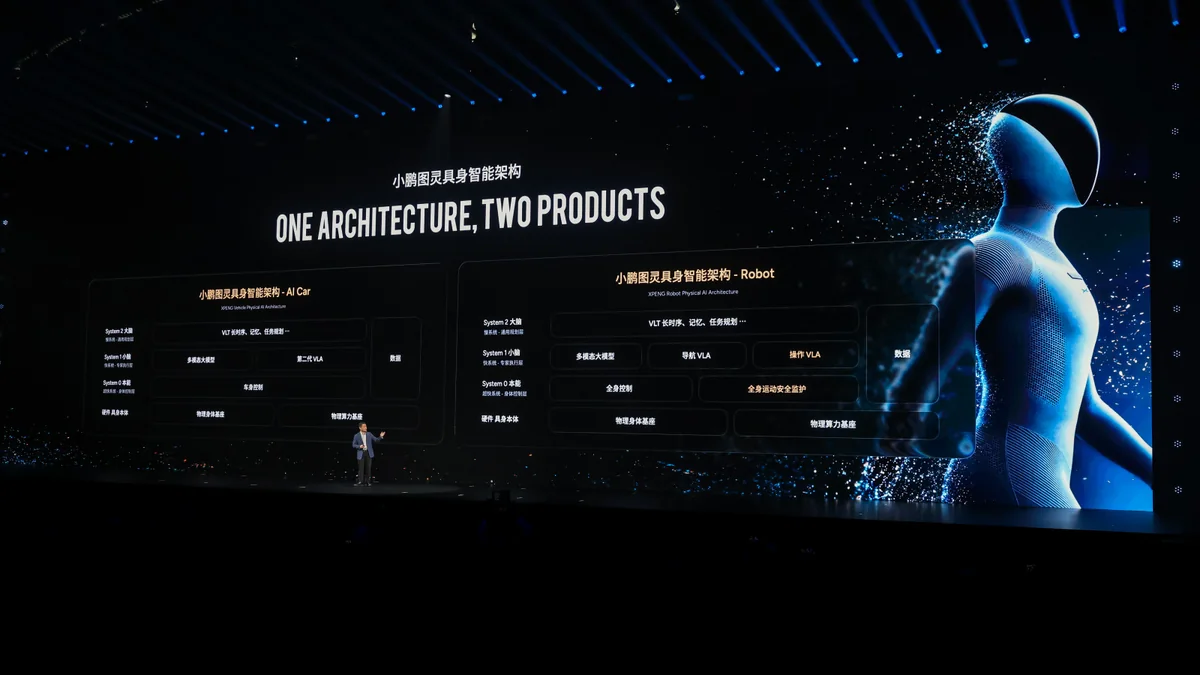
Turing Physical AI Architecture (VLA 3.0): Three-Layer Closed Loop
Rather than separating automotive autonomy from humanoid control, XPENG runs IRON OS, IRON VLM, and its Turing Physical AI Architecture (VLA 3.0) across smart EVs, the upcoming YOYO-01 robotaxi, ARIDGE eVTOL aircraft, and XPeng IRON. The stack links three layers in a continuous closed loop:
- System 0 (Ultra-fast layer): Embeds low-level power, energy, communication, dual-channel safety redundancy, and whole-body balance control directly into the AI loop, including fall prediction and protective knee-bending direction selection.
- System 1 (Fast layer): Powered by XPENG’s VLA 2.0 model (version 6.4.0 introduces agent-driven autonomous closed-loop training reported at 10 to 12 times faster training speed via recursive self-improvement and self-distillation) for millisecond-scale offline navigation and manipulation.
- System 2 (Slow layer): Combines vision-language task planning (VLT) with an Agent Runtime state machine for multi-step scheduling, local site mapping after a single walkthrough, and map sharing across robots.
Commercial Model vs. Real-World Constraints
XPENG outlined a hybrid commercial model pairing hardware sales with software subscriptions, downloadable skill packages (with a two-person team able to prototype a new skill in 48 hours), and potential token-based or scenario-based services, alongside a broader 2027 global rollout plan first outlined at the Paris Motor Show in October 2026. Still, two important qualifiers remain: XPENG explicitly warns that displayed performance, functions, and appearance may differ in the final mass-production unit, and CEO He Xiaopeng noted after the event that the global robotics market likely numbers only in the tens of thousands of units today until robots deliver clear ROI without extensive human intervention.
Compare XPeng IRON head-to-head against competing platforms in our 50-robot database:
- XPeng IRON vs Tesla Optimus Gen 3 (Fremont pilot lines scaling custom hand actuators and AI5 inference)
- XPeng IRON vs Figure 03 (zero-shot home and commercial deployment powered by Helix 2.5 neural policies)
- XPeng IRON vs Unitree G1 ($16,000 commercial research benchmark with 35 DoF and open Python SDK)