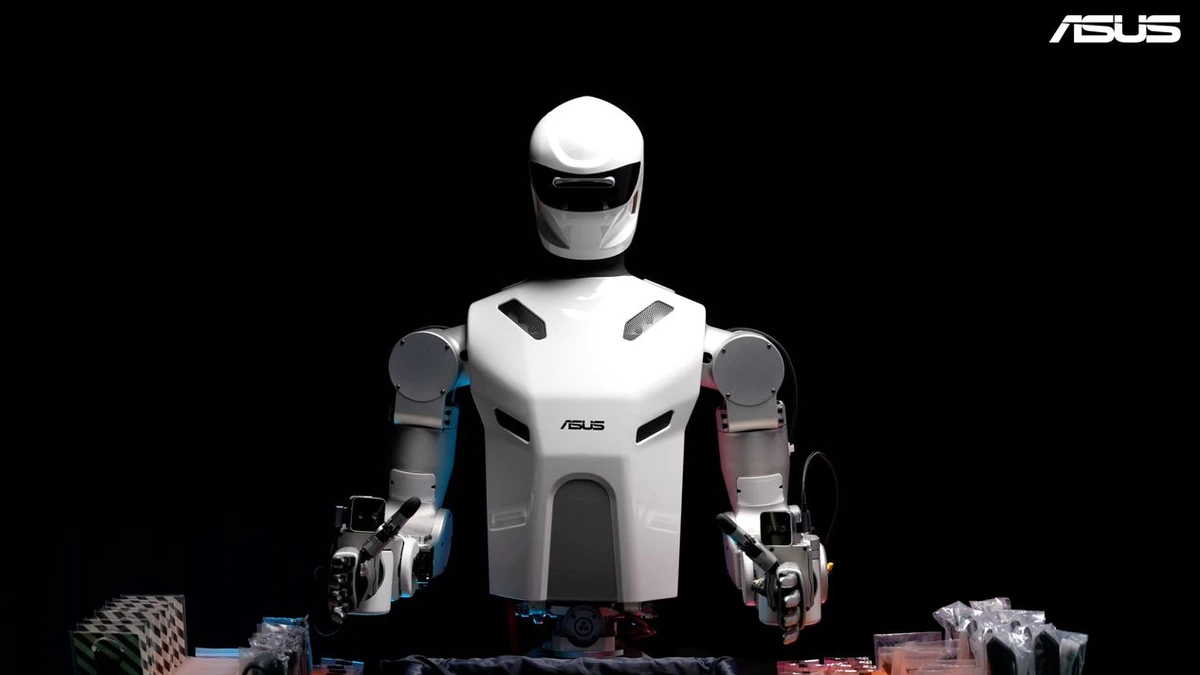
Global computing hardware giant ASUSTeK Computer (ASUS) has officially taken the wraps off its long-anticipated physical AI platform: Gallop, the company’s first dual-arm industrial humanoid robot. Spearheaded by the newly formed Humanoid Robotics Business Unit within ASUS’s Physical AI Solutions Business Group (PAS BG), the announcement by Corporate Vice President Dr. Albert Chang and Co-CEO S.Y. Hsu signals a decisive strategic shift. After decades of manufacturing motherboards, PCs, graphics cards, and enterprise servers, ASUS is bringing artificial intelligence out of digital screens into real-world production machines.
Rather than showcasing staged promotional demonstrations of dancing, tumbling, or folding domestic laundry, ASUS has deployed Gallop directly onto active manufacturing lines within an ASUS group electronics manufacturing services (EMS) factory. The mission is unambiguous: proving whether an embodied physical AI robot can perform real-world workstation shifts continuously, reliably, and to rigorous commercial quality standards.
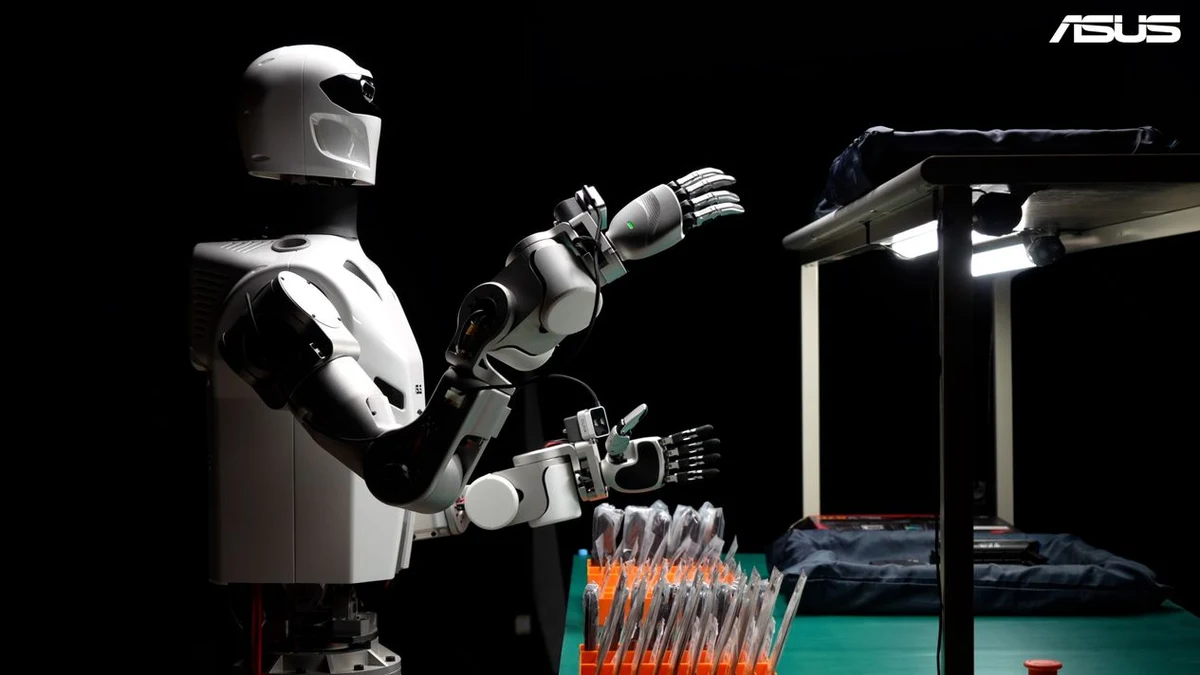
Starting with the Hardest Workstation: 15 Flexible Parts in 20 Seconds
Instead of picking an easy, repetitive task like sorting uniform solid blocks, ASUS engineers assigned Gallop to one of the most mechanically complex manual assembly stations in PC hardware production: packaging motherboard accessories.
The station demands high dexterity and adaptability:
- Deformable, Transparent Materials: The packaging station involves 15 separate small parts, including SATA cables, Wi-Fi antenna modules, M.2 retaining screws, cable ties, and thermal pads. Crucially, many of these parts arrive enclosed in thin, transparent plastic pouches.
- Failure of Traditional Automation: Conventional factory automation (such as fixed industrial pneumatic pickers or rigid vacuum suction cups) regularly fails when encountering flexible, crinkled plastic bags that alter their shape upon touch or reflect glare into optical sensors.
- Human-Parity Cycle Times: ASUS has benchmarked Gallop against human operator performance, targeting a 99.5% task success rate within a 20-second cycle per motherboard box.
- Zero Line Re-engineering: Gallop operates directly within existing human-scaled workstations, trays, and bins, ensuring factories do not need multi-million dollar architectural renovations to accommodate robotics.
By validating Gallop on flexible components that conventional industrial arms cannot handle, ASUS aims to relieve human workers from ergonomically exhausting, repetitive packaging shifts and transition staff into supervising and optimizing robotic fleets.
Four-Layer Decoupled Architecture on NVIDIA Jetson AGX Thor
At the heart of Gallop is a fully integrated, modular edge computing architecture powered by a single embedded NVIDIA Jetson AGX Thor system-on-chip. Delivering massive FP4 computing throughput based on NVIDIA’s Blackwell GPU microarchitecture, Jetson Thor enables Gallop to run end-to-end multimodal perception, Vision-Language-Action (VLA) foundation models, and real-time kinematic control without relying on external cloud connectivity.
To prevent hardware obsolescence as AI research accelerates, ASUS structured Gallop’s software stack into four decoupled layers communicating via fixed, standardized interfaces:
- The Planner Layer: Analyzes real-time visual scene inputs, interprets workstation instructions, and breaks complex tasks down into logical sequential sub-goals.
- The Supervisor AI: Operates as an independent watchdog neural network, continuously evaluating execution quality at every sub-step and triggering autonomous recovery routines if a part slips or misaligns.
- The Skills Layer: A modular library containing specialized motor primitives for approach trajectories, adaptive grasping, alignment, and insertion.
- The Real-Time Control Layer: Translates high-level motions into deterministic joint torques across the torso, arms, and hands, enforcing instant sub-millisecond safety stops upon unexpected mechanical resistance.
This decoupled modularity ensures that when new foundation models emerge, ASUS engineering teams can swap in upgraded planners or skill policies without re-engineering the underlying structural actuators or robotic chassis.
In-House Tactile Hands: Overcoming the Global Hardware Bottleneck
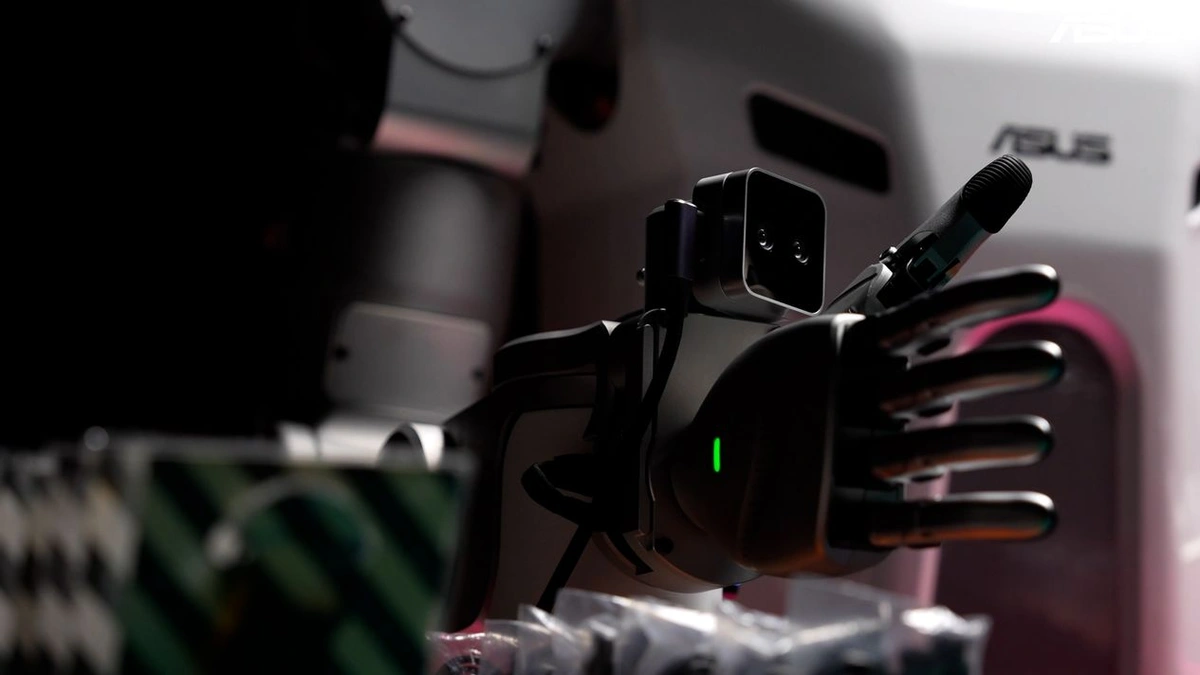
A critical engineering insight highlighted by ASUS is that dexterous hands remain the most constrained bottleneck in humanoid robotics worldwide. Commercial robot hands are either too fragile, lack sensory feedback, or carry prohibitive research price tags.
To solve this, ASUS developed its own articulated dexterous hand internally. Featuring articulated metal digits, integrated high-precision micro-actuators, and sensitive tactile fingertip sensors, the hand provides closed-loop force modulation. The robot can sense whether a plastic bag has been securely gripped or whether slippage has occurred before moving to the packaging box, mirroring human sensory feedback.
Dual wrist-mounted RGB-D depth cameras complement the robot’s head-mounted stereo vision, eliminating optical blind spots during close-up manipulation.
Deployment Roadmap: Computex 2027 Showcase and 2028 Commercial Rollout
The Gallop project initiated internally in early 2026. ASUS has laid out a phased commercialization roadmap:
- 2026 to Early 2027: Continued production hardening on fixed workstation mounts inside ASUS EMS factories, followed by the integration of a wheeled mobile base for inter-station transit.
- Computex 2027: First public customer demonstration of Gallop operating live at Computex Taipei.
- Late 2027: Deployment of pilot programs with select enterprise manufacturing partners.
- Second Half of 2028: Broader commercial availability under purchase and Robotics-as-a-Service (RaaS) models, expanding from electronics assembly into hospital supply logistics and commercial service facilities.
With Gallop, ASUS joins the physical AI race with a distinct competitive advantage: proprietary hardware manufacturing expertise, internal electronics factories serving as perpetual proving grounds, and direct deep integration with NVIDIA’s robotics compute stack.
Explore the complete technical breakdown on our ASUS Gallop engineering specifications page, or examine how it compares to industrial robotic manipulators in our head-to-head duels: ASUS Gallop vs Agibot G2 Max and ASUS Gallop vs Figure 02.