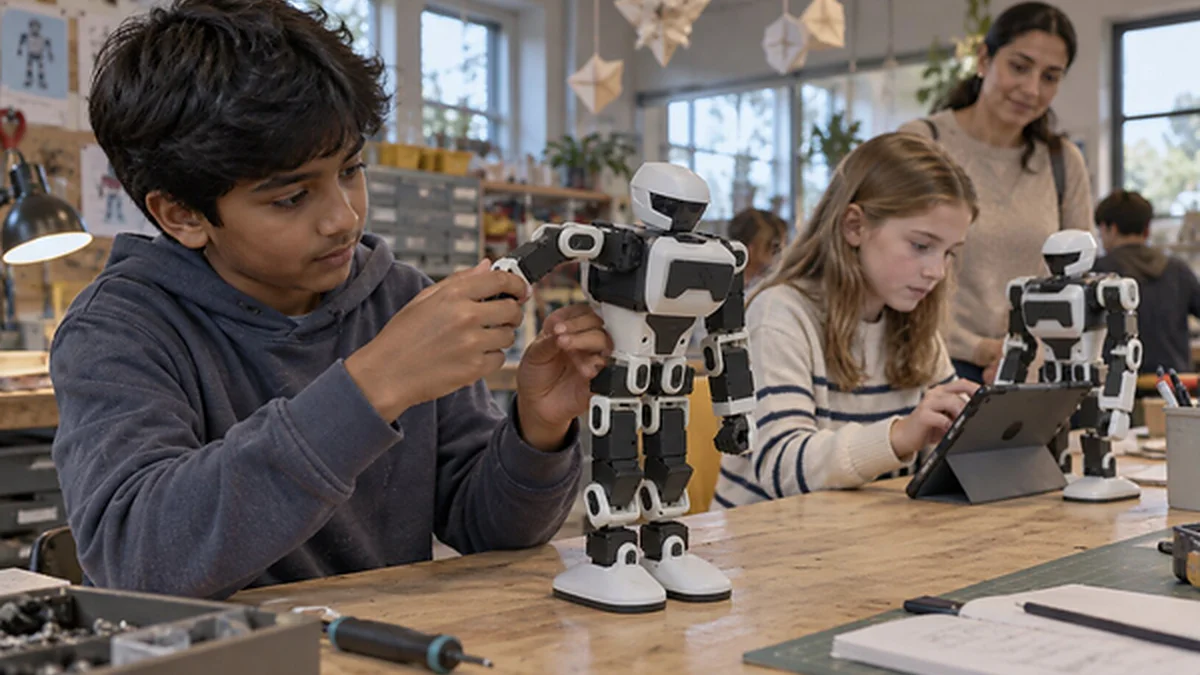
In a significant pricing breakthrough for physical artificial intelligence, Faraday Future Intelligent Electric Inc. and sister company FF EAI Robotics Ecosystem Inc. (FFR) have jointly unveiled FF Nova. Billed as the first embodied AI humanoid robot in the United States priced below $2,500, the machine enters the market at $2,490 for the core unit, accompanied by an optional $390 Developer Skills Package.
The launch is aimed squarely at universities, AI research labs, and independent roboticists who have previously been priced out of bipedal physical AI platforms. While entry-level research humanoids like the Unitree G1 start around $16,000 to $21,600 and industrial-tier bipeds like the Booster Robotics T1 exceed $30,000, FF Nova establishes a new sub-$2,500 price floor for development hardware.
Compact Bipedal Architecture and Hybrid Locomotion
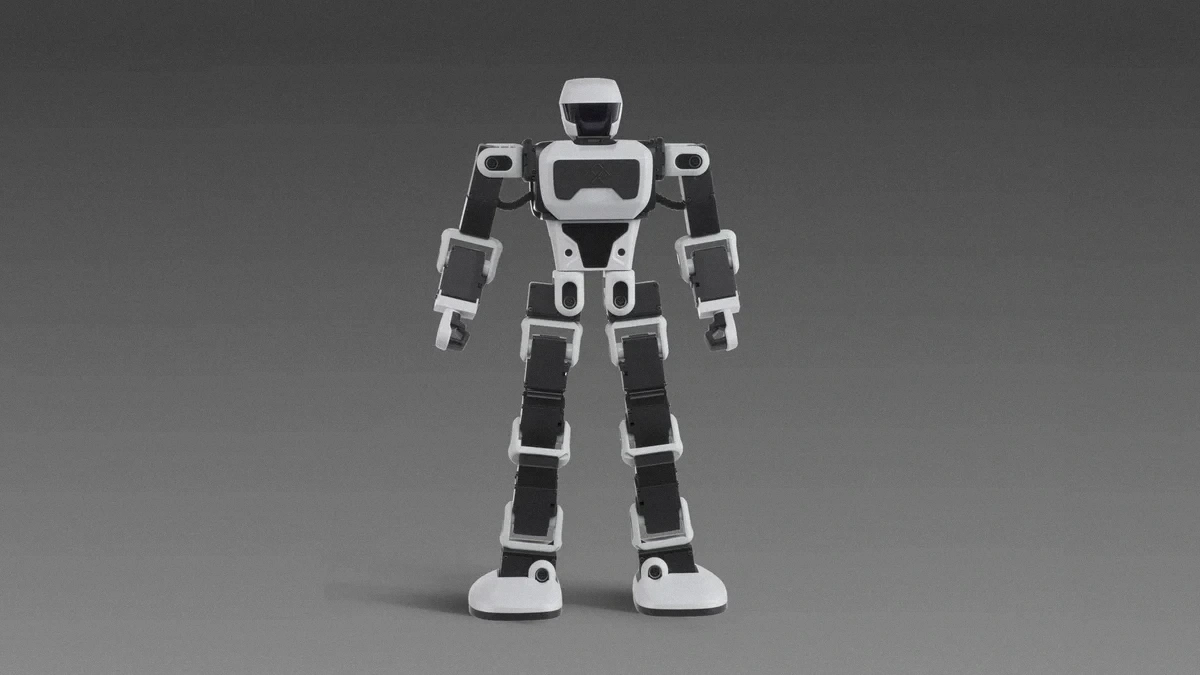
Standing 49.7 cm tall and weighing 2.8 kg, FF Nova is designed as a portable “physical AI lab in a backpack.” The chassis integrates 20 degrees of freedom (DoF), distributed across a 2-DoF pan-tilt neck, 6 DoF across the dual arms, and 12 high-torque bus-servo actuators powering the hip, knee, and ankle joints.
The bipedal kinematic system allows the robot to walk dynamically, execute omnidirectional turns, step over low obstacles, wave, and autonomously recover its standing posture following a tip-over or fall. Crucially, Faraday Future has integrated a convertible chassis design: Nova can be fitted onto an optional detachable wheeled base module. This hybrid architecture allows developers to switch between energy-intensive bipedal locomotion for complex terrain and efficient wheeled rolling for extended indoor patrols or navigation tasks.
Multimodal Sensing and NVIDIA Isaac Sim Integration
To support autonomous perception and spatial reasoning, FF Nova carries a comprehensive sensor payload:
- Spatial Mapping: A 2D/3D LiDAR sensor mounted in the upper torso for real-time SLAM (Simultaneous Localization and Mapping).
- Vision: A forward-facing wide-angle RGB camera combined with a dedicated Time-of-Flight (ToF) depth sensor for obstacle classification and hand-eye coordination.
- Acoustics & Voice: A circular 6-microphone array supporting 360-degree beamforming, noise cancellation, and sound source localization.
The robot is driven by an onboard neural compute module delivering 10 TOPS of AI inference, supported by 8 GB of RAM and 32 GB of high-speed flash storage. Running natively on ROS 2 (Robot Operating System 2), the platform connects to cloud voice foundation models, allowing users to incarnate conversational AI agents into physical movements.
For algorithmic development, FFR has integrated the robot into NVIDIA’s Isaac Sim and Isaac Lab simulation environments. This enables developers to train reinforcement learning (RL) policies virtually at thousands of times real-time speed before transferring weights to the physical hardware via zero-shot Sim2Real pipelines. A built-in Skill Store provides a framework for researchers to publish, share, and monetize custom motor primitives and behavior trees.
Educational Expansion and Corporate Realignment
Alongside FF Nova, the companies debuted the FF Nova Mini, an ultra-compact bipedal humanoid weighing under 1 kg and priced at $299. Targeted at K-12 STEM education, makers, and younger students, the Nova Mini is paired with a $499 “Physical AI Spark Program Curriculum” covering foundational block coding, Python scripting, choreographic kinematics, and obstacle racing.
The hardware rollout accompanies a major corporate restructuring disclosed in Faraday Future’s SEC Form 8-K filings. Under definitive agreements, FFR is acquiring Faraday Future’s full robotics assets and intellectual property in an all-stock transaction valued at approximately $200 million ($2.246 per share), leaving Faraday Future with an approximate 65.7% controlling stake in the pure-play robotics entity alongside a $10 million PIPE financing round.
Rollout of FF Nova will proceed in three stages:
- Phase 1 (Immediate): An invitation-only batch of 100 developer units, with the first 20 units dispatched immediately to select academic partners and AI developers.
- Phase 2 (Late Q4 2026): Open reservations for accredited educational institutions and certified robotics developers.
- Phase 3 (2027): General consumer and commercial availability across international markets.
By packaging open-source ROS 2 tooling, modern sensor modalities, and NVIDIA Isaac simulation into a sub-$2,500 form factor, FF Nova significantly lowers the financial barrier for developers entering the humanoid robotics domain.