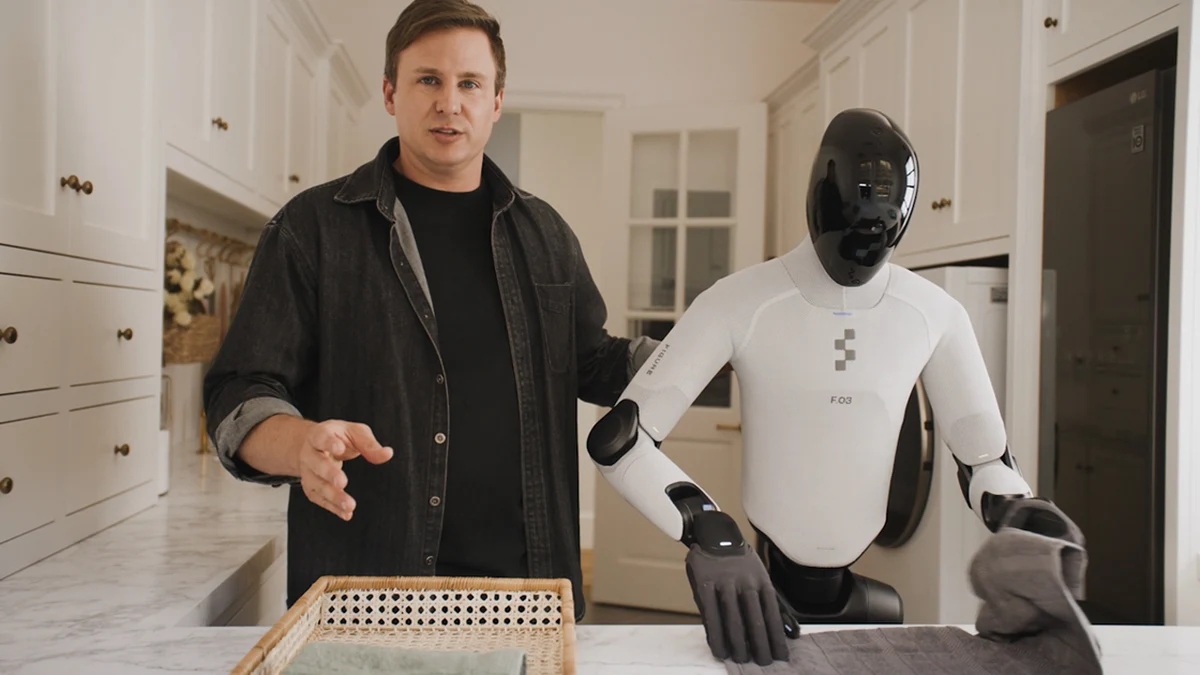
On September 17, 2026, Brett Adcock and the robotics engineering team at Figure AI officially introduced Helix 2.5, their most advanced neural network to date. Unlike previous generations of robots forced to painstakingly map and relearn every new workcell, Helix 2.5 delivers an unprecedented leap forward: zero-shot, whole-body humanoid autonomy in completely unfamiliar domestic homes.
At SpecsLib, we examined the raw metrics, experimental controls, and software architecture to dissect how Figure AI is transitioning humanoid robotics from choreographed lab trials into true, generalized physical intelligence.
The Physical Generalization Dilemma: Why the Real World Breaks Robots
Until now, robotic autonomy has hit a stubborn empirical ceiling. Whether using articulated industrial arms or wheeled bases, conventional robotic systems demand an environment engineered around the machine: clean flat surfaces, structured lighting, and fixed dimensional tolerances.
In private homes, those assumptions break down immediately:
- Infinite Geometric Variance: Bed heights, couch cushioning, table clearances, and cluttered floorplans differ across every single room.
- Deformable Object Manipulation: Folding towels or smoothing a comforter demands continuous visual and haptic tactile feedback of fabric tension, something rigid Cartesian motion paths cannot handle.
- Coupled Locomotion and Manipulation: To retrieve an object beneath a coffee table, a humanoid cannot decouple walking from grasping. It must simultaneously adjust its stance, bend its knees, pitch its torso, angle its head cameras, and balance its center of mass.
While Helix 02 proved that neural policies could manage whole-body coordination over long horizons (such as 200 hours of autonomous warehouse tasks), it relied on demonstration data collected directly within the operational environment. Helix 2.5 tackles the harder challenge: walking into a home it has never seen before and getting straight to work with zero on-site calibration.
The 30 Unseen Homes Blind Evaluation Protocol
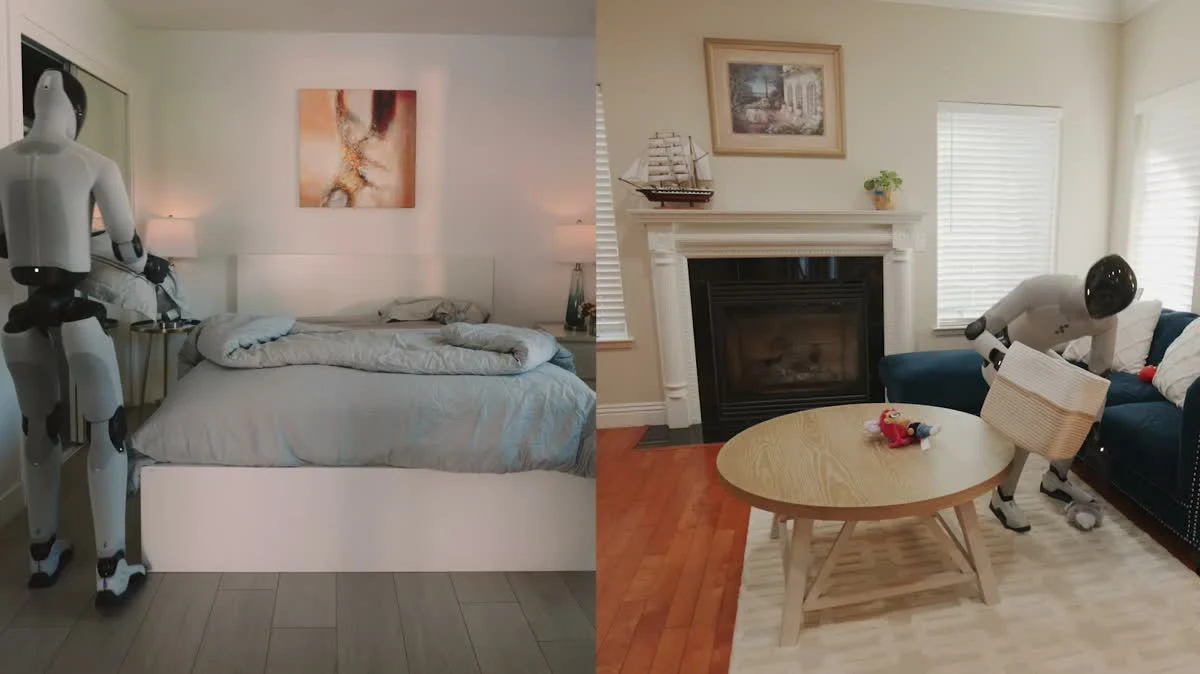
To measure real-world zero-shot generalization without laboratory bias, Figure AI executed an extensive blind evaluation across 30 private homes in the San Francisco Bay Area:
- Zero data collected in any of the evaluation homes prior to testing.
- Unseen objects: Evaluation toys, towels, and bed linens were strictly quarantined and verified by both AI filtering and human review to ensure they never appeared in task-specification data.
- Single fixed checkpoint: The exact same frozen neural model weights were deployed across all 30 residences, with no per-home tuning or test-time adaptation.
Operators benchmarked 3 complex long-horizon whole-body tasks under strict binary pass/fail standards with no partial credit:
- Living Room Tidy: Picking up all 13 to 15 scattered toys and placing them into a floor basket (1-minute timeout per item).
- Towel Folding: Grasping loose towels from a surface, folding them cleanly with all 4 corners aligned within one inch, and stacking them in a hamper.
- Bed Making: Pulling the comforter straight, smoothing out wrinkles, aligning both corners within the top third of the bed, and aligning pillows horizontally within 15 degrees.
The Power of Index Pretraining: Surging from 9% to 56% Success
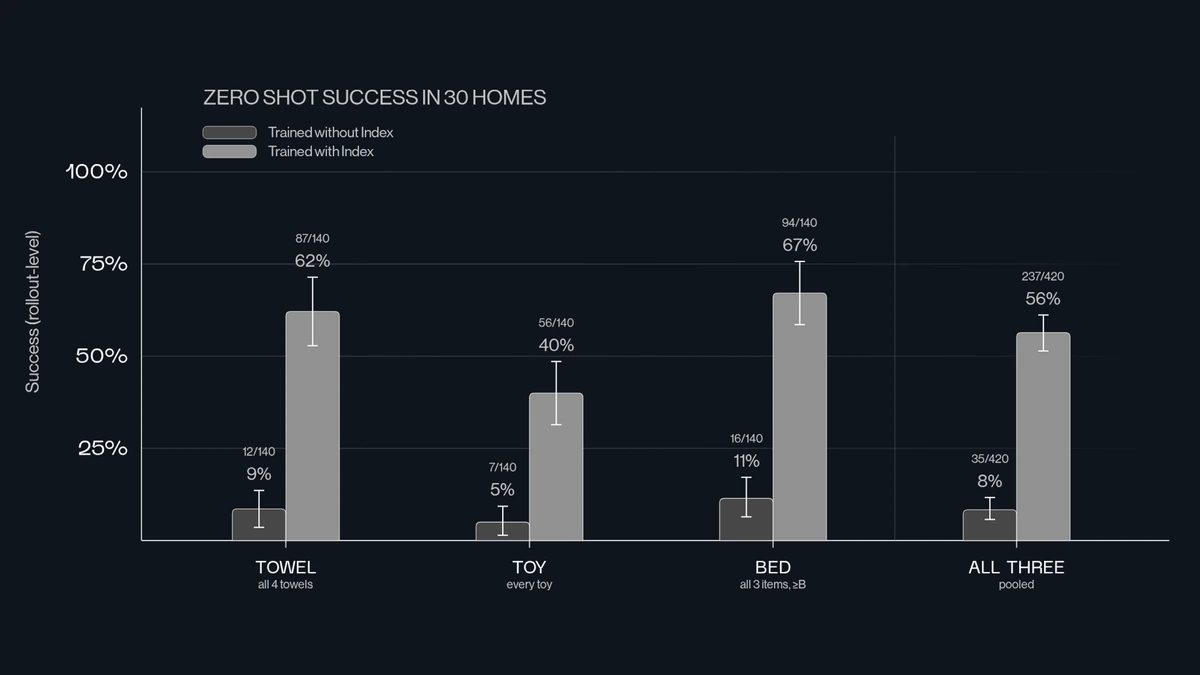
The empirical results reveal a stark contrast. Keeping network architecture, optimization, hyperparameters, and task-adaptation demonstrations strictly identical:
- The policy trained from scratch with random weight initialization achieved only a 9% overall zero-shot success rate.
- The model initialized from Index pretraining soared to a 56% full-task success rate across 420 rollouts (achieving 67% on bed making and 62% on towel folding).
This finding proves a critical insight: task-specific robotic data alone is insufficient; broad physical pretraining on general human behavior provides the foundational substrate for zero-shot dexterity.
Furthermore, data efficiency doubled: Helix 2.5 required half as much task-specific adaptation data as Helix 02 while expanding its operating domain across an environmental scope 30 times wider.
Whole-Body Self-Correction and Dynamic Recovery
A striking qualitative leap demonstrated by Helix 2.5 is its closed-loop ability to recover from execution errors in real time:
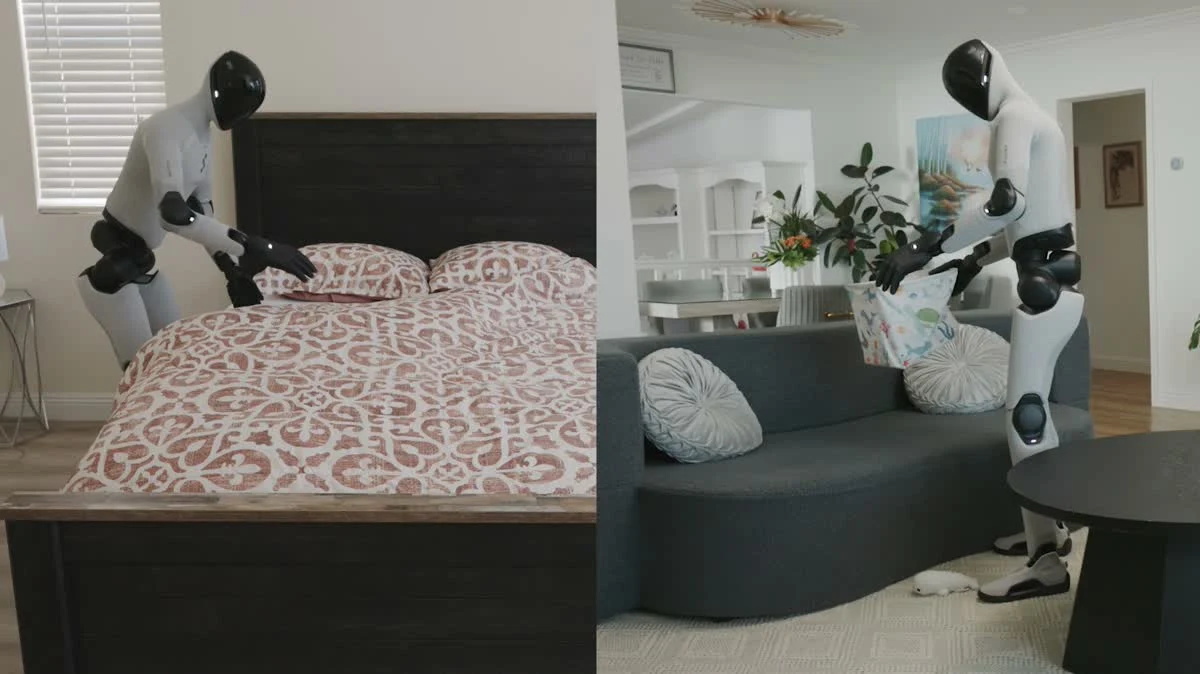
- Kinematic Stance Adjustments: If the robot misjudges its initial reaching stance, it does not abort. It steps back, circles around the corner of the bed, and re-approaches with an optimal posture.
- Grasp Failure Recovery: If a slippery towel corner slips from its fingers, the model detects the failure haptically, adjusts palm orientation, and re-engages without halting execution.
This kinematic intelligence stems directly from Index, Figure AI’s proprietary human behavioral dataset that ingests roughly 35 minutes of physical human experience every single second worldwide.
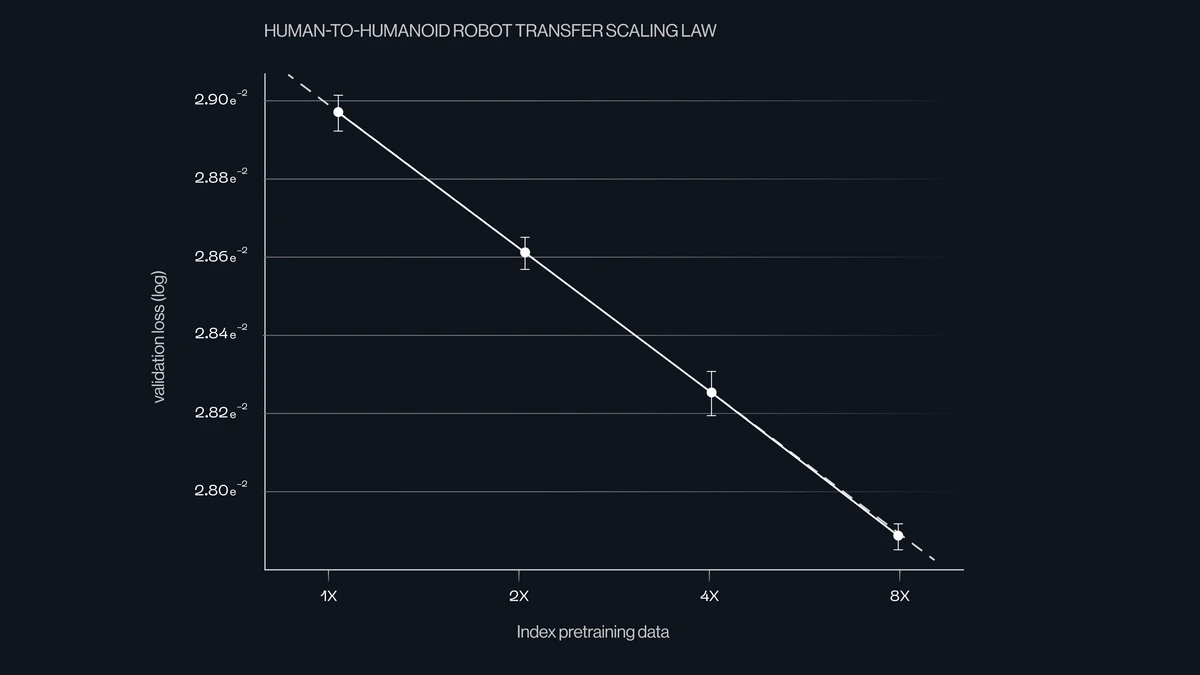
A Mathematical Scaling Law for Humanoid Robotics
Much like the scaling laws identified by Kaplan and Chinchilla that fueled rapid LLM progress, Figure AI demonstrated that human-to-humanoid transfer obeys a predictable mathematical scaling law.
By training models across an 8x data span of nested Index subsets, researchers observed that validation loss falls smoothly on a logarithmic curve. Using only smaller initial training runs, Figure was able to forecast their largest model’s test loss to four decimal places before training even began, with a forecasting error of only 0.54%.
Backed by a $3.5 billion compute infrastructure commitment, Helix 2.5 confirms that the scaling recipe that revolutionized natural language now applies to physical space: pretrain broadly on human reality, specify a behavior once, and deploy zero-shot anywhere humans live and work.