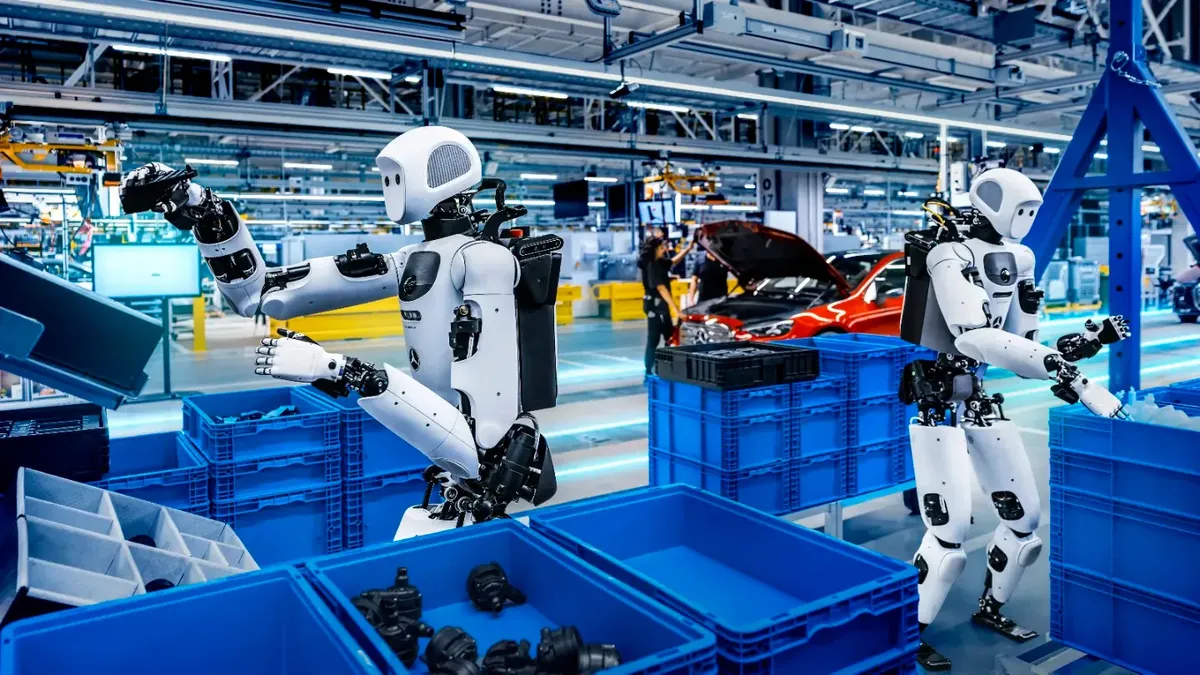
In a significant proof of concept for embodied artificial intelligence in heavy manufacturing, Google DeepMind unveiled Gemini Robotics 2.5, its most capable Vision-Language-Action (VLA) foundation model to date. Validated during active factory trials at Mercedes-Benz manufacturing facilities in Kecskemét, Hungary, and Sindelfingen, Germany, the model achieved a 96% autonomous task success rate directing Apptronik Apollo 2 humanoid robots through complex automotive parts-kitting workflows.
The milestone marks a decisive shift in humanoid deployment: moving past scripted choreographies and teleoperated demonstrations toward real-time neural network control operating reliably inside live automobile assembly lines.
Two-Tier Hierarchical AI: Embodied Reasoning and VLA Control
The deployment relies on a dual-model software architecture designed to bridge high-level operational planning with low-level physical dexterity:
- Gemini Robotics ER (Embodied Reasoning): Functions as the supervisory cognitive brain. It tracks overall workflow state against the vehicle bill of materials, monitors multi-step progress, coordinates part-matching logic, and triggers real-time error recovery policies when an anomaly occurs.
- Gemini Robotics 2.5 (VLA Motor Execution): Translates live visual perception and high-level commands directly into continuous 3D joint velocities, controlling torso posture, arm trajectories, and multi-fingered hand manipulation at high frequency.
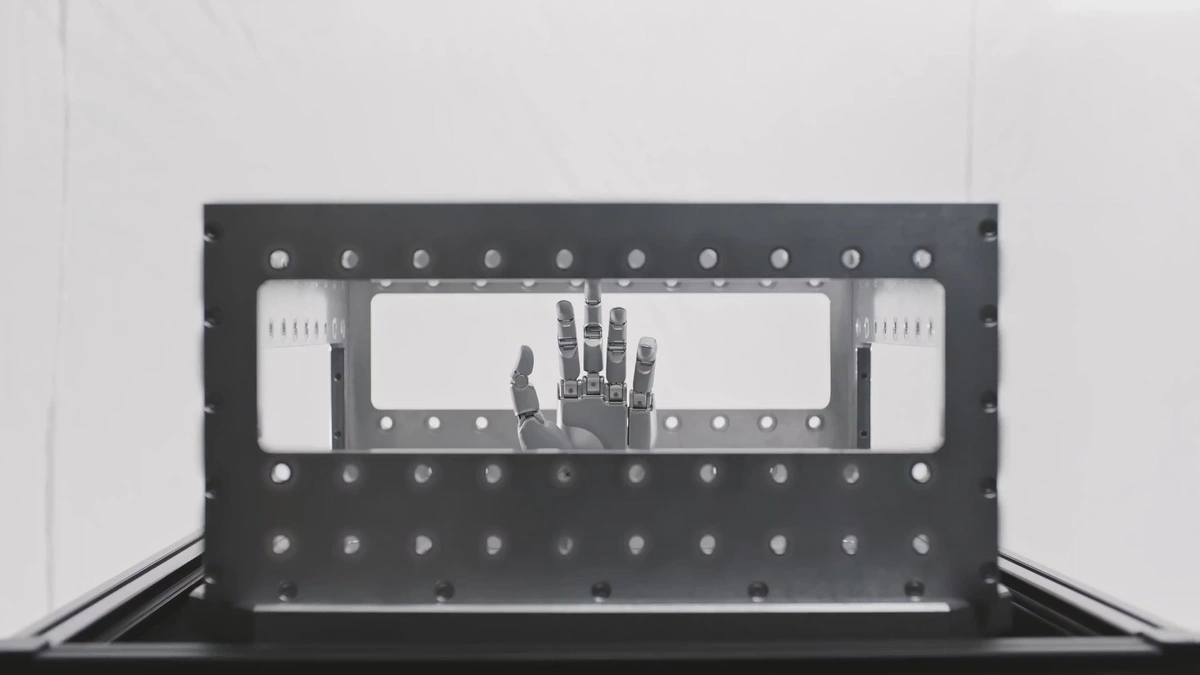
To handle delicate automotive fasteners and structural brackets, the Apollo 2 units were configured with specialized SharpaWave five-finger hands providing 22 active degrees of freedom (DoF) and high-density tactile fingertip arrays.

According to Apptronik co-founder and CEO Jeff Cardenas, pairing Apollo 2 with Gemini Robotics enabled dramatic model improvements within weeks of post-training, transferring from simulation directly onto Mercedes-Benz production floors with minimal real-world performance drop-off.
Factory Parts-Kitting: Precision Sorting from Bulk Supply Bins
Automotive parts kitting is traditionally among the most labor-intensive assembly prep stages. Human technicians must repeatedly bend, reach into cluttered bulk bins, extract irregular steel and aluminum brackets, orient them correctly, and place them into designated vehicle sequencing trays.
Operating line-side alongside vehicle conveyors, Apollo 2 executed the entire sequence autonomously:
- Visual Disambiguation: Identifying overlapping metal parts under shifting industrial lighting and reflections.
- Singulation and Grasping: Tactilely verifying component seating to prevent slipping or multiple simultaneous pickups.
- Tray Sequencing: Accurately staging brackets into vehicle trays in the exact build order required by downstream chassis assembly technicians, autonomously repositioning components whenever initial alignment deviated.
Multi-Task Dexterity, Cycle Cadence, and ASIMOV-Jailbreak
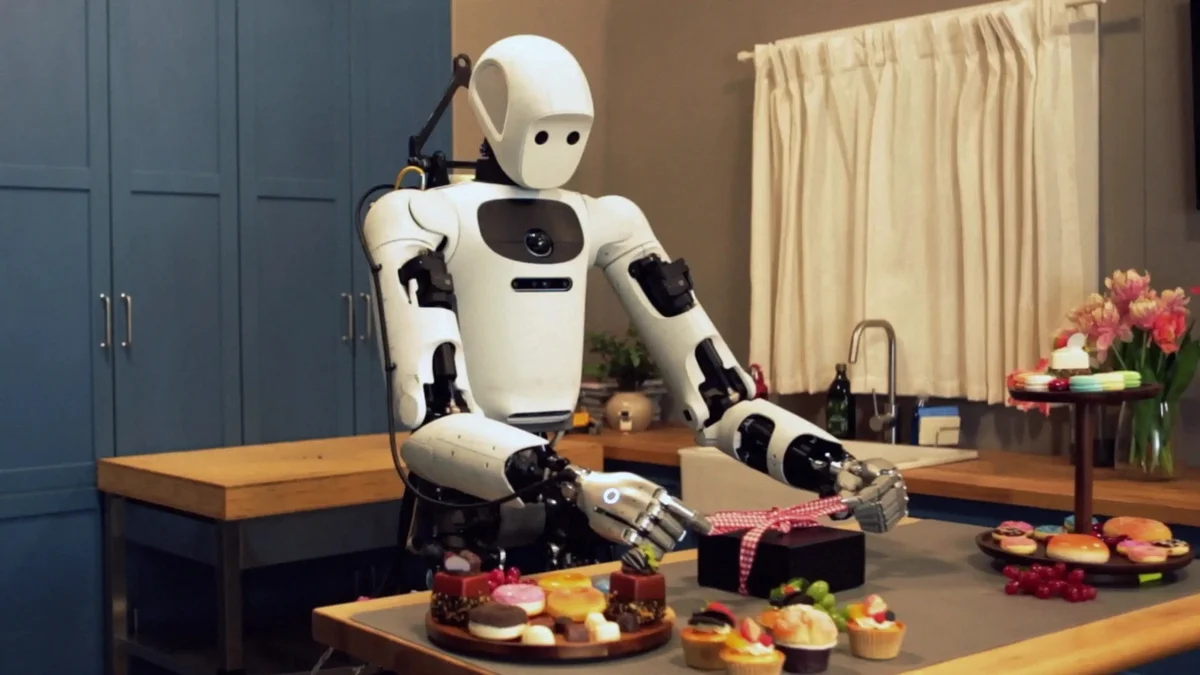
Beyond automotive kitting, DeepMind evaluated Gemini Robotics 2.5 across an extensive suite of more than 200 complex physical tasks, including using tongs to serve food, pipetting laboratory liquids, and tying ribbon bows on gift boxes.
Across the evaluation matrix, Gemini Robotics 2.5 achieved 30% to 100% higher success rates and 20% to 30% faster cycle times compared to previous VLA baselines. In automotive manufacturing, closing the speed gap toward human takt time (the 60 to 90-second assembly station cycle) is critical. The 20% to 30% speedup brings autonomous staging significantly closer to sustaining full vehicle line throughput without buffering delays. DeepMind accelerated training using Gemini 4 Argon, reconstructing calibrated MuJoCo physics simulation digital twins from single camera captures to simulate thousands of corner-case variations.
On physical safety, the model incorporates inference-time reasoning guidance:
- 33% improvement in safe task completion around physical machinery obstacles.
- 43% improvement in collision avoidance and safe spacing near human factory personnel.
- ASIMOV-Jailbreak Benchmark: DeepMind open-sourced a comprehensive benchmark under the MIT license comprising 845 adversarial multi-turn prompts across 15 strategy categories. Gemini Robotics 2.5 achieved a 99.5% defense success rate against physical jailbreak attempts while maintaining minimal benign over-refusal.
Engineering Impact on Commercial Humanoid Robotics
The Mercedes-Benz pilot underscores that the primary competitive frontier for general-purpose humanoids is shifting from custom mechanical prototypes to foundation AI model adaptability. By integrating foundation models like Gemini Robotics with production-ready humanoid hardware like Apollo 2, automotive manufacturers can deploy automated logistics and staging without restructuring existing assembly architecture.
To review mechanical dimensions, payload capacities, and actuator architectures, explore our detailed Apptronik Apollo 2 engineering profile, or compare Apollo 2 against leading commercial competitors: