
On November 2, 2026, the ancient stone paths of Mount Taishan in Shandong Province, China, hosted the inaugural China Media Group (CMG) World Robot Mount Tai Climbing Competition. Bringing together nearly 90 robotics teams from domestic manufacturers, research laboratories, and universities, the event subjected bipedal humanoids, quadrupeds, and powered exoskeletons to one of the most grueling physical proving grounds in real-world robotics.
The primary race track followed the historic hiking route from Hongmen (Red Gate) to Zhongtianmen (Middle Gate of Heaven), traversing 3.9 kilometers (2.4 miles) with an elevation gain of roughly 600 meters (1,970 feet). Featuring over 3,100 irregular, centuries-old stone steps and steep cobblestone passages, the route transformed a trail that typically takes experienced human hikers between 90 and 120 minutes into an unsparing benchmark for embodied AI locomotion algorithms.
Humanoid Speed Race: Bipedal Kinematics on Irregular Steps
While quadrupedal machines tackled the entire 3.9-kilometer mountain ascent, the bipedal humanoid sprint was staged on a dedicated high-difficulty section from Hongmen Square to Doumugong Palace, covering approximately 1.6 kilometers (1.0 mile) and more than 600 steep stone steps.
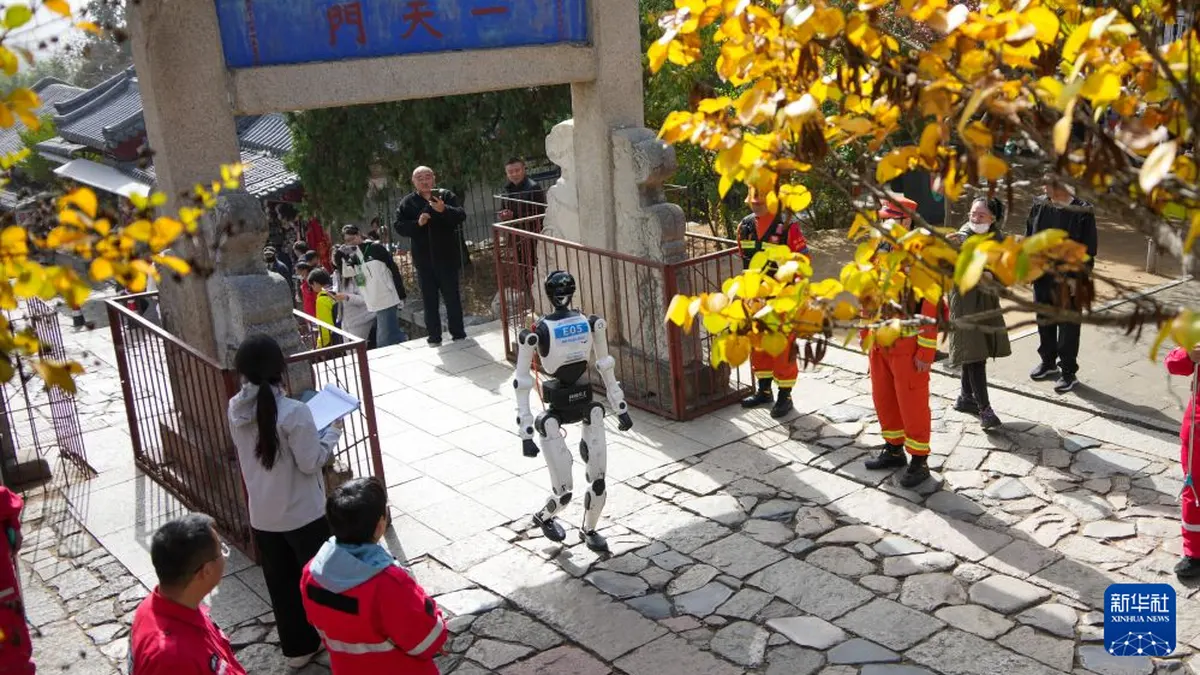
The humanoid speed category demonstrated both rapid progress and mechanical vulnerabilities:
- Champion Performance: The bipedal humanoid “Yinyi NE01”, fielded by the joint Zhishen Lingyue team (Zhishen AI and Lingyue Intelligent), secured first place by completing the 1.6-kilometer stair climb in 27 minutes and 26 seconds. The machine utilized high-frequency whole-body coordination to adjust foot placement dynamically on polished stone risers.
- Runner-Up Honors: Shandong Yobotics Intelligent Robot Co. captured second place with its Yobotics E1 “Xingzhe Taishan” (Walker Taishan), completing the route in 36 minutes and 18 seconds. Standing 1.40 meters tall (4 feet 7 inches) and weighing 39 kilograms (86 pounds), the E1 relies on a modular joint architecture and real-time center-of-mass trajectory compensation.
- Thermal Stress and Real-World Dropouts: The trial highlighted current hardware limits. An entry running the Unitree G1 humanoid platform was forced to retire mid-ascent after continuous stair climbing caused thermal overheating across its knee and ankle electric actuators, illustrating the severe duty cycle imposed by continuous vertical ascent without level recovery phases.
Quadruped Endurance and Load-Carrying Challenges
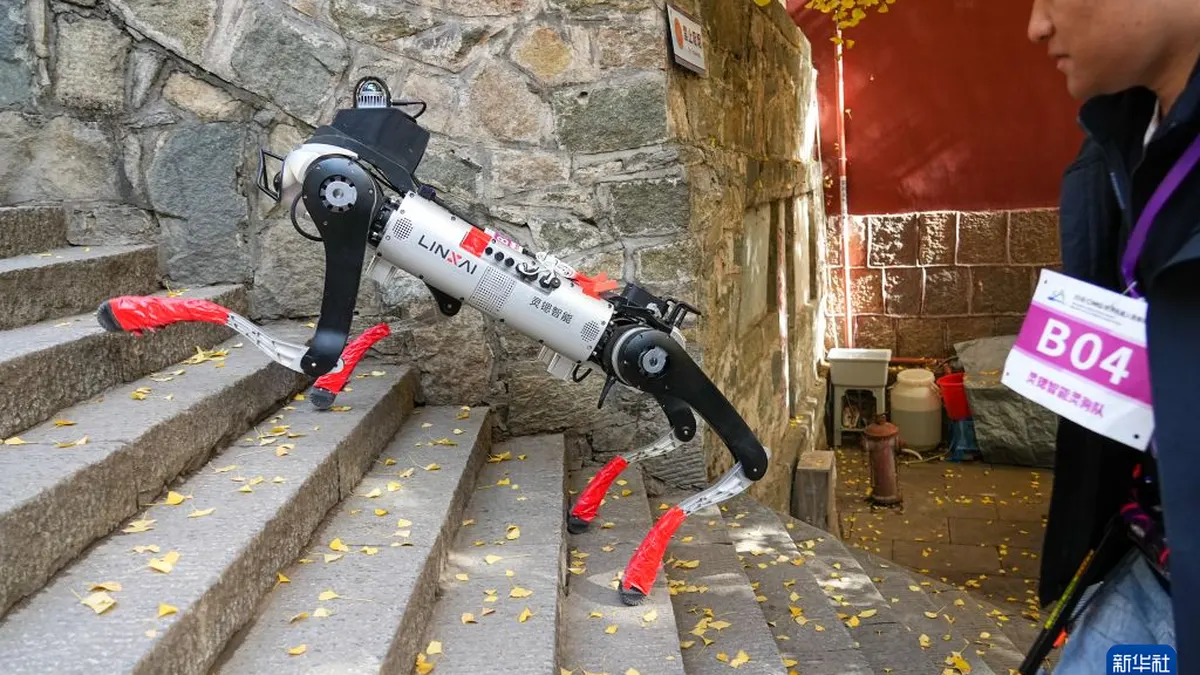
In the quadruped category, machines completed the full 3.9-kilometer climb to Zhongtianmen:
- Speed Victor: Beijing Lingyi Technology, a wholly owned subsidiary of Unitree Robotics, took top honors with a specialized Unitree A2 quadruped running the course in 43 minutes and 41 seconds.
- Autonomous SLAM Demonstration: Hangzhou-based UNIUBI AI fielded Cyvet, the most compact quadruped in the field. Using 360-degree LiDAR and real-time 3D point-cloud mapping, Cyvet autonomously completed the route during validation testing in 35 minutes and 47 seconds without human umbilical tethering.
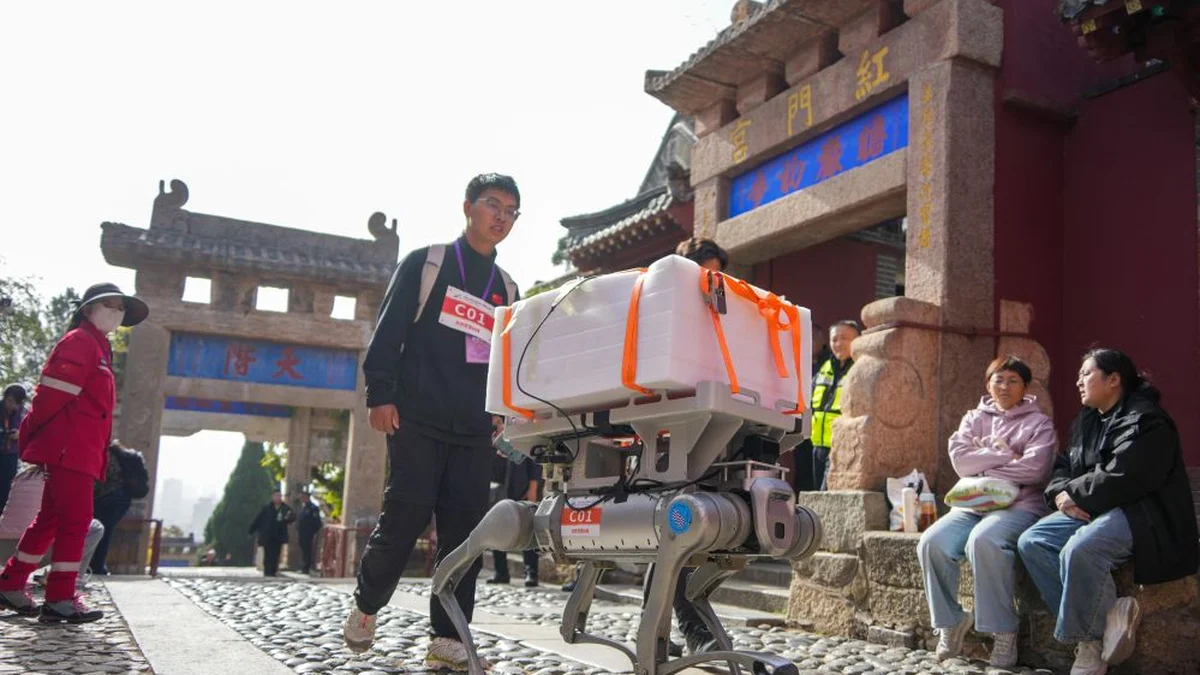
Beyond pure speed, the competition featured a dedicated load-carrying race simulating the traditional work of Mount Taishan porters (Taishan Tiaoshangong). Operating over a 3.3-kilometer route with 2,100 steps, legged platforms hauled payloads including fresh watermelons and crates of fragile eggs to evaluate impact absorption and dynamic shock isolation under variable payload shifts.
Engineering Takeaways: Bridging the Sim-to-Real Gap
For the robotics industry, Mount Taishan served as an objective reality check against laboratory benchmarks:
- Sim-to-Real Step Irregularities: Reinforcement learning policies trained in NVIDIA Isaac Gym or MuJoCo typically assume uniform riser heights. Mount Taishan’s steps vary between 12 cm and 28 cm in height, with rounded edges and shifting cobblestones that exposed blind spot errors in depth perception.
- Actuator Thermal Management: Ascending 600 continuous steps creates sustained peak torque without regenerative cooling windows. Actuator cooling systems, gearhead heat dissipation, and motor windings emerged as the decisive bottleneck separating finishing robots from thermal shutdowns.
- Multi-Modal Perception Necessity: Pure vision struggled against fluctuating mountain shadows and fallen leaves. Successful teams combined solid-state LiDAR point clouds with joint-level torque feedback to enable tactile “blind walking” when optical sensing degraded.
According to data cited from China’s Ministry of Industry and Information Technology (MIIT), Chinese developers have produced over 40,000 humanoid units across 400 distinct models during the first half of 2026. Events like the Mount Taishan trial mark the transition of embodied AI from polished stage demos to rugged outdoor deployment in emergency rescue, geological monitoring, and hazardous mountain logistics.