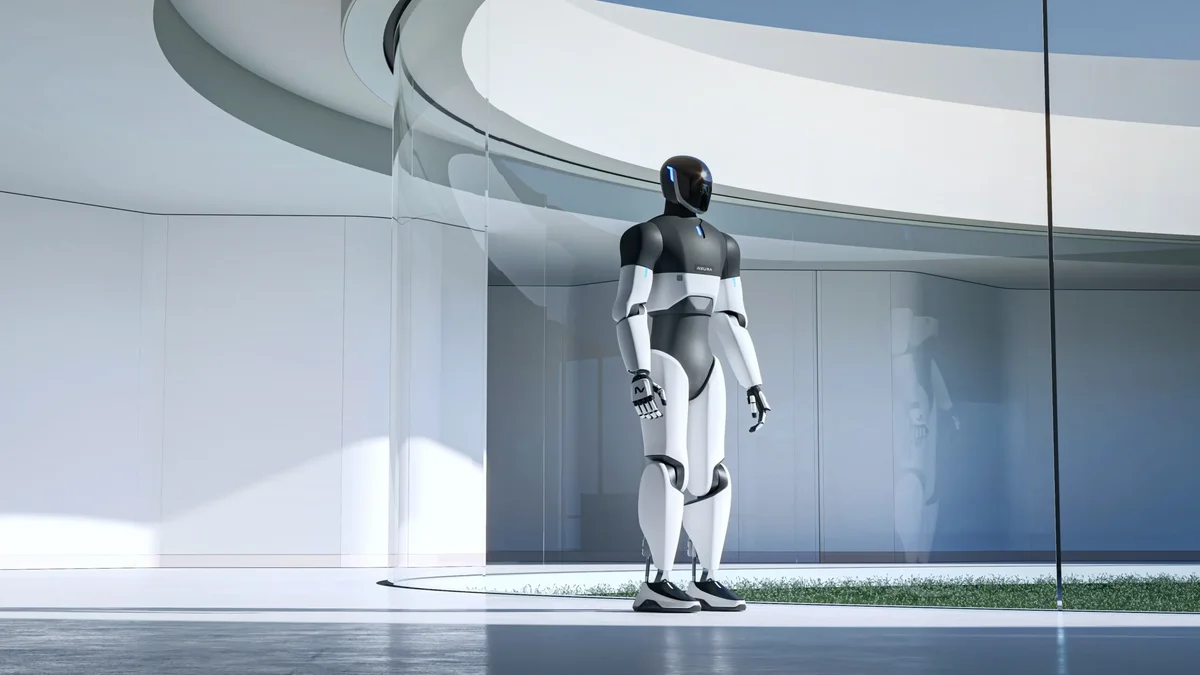
Metzingen-based NEURA Robotics has introduced Neuron AI, its proprietary multimodal foundation model for Physical AI, alongside milestone autonomous demonstrations on its flagship bipedal humanoid robot, 4NE1. Designed and trained in Germany, Neuron AI moves beyond conventional vision-only robotics by integrating 3D vision, artificial tactile skin, force sensing, acoustic feedback, and robot telemetry with continuous temporal memory in a unified Perception-Language-Action (PLA) architecture.
The announcement positions NEURA Robotics as Europe’s leading contender in the global race for embodied artificial intelligence, competing directly with Silicon Valley and Chinese humanoid programs. Rather than treating sensory modalities as isolated pipelines, Neuron AI projects multimodal inputs into a single latent space, allowing the robot to reason about physical contact, occluded tools, and mechanical reactions that cameras alone cannot observe.
Beyond Vision: Tactile Skin, Acoustic Feedback, and Object Permanence
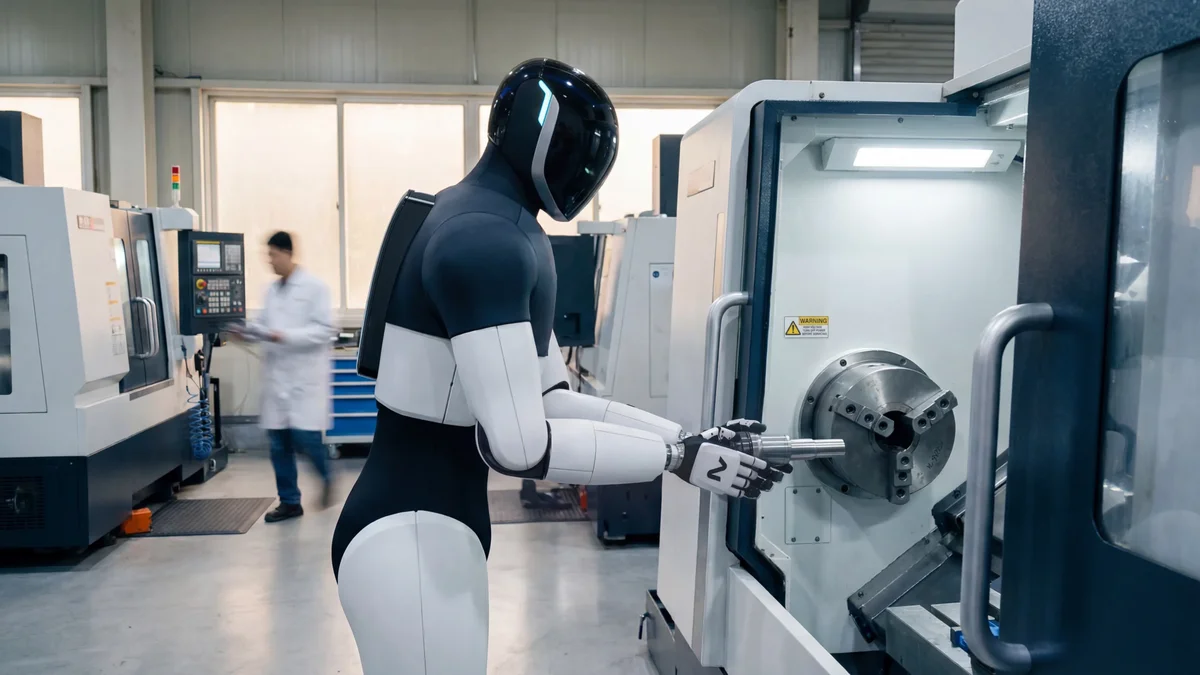
Standard Vision-Language-Action (VLA) models often struggle in industrial manufacturing and domestic environments because visual line-of-sight is easily blocked by the robot’s own arms, grippers, or target machinery. Humans compensate for visual occlusion by feeling whether a screw thread has engaged properly or listening for the distinct click of a locking connector.
Neuron AI embeds these exact sensory feedback loops into its neural architecture. By ingesting high-frequency tactile readings from 4NE1’s artificial sensor skin, multi-axis torque measurements from every joint, and directional acoustic signals, the model can execute precision contact tasks blind:
- Acoustic feedback verification: Assessing the quality of mechanical latches, motor engagement, and welding seams via acoustic signatures.
- Tactile surface sensing: Measuring friction, micro-slippage, and contact pressure across the entire finger surface before lifting delicate or deformable objects.
- Continuous temporal memory: Endowing the robot with object permanence. If a component slips behind an obstacle or inside a machine cavity out of camera view, Neuron AI tracks its physical state and coordinates recovery movements based on prior actions.
4NE1 Hardware Architecture: 55 Degrees of Freedom and Cobot Safety
The primary embodiment demonstrating Neuron AI is 4NE1 (pronounced “For Anyone”), NEURA’s full-scale cognitive bipedal humanoid. Standing 1.80 meters tall with an operational mass of 80 kilograms, 4NE1 incorporates German collaborative robotics (cobot) safety engineering into a human-scale chassis:
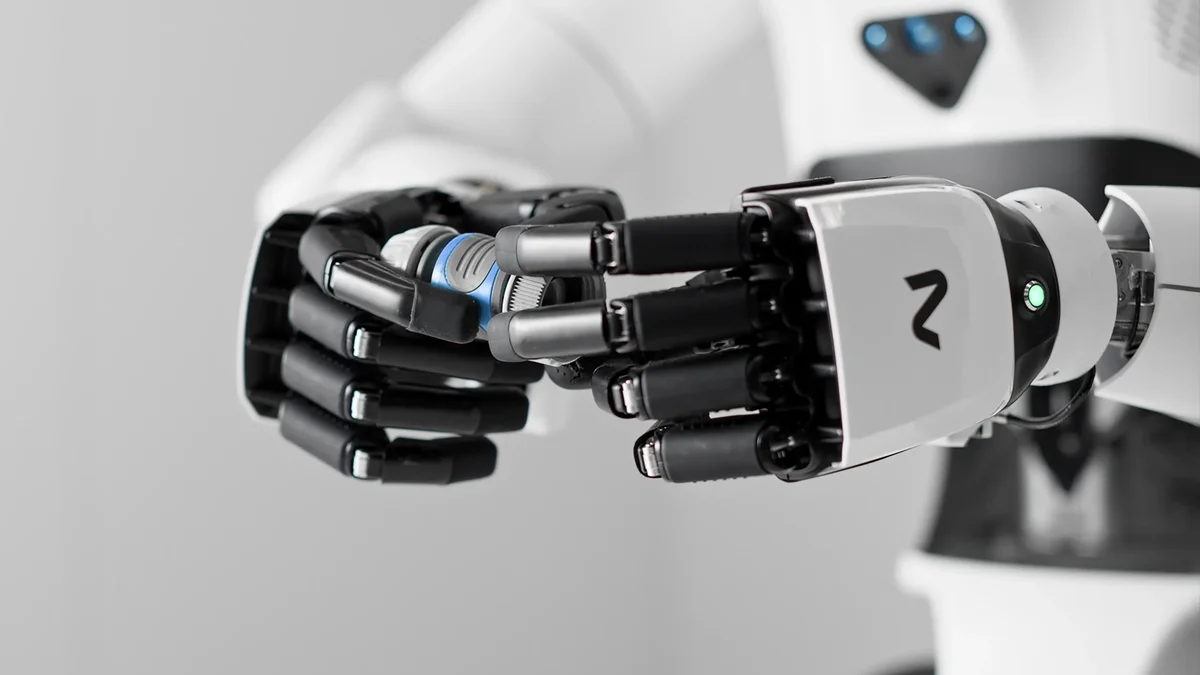
- 55 total degrees of freedom (DoF): Featuring 14 DoF across the dual arms (7 DoF per arm), 12 DoF across the legs (6 DoF per leg), 5 DoF in the torso and cervical neck, and 24 DoF in the dexterous hands (12 active DoF per 5-finger hand).
- Integrated joint torque sensing: Every joint houses proprietary high-torque precision harmonic drives equipped with absolute encoders and embedded torque sensors, ensuring compliant force control.
- Locomotion and runtime: Dynamic walking speed up to 5 km/h, paired with 6 to 8 hours of runtime per charge and hot-swappable battery packs for continuous 24/7 industrial shift coverage.
- Full-body artificial skin: A patented sensitive skin covering the torso, limbs, and hands provides both touchless human proximity detection and millisecond-level tactile impact detection, allowing safe cage-free operation alongside human factory workers.
- Payload capacity: Capable of manipulating 10 kg payloads per hand (up to 20 kg bimanually) and supporting structural lifting loads up to 100 kg through dedicated kinematics.
For complete mechanical specifications, joint kinematics, and performance ratings, explore the detailed NEURA 4NE1 technical profile in our robotics directory, or compare how it stacks up against American flagships in our head-to-head duels: NEURA 4NE1 vs Figure 02 and NEURA 4NE1 vs Tesla Optimus Gen 2.
Three Data Pillars and the Neuraverse Fleet Ecosystem
Foundation models in physical AI require diverse, synchronized multimodal datasets that cannot be scraped from the public internet. NEURA Robotics trains Neuron AI across three complementary data streams:
- Real-world multisensory data: Captured across dedicated NEURA Gym training centers in Metzingen and RWTH Aachen. Fleets of cognitive robots execute manipulation sequences while recording synchronized vision, force, touch, sound, and joint positions. Industrial data partnerships with German manufacturing titans including Bosch and Schaeffler ground training in actual factory tolerances.
- Simulation-amplified variations: NEURA’s proprietary Data Amplifier generates millions of physics-accurate synthetic permutations, varying lighting conditions, surface textures, material elasticity, and obstacle placements.
- Sensor-suit human demonstrations: Expert human operators wearing teleoperation suits capture natural movement trajectories and complex hand-eye coordination routines.
Once a skill is validated, deployment is managed through Neuraverse, an open cloud platform designed to distribute model checkpoints and task skills across customer robot fleets. Progress is measured by Time-to-Skill, the elapsed duration required for a robot fleet to absorb a novel industrial procedure and execute it with six-sigma repeatability.
Live Benchmark: 11-Minute Autonomous Laundry Sequence at NVIDIA GTC Berlin
To prove that Neuron AI solves multi-step horizon planning rather than scripted short-burst actions, NEURA Robotics is demonstrating 4NE1 live at NVIDIA GTC Berlin 2026 (Station-Berlin, Booth #3031, October 20-22).
During the live demonstration, 4NE1 executes an unassisted eleven-minute domestic sequence:
- Identifying and sorting heterogeneous garments from a basket.
- Opening the washing machine door with compliant latch manipulation.
- Loading the garments into the drum, dosing detergent, and securing the door seal.
- Operating the rotary cycle selector and start switch.
- Unloading wet clothing upon completion and transferring the batch into an adjacent dryer.
Carrying operational context across an eleven-minute unstructured sequence represents a major technological leap. Because soft textiles deform unpredictably and obscure their own geometry, success hinges entirely on Neuron AI combining force feedback, temporal memory, and adaptive re-grasping without human teleoperation intervention.
With commercial pilot leasing programs currently rolling out across European automotive, machine tooling, and healthcare facilities, NEURA Robotics has demonstrated that Europe can build sovereign, industrial-grade Physical AI foundation models grounded in world-class mechanical precision.