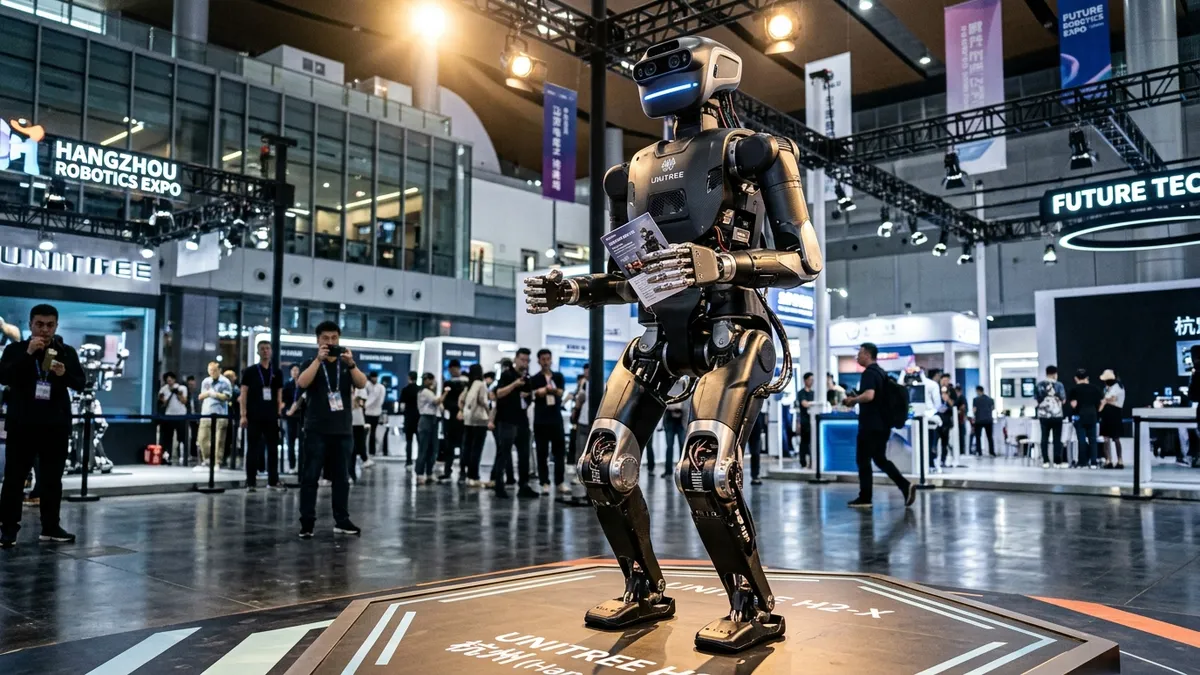
At the 2026 World Physical AI Conference and Partner Ecosystem Summit in Hangzhou, Chinese robotics leader Unitree Robotics staged an aggressive demonstration of dynamic physical intelligence. Headlining the showcase was the surprise unveiling of the H2-X, marketed under the moniker “Kung Fu Legend: Guardian.” Engineered as a reinforced, high-agility variant of Unitree’s full-scale humanoid architecture, the machine is explicitly oriented toward physical security patrol, dynamic defense, and emergency rescue operations.
Alongside this kinetic hardware reveal, Unitree founder and CEO Wang Xingxing announced Unitree Rehearsal, a self-evolving artificial intelligence software pipeline designed to autonomously generate, simulate, and deploy humanoid motor policies without manual human programming. However, a high-profile hardware detachment during a live aerial acrobatic demonstration in Hangzhou served as a stark reminder of the unforgiving physical realities governing high-energy Sim2Real deployment.
The H2-X Architecture: Kinetic Power and Defensive Kinematics
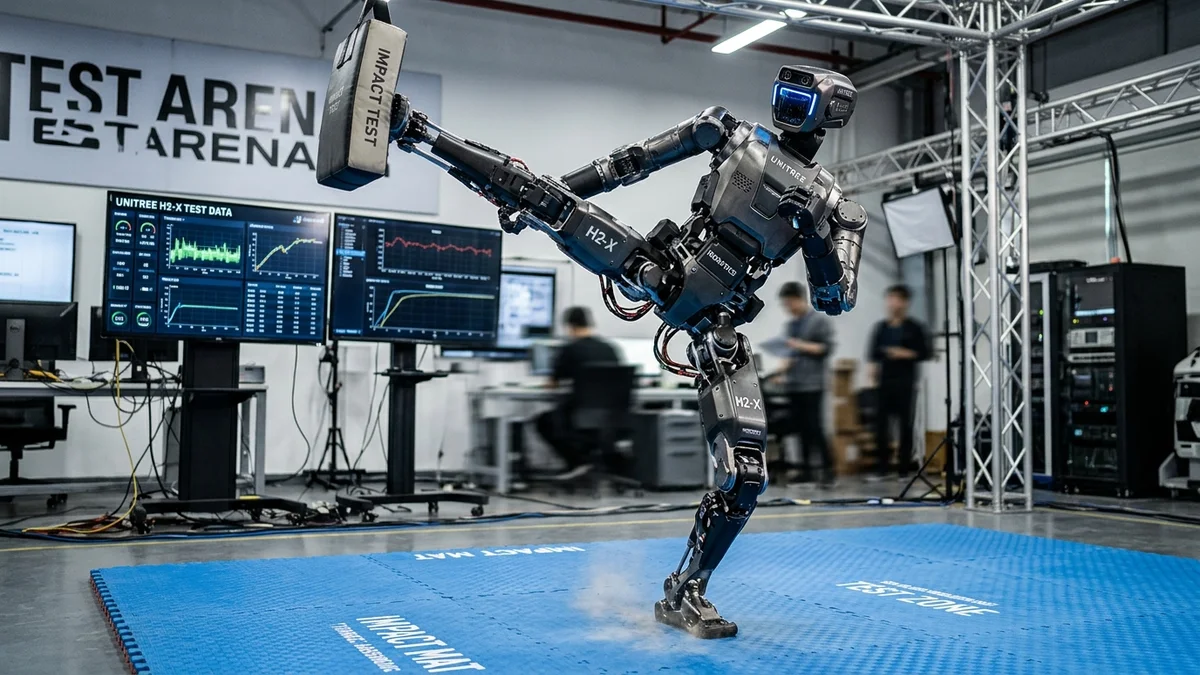
While consumer-oriented platforms like the compact Unitree G1 prioritize affordability and lightweight agility, the H2-X scales up the mechanical footprint to full human proportions:
- Chassis Dimensions & Mass: Standing 1.80 meters (5 ft 11 in) tall with a structural operating weight of 70 kg (154 lbs), the robot utilizes a reinforced carbon-composite and aviation-grade aluminum unibody exoskeleton.
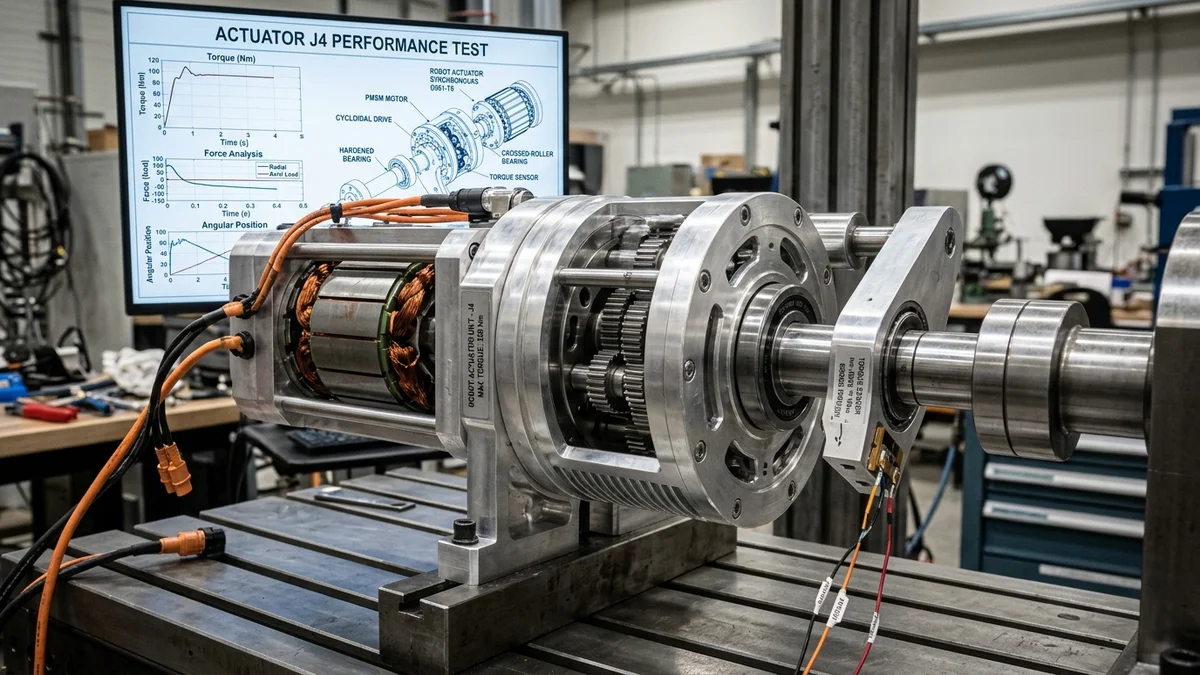
- Actuation Backbone: Across its 31 degrees of freedom (DoF), the lower extremities leverage Unitree proprietary high-torque permanent magnet synchronous motors (PMSM) paired with planetary reduction stages and heavy-duty crossed-roller bearings, outputting a peak joint torque of 360 N·m.
- Payload and Force Output: Arm joints deliver up to 120 N·m, enabling sustained two-handed pushing forces exceeding 40 kg and short-duration emergency lifting capacities demonstrated in staged vehicular obstacle extraction.
- Power Management: Powered by a 0.972 kWh (64.8V, 15 Ah) dual hot-swappable battery array positioned within the central torso cavity, Unitree claims up to 8 hours of standing patrol endurance, though intense dynamic maneuvering drops continuous operational runtime to approximately 2.2 hours.
Promotional sequences released ahead of the summit illustrated the H2-X executing high-velocity side kicks, four-meter drop landings, and tactical disarmament maneuvers against simulated assailants. Unitree emphasized that the machine is intended to protect human operators in hazardous structural environments and industrial perimeters.
Decrypting the Hangzhou Live Landing Mishap: The Sim2Real Impact Gap
The viral highlight of the conference occurred during a live acrobatic exhibition on a cushioned demonstration mat. While attempting a high-dynamic aerial side flip, the H2-X lost roll-axis attitude control during mid-air trajectory execution. Upon contact with the floor, an asymmetrical landing angle concentrated ground reaction forces onto the lateral edge of the right foot. Within milliseconds, the acute shear torque transmitted upward through the tibia link caused the lower right mechanical leg assembly to violently detach at the knee interface.
From a structural engineering standpoint, the incident highlights the fundamental gap between simulation physics and real-world dynamic kinetics:
- Torque Transmission vs. Bolt Shear Limits: Modern reinforcement learning policies trained in physics engines like NVIDIA Isaac Gym or MuJoCo frequently treat mechanical joints as rigid kinematic pairs with theoretical torque saturations. In physical hardware, rapid deceleration from a 70 kg mass landing off-axis generates instantaneous shock spikes far exceeding continuous ratings. If the joint lacks compliant mechanical shear protection or dynamic slip clutches, the fastening flange bolts absorb the entire kinetic shock wave.
- Ground Contact Modeling Divergence: In simulation, contact surfaces provide uniform normal vectors and idealized friction cones. In real life, flexible padded mats introduce unpredictable hysteresis and localized deformation, delaying the robot ground-reaction sensor feedback loops by critical tens of milliseconds and preventing proactive motor damping.
- The Imperative for Compliant Actuation: While Boston Dynamics has long incorporated hydraulic compliance or custom strain-wave buffers to dissipate landing shock on Atlas, direct-drive and quasi-direct-drive electric humanoids must solve impact resilience purely through software impedance control. When algorithmic attitude recovery fails mid-flight, mechanical hardware failure remains the inevitable fail-safe boundary.
Rather than dismissing the incident, engineering observers noted that Unitree willingness to push dynamic humanoids to structural destruction in unscripted public environments represents the aggressive trial-and-error ethos driving Chinese robotics acceleration.
“Unitree Rehearsal”: The Self-Evolving Embodied AI Loop
To address the bottleneck of manual robot programming, founder Wang Xingxing unveiled Unitree Rehearsal, described as the company core software initiative for 2026 and beyond.
Unitree Rehearsal establishes an autonomous closed-loop physical AI system:
- Autonomous Literature & Code Parsing: Multimodal AI agents scan academic robotics repositories, kinematic research, and simulation codebases to formulate new locomotion and manipulation hypotheses.
- Synthetic Policy Generation: The system synthesizes reinforcement learning policies and automatically compiles digital twin training simulations.
- Digital Twin to Hardware Validation: Candidate motion models run thousands of accelerated iterations in simulated environments before automatically deploying onto physical robot test rigs in Unitree Hangzhou validation facilities.
- Real-World Sensory Feedback: Strain gauges, joint encoders, and thermal telemetry feed real-world physical discrepancies back into the foundation model, refining the next iteration without manual engineering intervention.
Wang Xingxing asserted that through automated systems like Rehearsal, the robotics sector will achieve its “ChatGPT moment” within one to two years (by late 2027 or 2028), enabling humanoids to autonomously handle up to 80% of natural language tasks in unmapped physical environments.
G1 Production Scale and Financial Milestones
Unitree technical aggressiveness is underpinned by expanding industrial scale. During his keynote, Wang disclosed that cumulative production of the smaller Unitree G1 humanoid has surpassed 10,000 to 20,000 units, establishing it as the most widely manufactured bipedal developer platform in global history.
This manufacturing momentum is reflected in Unitree first quarterly financial report following its public listing on the Shanghai Stock Exchange STAR Market. For the third quarter of 2026:
- Revenue Expansion: Quarterly revenue surged approximately 70% year-on-year to 665 million yuan ($93 million USD), propelled by volume deliveries of the G1, G1+, and industrial quadruped platforms.
- Aggressive R&D Reinvestment: Research and development expenditures expanded by nearly 250% year-on-year, reflecting massive capital allocation toward physical foundation models, custom actuator silicon, and autonomous testing pipelines.
While full commercial pricing and production schedules for the H2-X Guardian remain unannounced, Unitree has positioned the platform for corporate pilot evaluations starting in 2027, with preliminary enterprise research estimates circling $95,000.
You can inspect full technical specifications, joint kinematics, and payload metrics on our dedicated Unitree H2-X specification profile, or explore head-to-head engineering trade-offs in our interactive comparison duels: