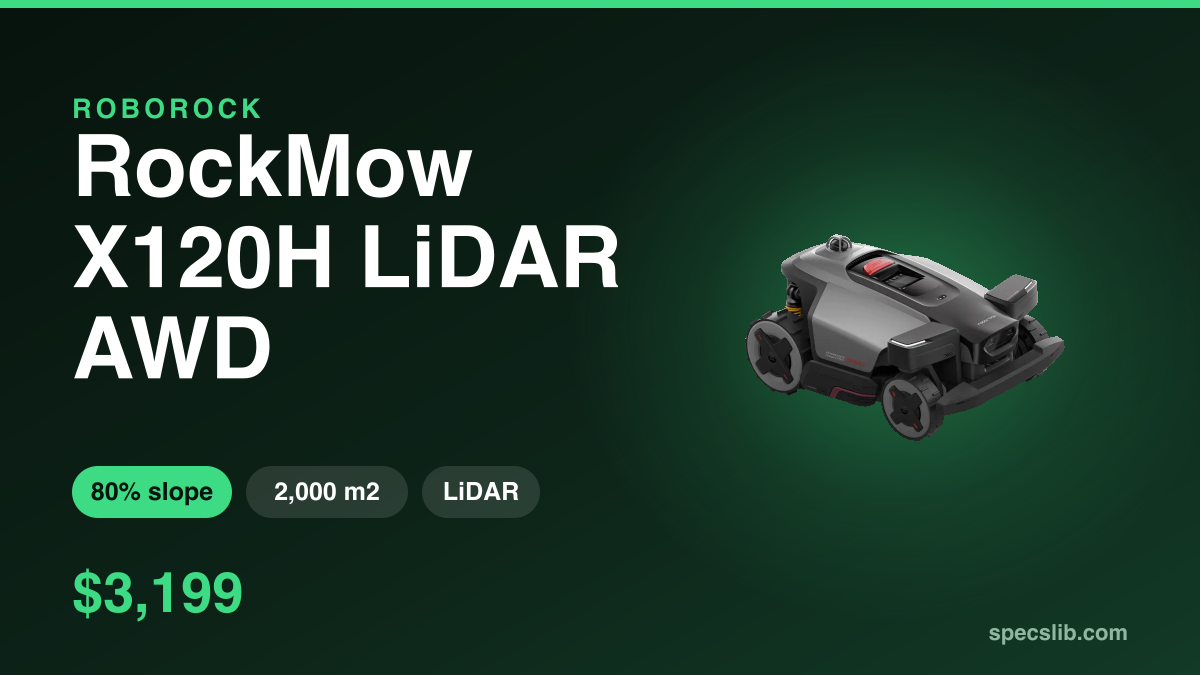
Roborock put the RockMow X120H LiDAR AWD on sale in the United States on 20 July, at $3,199 list with a $700 introductory cut to $2,499 running through 6 August. The price is not the interesting part. The interesting part is what is missing from the spec sheet: there is no RTK antenna, no base station, and no satellite positioning at all.
Why removing RTK is a real decision, not a cost cut
Almost every wire-free mower sold in the last three years positions itself with RTK, which reads GNSS satellites and corrects them to roughly a centimetre using a fixed reference point. It works extremely well on an open lawn. It works badly under a mature tree canopy, alongside a two-storey wall that bounces signals, or on a narrow side yard where the sky is a strip.
RTK also comes with setup tax. You mount an antenna somewhere with a clear view of the sky, you run power to it, and you accept that its placement now constrains where the mower can reliably work.
The X120H throws that away. It maps with a 360° 3D LiDAR on the top of the chassis, paired with a camera feeding AI obstacle avoidance. The mower builds its own map of the space and localises inside it, the same way a robot vacuum does indoors, at garden scale. No sky required.
What Roborock published, and what it did not
The confirmed numbers are narrow but useful:
| Spec | Value |
|---|---|
| Coverage | up to 0.49 acre (about 2,000 m²) |
| Cutting width | 9.49 in (24 cm) |
| Cutting height | 1.57 to 3.54 in (40 to 90 mm) |
| Max slope | 80% (38.7°) |
| Obstacle crossing | 3.15 in (8 cm) |
| Edge precision | within 3 cm |
| Drive | all-wheel drive, dynamic suspension |
| Cutting system | six blades, floating deck |
| Weatherproofing | IPX6 |
| Connectivity | app, plus three years of 4G included |
Roborock has not published battery capacity, runtime per charge, charge time, weight, or noise level. That is a genuine gap on a $3,199 machine, and it is the main reason our product page carries a lower confidence score than the European RockMow Z line, where those figures are documented.
Who it is actually for
If your lawn is open, flat and under half an acre, this is the wrong machine. An RTK mower will cut the same grass for a thousand dollars less, and the satellite dropouts everyone complains about will not happen to you.
The case for the X120H is specific: heavy tree cover, tall walls or a hillside. Those three conditions are exactly where RTK degrades and where an 80% slope rating with all-wheel drive stops being a marketing line. A LiDAR-first mower does not care that it cannot see the sky.
The comparison worth making is against Mammotion’s LUBA 3 AWD, which takes the opposite route: it fuses LiDAR, vision and RTK rather than picking one. That buys redundancy, at a higher price and with the antenna still in the box. Roborock’s bet is that the LiDAR alone is now good enough to make the satellite layer unnecessary.
Bottom line
Dropping RTK on a flagship is a confident move, and on paper it solves the single most common failure mode of wire-free mowers. The reservation is the missing half of the spec sheet. Before buying at $2,499, it is worth waiting for Roborock to publish battery and runtime figures, or for the first independent tests to report how long it actually mows a half-acre on one charge.