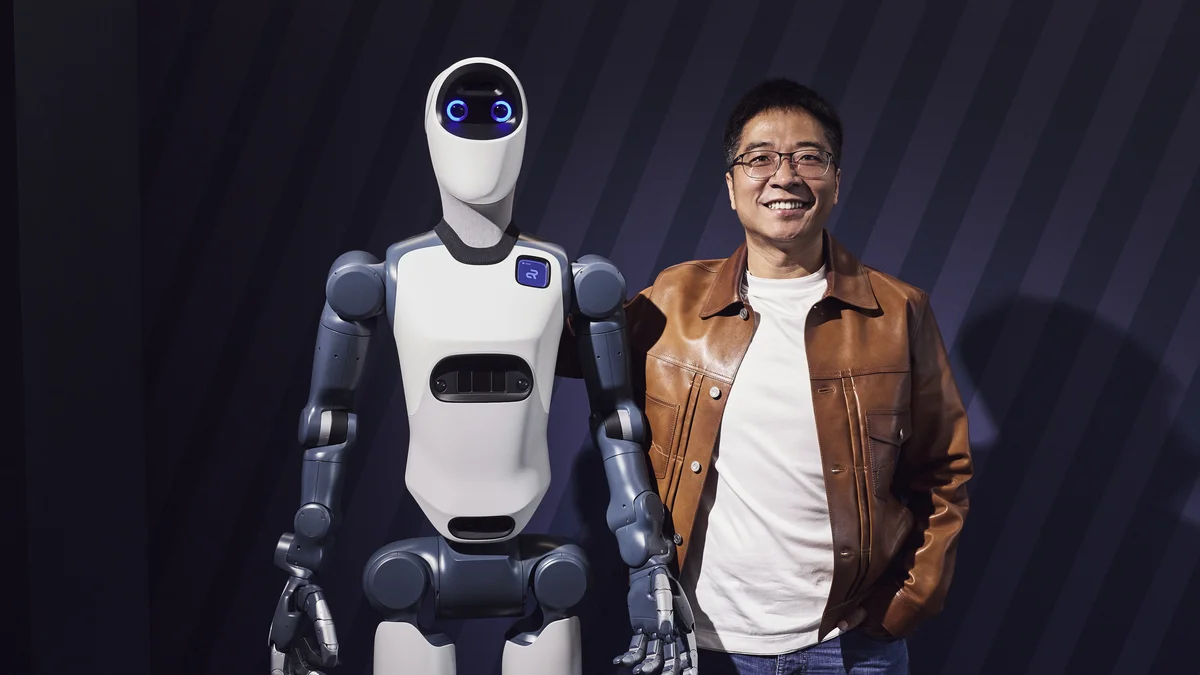
The global commercialization of physical artificial intelligence and general-purpose humanoid robotics has reached a monumental capital milestone. Munich-headquartered robotics manufacturer Agile Robots SE has officially closed a $500 million Series F financing round at a post-money valuation of $8.5 billion. The round brings the German-founded company’s total invested capital to $2.0 billion, elevating Agile Robots alongside Figure AI, Tesla, and Boston Dynamics as one of the most capitalized embodied AI organizations in the world.
The financing round was led by SoftBank Group (via SoftBank Investment Advisers), with strategic participation from world-class industrial and technology leaders including NVIDIA, Hitachi Group (and Hitachi Ventures), and T.Capital. The capital injection is directly earmarked to accelerate commercial expansion across North America, expand application engineering teams, and scale the operational throughput of its cutting-edge manufacturing facility in Fürstenfeldbruck, Germany.
Inside Fürstenfeldbruck: Europe’s First 10,000-Unit Humanoid Facility
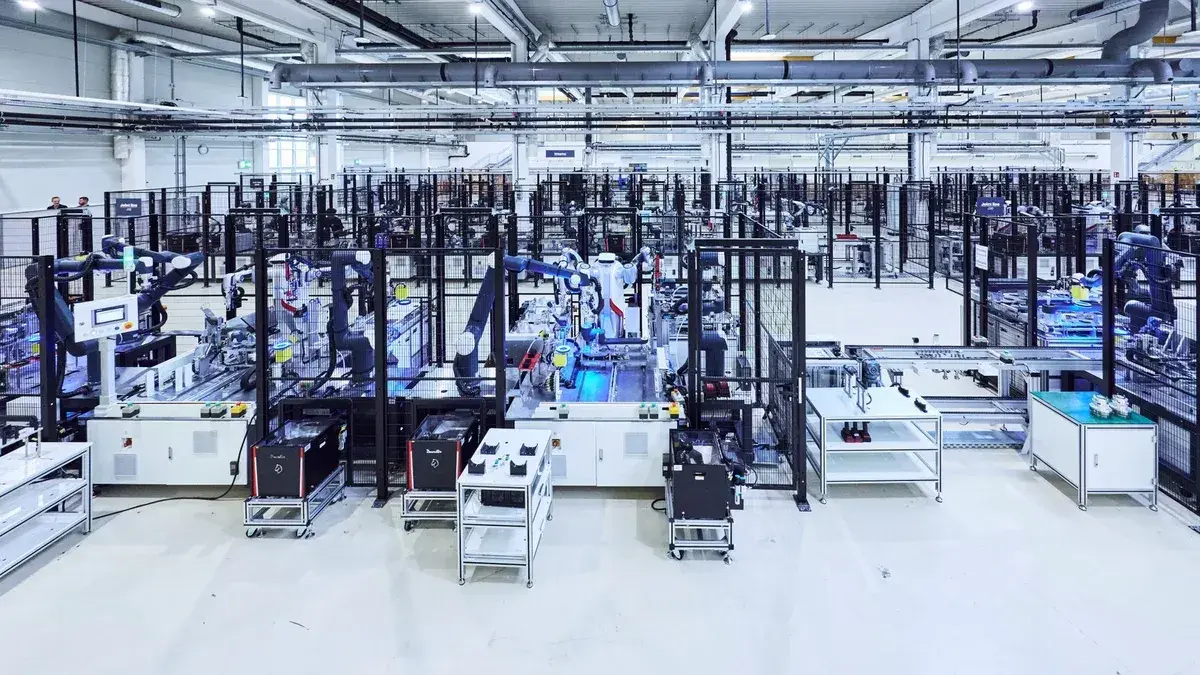
While many hardware startups rely on third-party contract manufacturers, Agile Robots elected from its inception to maintain end-to-end internal manufacturing. Located in Fürstenfeldbruck, just 25 kilometers west of the company’s Munich research headquarters, the brand-new 10,000-square-meter manufacturing plant was engineered specifically to bridge the gap between rapid laboratory prototyping and high-throughput series production.
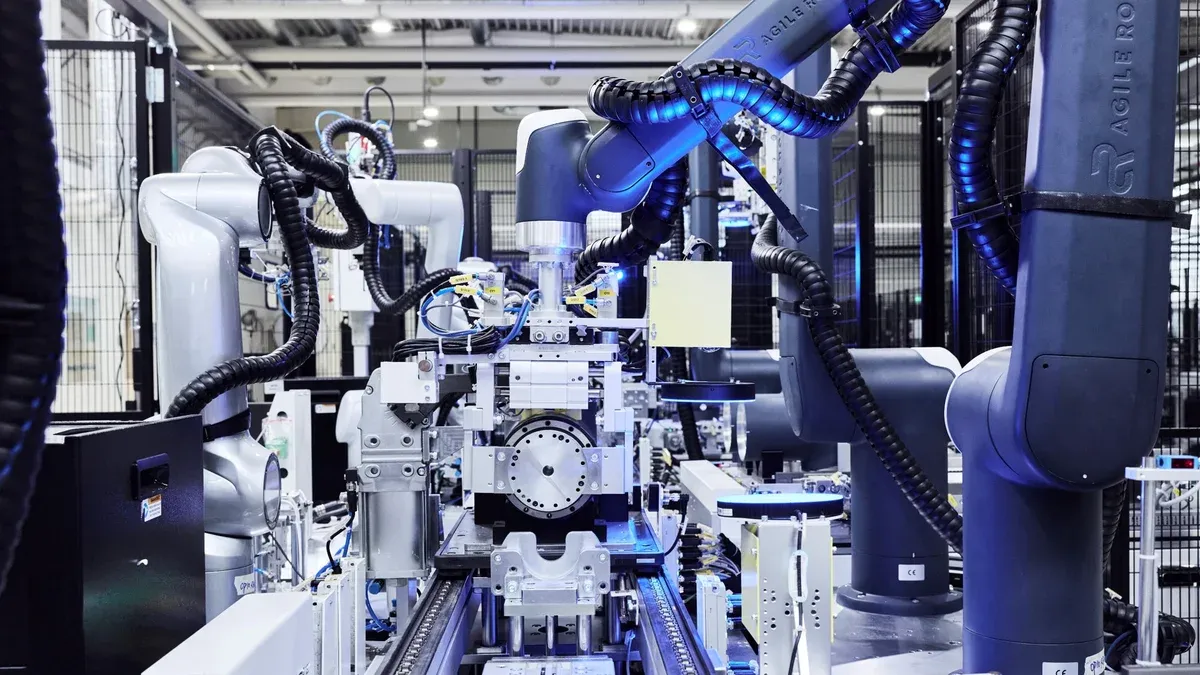
The facility is scaled for a theoretical annual output of up to 10,000 legged and wheeled humanoid robots, including the company’s flagship Agile ONE SN humanoid platform. The factory architecture combines fully automated cells for machining and mounting robot torsos and arm joints, where tight mechanical tolerances and repeatable torque calibration require robotic handling.
Precision Craftsmanship: Tactile Hands and Joint Torque Sensors
Despite high levels of line automation, Agile Robots deliberately maintains dedicated manual assembly stations for its most critical sensory components. Inside the designated “Agile ONE Production Area”, trained technicians assemble each dexterous 5-finger Agile Hand individually, seating micro-tactile sensors into each fingertip and verifying multi-axis force-torque transducers integrated directly into every articulating joint.
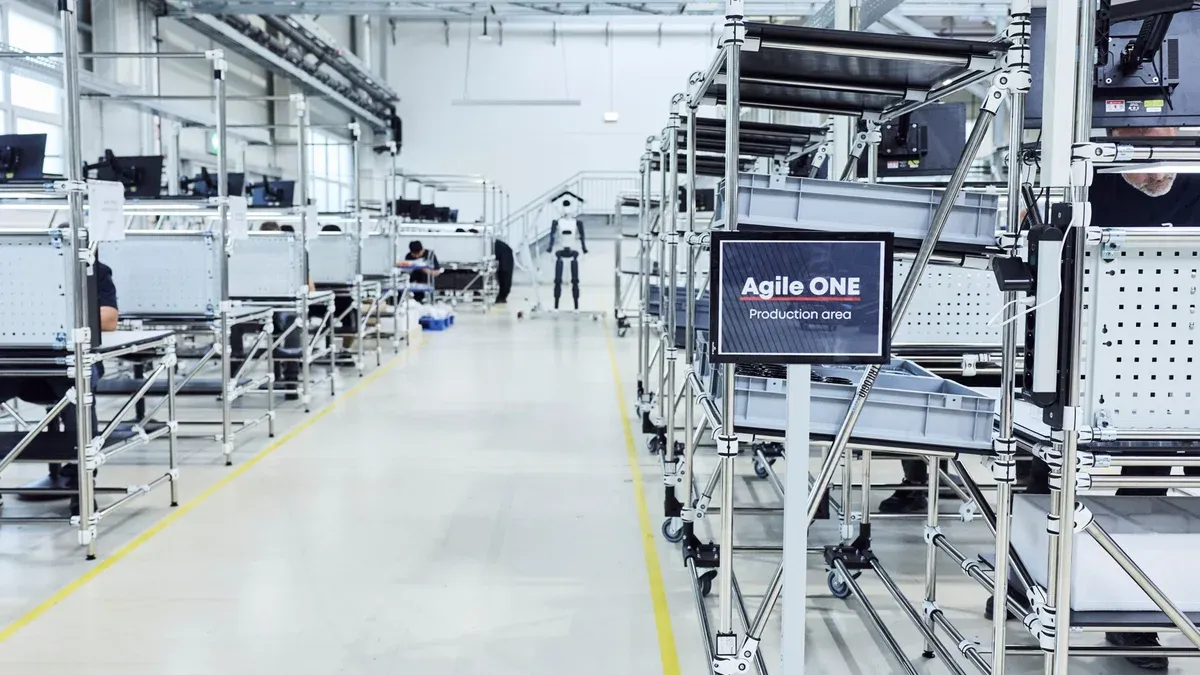
Because these sensory subsystems and strain-gauge joint modules are proprietary internal developments rather than off-the-shelf tier-1 components, assembly procedures require specialized human oversight. From the first structural sub-assembly station to final functional calibration and safety testing, each humanoid unit travels through the plant over an end-to-end production cycle of three to four days.
Material transport between production stations is handled by a fleet of on-site autonomous mobile robots (AMRs). Operating without floor-bolted tracks or magnetic tape, these AMRs continuously log spatial telemetry, motor load currents, and route efficiency, creating a continuous operational data loop that feeds back directly into the autonomy stack for future robot generations.
The Pragmatic Go-to-Market: Wheeled Certification vs. Bipedal Standards
A standout engineering insight revealed by Agile Robots concerns its industrial delivery mix. While the Fürstenfeldbruck facility is fully equipped to manufacture both bipedal legged and wheeled humanoid variants, the majority of units currently shipping to commercial customers are wheeled mobile platforms.
This operational priority is driven by safety regulations as much as kinematics. In both Europe and the United States, standardized collaborative safety certification frameworks (such as ISO 10218 and CE machinery directives) do not yet exist for 70 kg bipedal humanoids walking alongside human workers in tight factory corridors. Conversely, wheeled mobile bases already possess robust, globally recognized machinery certifications, enabling industrial partners like Audi (at Ingolstadt) and Hitachi to deploy Agile robots immediately in brownfield facilities without waiting for multi-year regulatory rewrites.
Agile Robots enters this high-scale phase backed by more than 3,500 employees, 2,000 R&D engineers, over 650 patents, and a deployed base exceeding 20,000 industrial solutions worldwide. Its subsidiary network, spanning research cobot benchmark Franka Robotics, logistics software firm Idealworks, and automotive tooling provider Krause Automation (acquired from thyssenkrupp AG), creates an integrated industrial foundation that few humanoid competitors can match.
Humanoid Engineering Comparisons on SpecsLib
To evaluate how Agile Robots’ hardware architecture and torque-controlled joints compare against global industry competitors, explore our technical comparisons:
- Compare Agile ONE SN vs NEURA 4NE1: German physical AI duel between Bavarian force control and cognitive multi-modal robotics.
- Compare Agile ONE SN vs Unitree G1: High-dexterity manipulation platform versus compact bipedal research benchmark.
- Compare Agile ONE SN vs ASUS Gallop: Proprietary joint sensing architecture against NVIDIA Jetson Thor edge computing.
For complete dimensional schematics, degrees of freedom, and actuator specifications, consult the verified Agile ONE SN specification profile or browse the comprehensive Humanoid Robot Database.