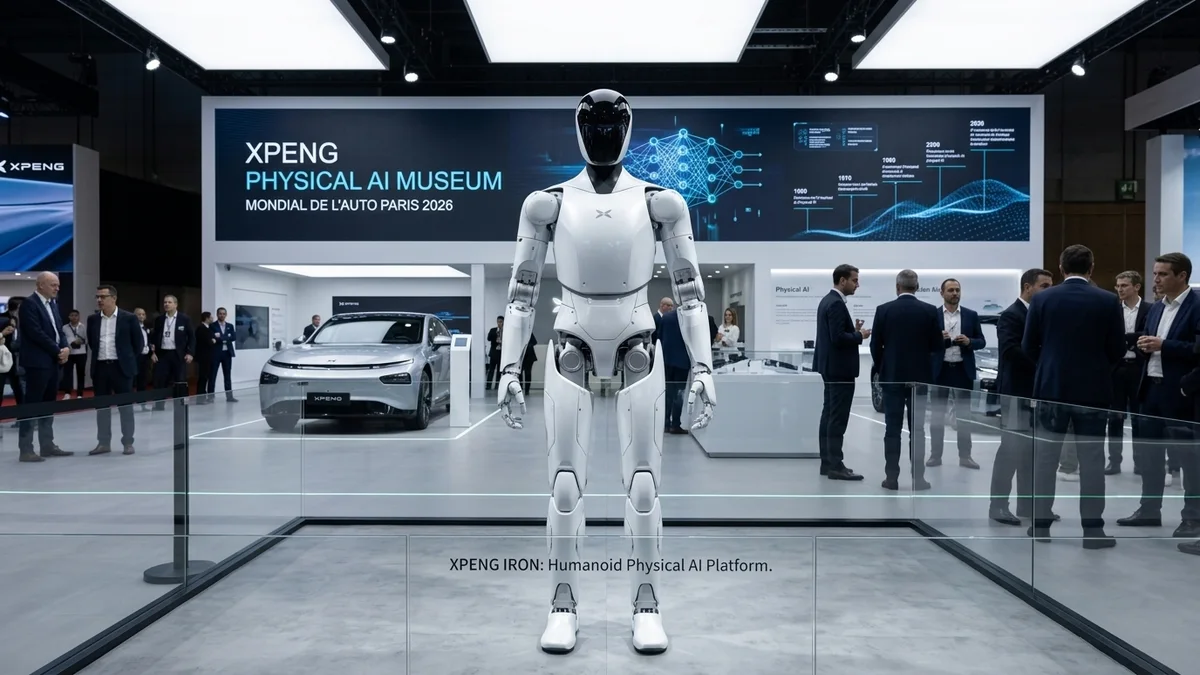
At the 2026 Paris Motor Show (Mondial de l’Auto) held at Paris Expo Porte de Versailles, Chinese smart mobility pioneer XPENG presented its general-purpose bipedal humanoid robot, IRON, on European soil for the first time. Transforming its 1,008-square-meter booth in Hall 6 (Stand A51) into an immersive Physical AI Museum, XPENG showcased the convergence of automotive intelligence, embodied AI, and bipedal mechanics under its unified “Car-as-a-Robot” platform.
The presentation marked a decisive strategic shift. During his keynote address at the Paris Automotive Summit, XPENG Chairman and CEO He Xiaopeng outlined the global commercialization timeline for IRON: after pilot validation in late 2026 and initial enterprise rollouts across China in the first half of 2027, XPENG plans to officially launch commercial deliveries in Europe during the second half of 2027.
76 Degrees of Freedom and Bionic Locomotion
Standing 1.78 meters tall with an operational mass of 70 kilograms, XPENG IRON demonstrates a human-scale mechanical architecture engineered for agile movement and fine manipulation across industrial assembly plants, retail showrooms, and public facilities:
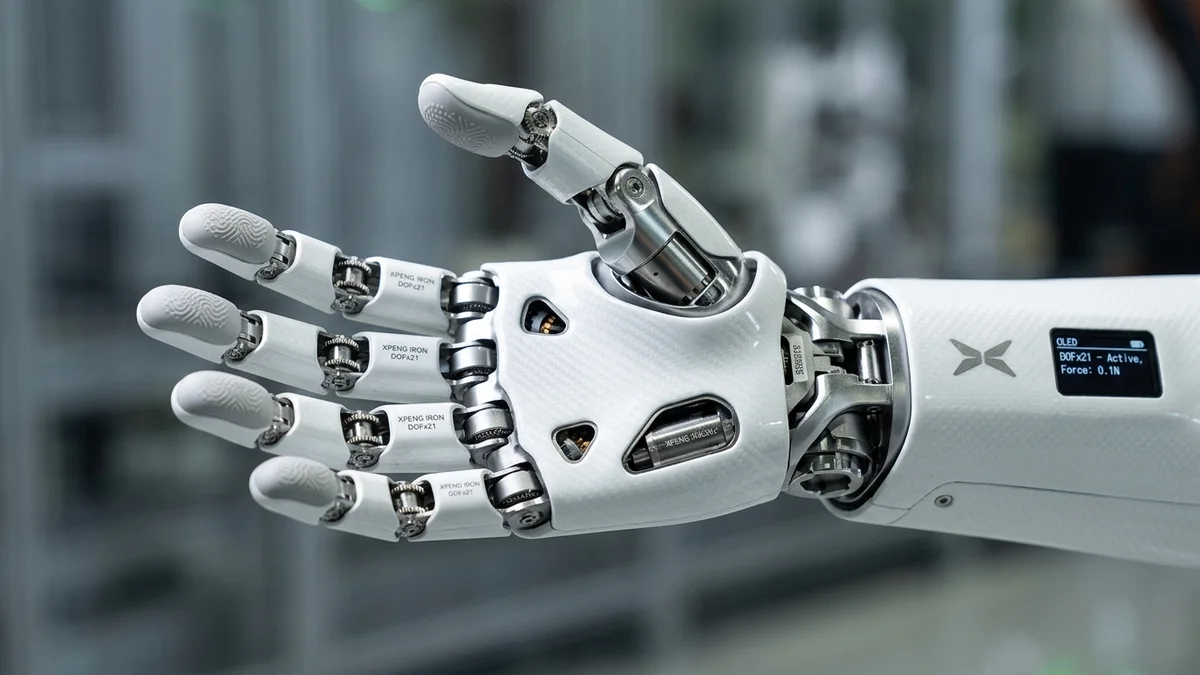
- 76 total degrees of freedom (DoF): Concentrated heavily in the extremities, including 42 DoF across both hands (21 DoF per hand), 14 DoF across the dual arms, 12 DoF in the bipedal leg assemblies, and 8 DoF distributed between the cervical neck and bionic spine.
- Bionic spine kinematics: Unlike rigid humanoid torsos that restrict natural walking gaits, IRON incorporates a flexible multi-segment bionic spine that replicates human pelvic tilt and torso rotation. This compliant structure absorbs dynamic kinetic shocks during walking and enables natural balance adjustments on uneven industrial flooring.
- 720-degree spatial vision: IRON eschews bulky mechanical spinning LiDAR units in favor of an integrated 720-degree surround-vision sensor suite, combining 360-degree horizontal and 360-degree vertical cameras to deliver seamless spatial neural reconstructions without blind spots.
Shared Silicon: Three Turing AI Chips Delivering 2,250 TOPS
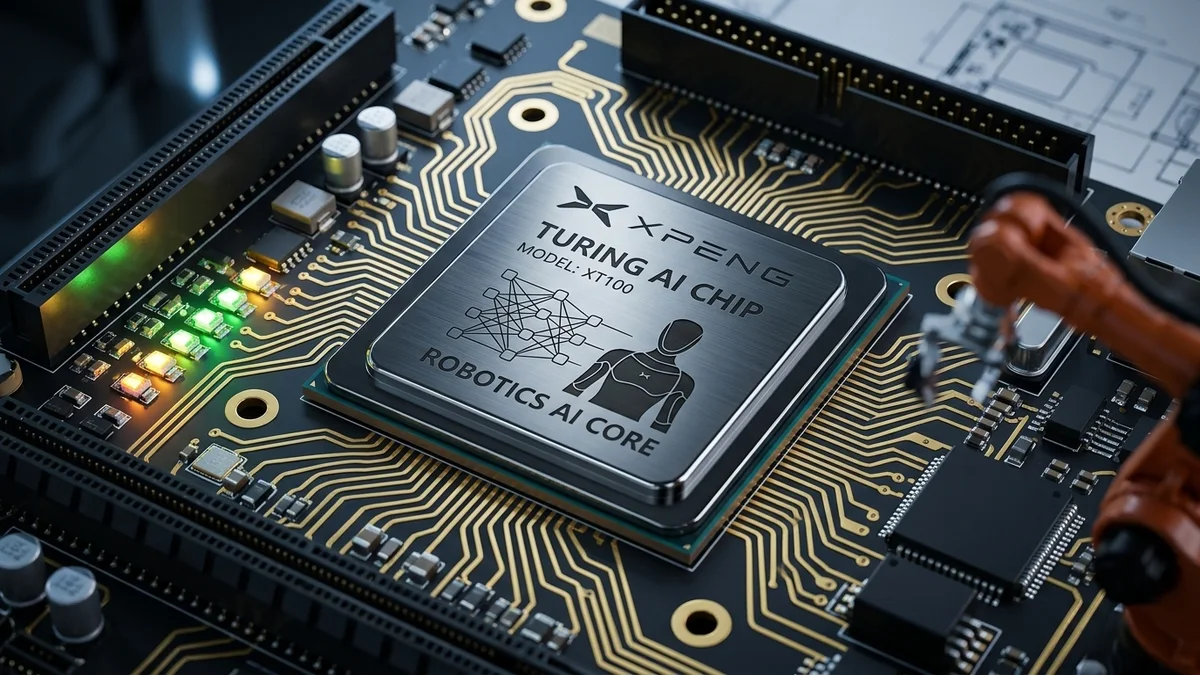
The technical backbone of IRON highlights XPENG’s automotive manufacturing synergies. Instead of sourcing discrete third-party AI accelerators, IRON is powered directly by three proprietary XPENG Turing AI chips, delivering a combined 2,250 TOPS (Trillion Operations Per Second) of local neural processing power.
This massive on-device compute budget runs XPENG’s multi-modal physical AI foundation model locally:
- Integrated VLT, VLA, and VLM models: IRON processes Vision-Language-Topology (VLT) for real-time spatial awareness, Vision-Language-Action (VLA) for precise kinematic path planning, and Vision-Language Models (VLM) for natural contextual reasoning and vocal interaction.
- Autonomous automotive heritage: The Turing AI chip architecture and foundational models are shared directly with XPENG’s production electric vehicles, including the flagship G9L SUV launched concurrently at the Paris show. Fleet learning accumulated across hundreds of millions of highway kilometers informs IRON’s predictive path planning and static obstacle negotiation.
- Low-latency end-to-end execution: Operating with zero cloud dependencies for motion safety, the triple-Turing stack executes motor control loops at frequencies exceeding 1,000 Hz, preventing stumbles and adapting grip force within milliseconds if a component slips.
Commercial Roadmap: Mass Production in 2026, European Deployment in 2027
XPENG’s presence in Paris solidifies the escalating technological rivalry between American and Chinese automotive giants entering embodied robotics. While Tesla displayed its Optimus Gen 2 humanoid alongside the Cybercab in Hall 7.1, XPENG presented its automated manufacturing milestone in Hall 6.
In September 2026, XPENG completed commissioning of its dedicated humanoid robot assembly facility in Guangzhou, featuring an automation rate exceeding 80 percent where industrial robotic arms assemble IRON units. With factory trials underway, the company confirmed the following phased rollout:
- Late 2026: High-volume pilot production runs in Guangzhou to validate automated assembly tolerance and supply chain durability.
- H1 2027: Initial commercial deliveries across Mainland China, prioritizing high-mix manufacturing assembly lines, XPENG flagship automotive retail stores, and commercial inspection patrols.
- H2 2027: Official European market introduction, making IRON one of the first mass-produced Chinese general-purpose humanoids commercially deployed in Europe.
For detailed hardware dimensions, joint kinematics, and actuator configurations, consult the complete XPENG IRON technical specification sheet in our robotics directory. To evaluate how XPENG’s automotive-derived robotics platform stacks up against its primary American rival, review our side-by-side engineering duel: XPENG IRON vs Tesla Optimus Gen 2.