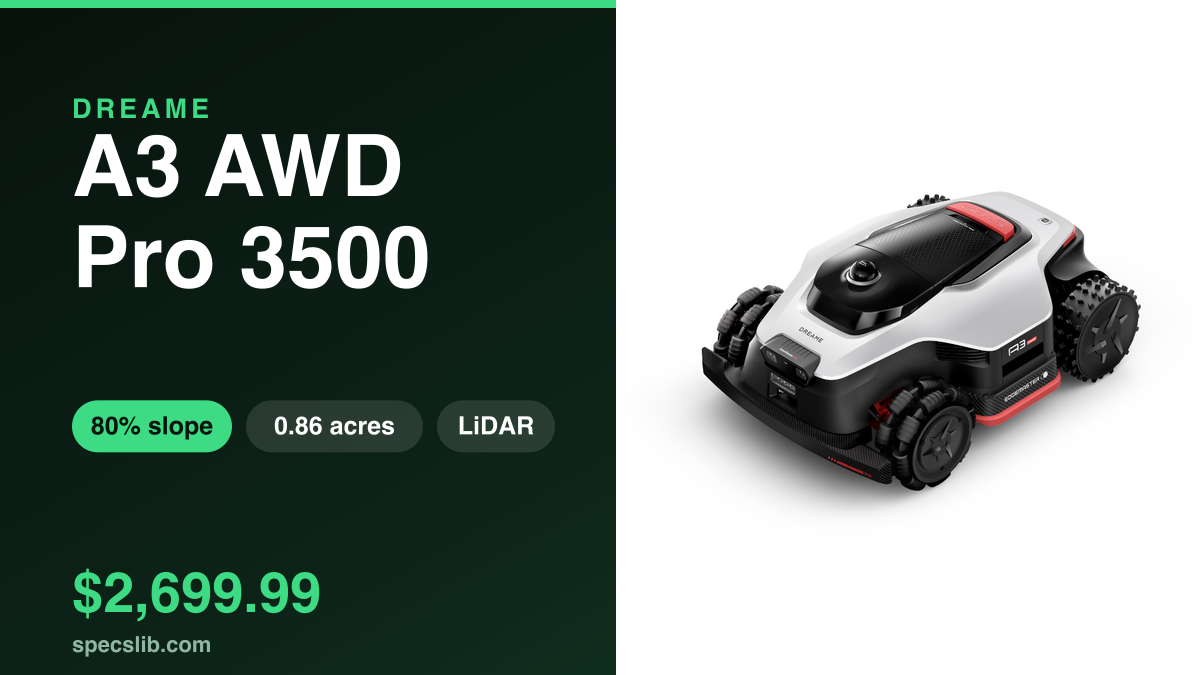
What this is. We have not mowed a lawn with an A3 AWD Pro. This is not a hands-on review. It is a synthesis of every independent test of this mower we could find, cross-read against Dreame’s published figures. Where testers agree, we say so. Where they contradict each other, we say that too, and here the contradiction turns out to be the most useful finding of the lot.
Two tests of the same mower, two opposite verdicts on the same feature. One rates its edge cutting among the best on the market, at under 3 cm from a wall. Another reports it keeping visibly too much distance from walls, with the deck failing to meet the edge cleanly.
Both are largely right, each about their own test. Reading a dozen tests together explains why, and surfaces a disagreement between testers that stays open on the 5000.
Claimed versus observed
| Specification | Dreame claims | What testers measured |
|---|---|---|
| Max slope | 80% (38°) | Held, with a condition: cleared confidently on dry ground, but one tester notes the rating applies over short pitches, not a continuous bank |
| Edge distance | 3 cm (EdgeMaster 2.0) | Reports disagree, regardless of variant: heise measures under 3 cm on a 3500; Labo Maison publishes about 5 cm on a 5000; smarthomeassistent rates edge cutting along a straight border 3 out of 5 on that same 5000; Presse-citron restates Dreame’s figure without an independent measurement |
| Runtime | 200 min | ~3h30 per cycle on the 5000 (10 Ah); the 3500 needs two to three trips to the dock to finish 3,500 m² |
| Mowing rate | not published per variant | around 186 m²/h on flat ground, among the fastest measured |
| Charge time | 85 min (3500), 110 min (5000) | 80 min reported for the 3500, broadly consistent |
| Person detection | Garden Guardian surveillance | around 50% detection, on a 640 × 360 camera |
The edge question, partly explained
Part of the disagreement dissolves once you sort the tests by what they were cutting against. Another part stays open: on a chassis testers describe as shared across variants, Dreame’s claimed 3 cm holds up for some and not for others.
Against a straight edge, the published measurements do not agree, even though heise and smarthomeassistent both describe the 3500 and the 5000 with the same chassis and the same cutting deck, battery aside. EdgeMaster 2.0 pushes the cutting deck outward along the boundary. heise reports under 3 cm on a 3500. Labo Maison itself measured about 5 cm along walls, hedges and borders on a 5000. smarthomeassistent, which tested the 5000, states its results apply across the range and rates the cut along a straight border 3 out of 5, never reaching a full 5 on this point. Presse-citron, after three months on that same 5000, does not publish its own measurement but restates Dreame’s claimed 3 cm and rates the mowing and edge quality excellent (9 out of 10). The gap between these accounts is about different testers and different gardens, not two different mowers.
Against anything that is not straight, it falls apart in a specific and predictable way:
- Acute or right-angled corners: the mower does not drive into the point, leaving an uncut wedge at the apex.
- Around trees: it leaves a ring of standing grass to finish by hand. One tester puts it plainly, EdgeMaster is effective against a straight border and much less so against a cylindrical one.
So the honest answer to “is the edge cutting good” is: look at your garden, not the spec sheet. On a chassis heise and smarthomeassistent both describe as identical between the 3500 and the 5000, a rectangular lawn bounded by walls came in under 3 cm for heise and about 5 cm for Labo Maison: the result depends on who is mowing what, not which variant you bought. A lawn with mature trees, angled beds or a pointed corner will need a strimmer either way, and no firmware update changes the geometry.
That is a conclusion no single review could reach, because each tester only had their own garden.
The slope rating comes with a caveat nobody puts on the box
The 80% figure holds up. Multiple testers confirmed confident climbing, and the all-wheel drive is the reason to consider this machine at all.
But one tester adds the qualifier that matters: the rating is achieved over short pitches. On a bank that falls away continuously, setting the cutting boundary too close to the drop is how the mower goes over it. If you have a real slope, keep the virtual boundary well back from the crest.
The second condition is water. Testers converge on wet steep ground being where it fails, losing traction and making repeated correction manoeuvres that tear the turf. Dry and steep is fine. Wet and steep is not.
What comes back in test after test
1. It marks soft ground. The omnidirectional wheels leave marks on saturated soil, and at 24 kg there is a lot of machine pressing down. This is the same criticism we found on the Mammotion LUBA 3 AWD, on a comparable chassis. It is starting to look less like a flaw of one model and more like the cost of heavy all-wheel-drive mowers in general.
2. Garden Guardian does not work as surveillance. Around 50% person detection on a 640 × 360 sensor. Treat it as a novelty, not a security feature, and do not let it factor into the price you are willing to pay.
3. Automatic mapping needs manual cleanup. On complex gardens the auto-generated map requires correcting by hand. The setup promise is “no wire, no antenna”, which it delivers; it is not “no work”.
4. Smart home integration is partial. Described as patchwork, with no full local control.
Single-source observations
Leads rather than findings, since we found each in one place only: a rain sensor slow to react, a lift alarm too quiet to be useful, and limited spare parts availability. The last one is worth weighing on a machine at this price with a battery that is not user-replaceable.
Who it is for
If your garden is large, sloped and complicated, this is the machine the corpus supports. The all-wheel drive is real, 186 m²/h makes it one of the fastest measured, and the LiDAR mapping works without an RTK antenna to site.
If your garden is flat and simple, every tester says the same thing in different words: you are paying for capability you will never use.
And if your boundaries are curved, angled or full of trees, weigh the edge finish carefully. It is the one place where this mower’s headline feature meets its limit, and where the ECOVACS GOAT A3000 LiDAR PRO, with a dedicated trimmer head that reaches the boundary itself, takes a different approach to the same problem.
Full sourced specifications: A3 AWD Pro 3500 and A3 AWD Pro 5000.