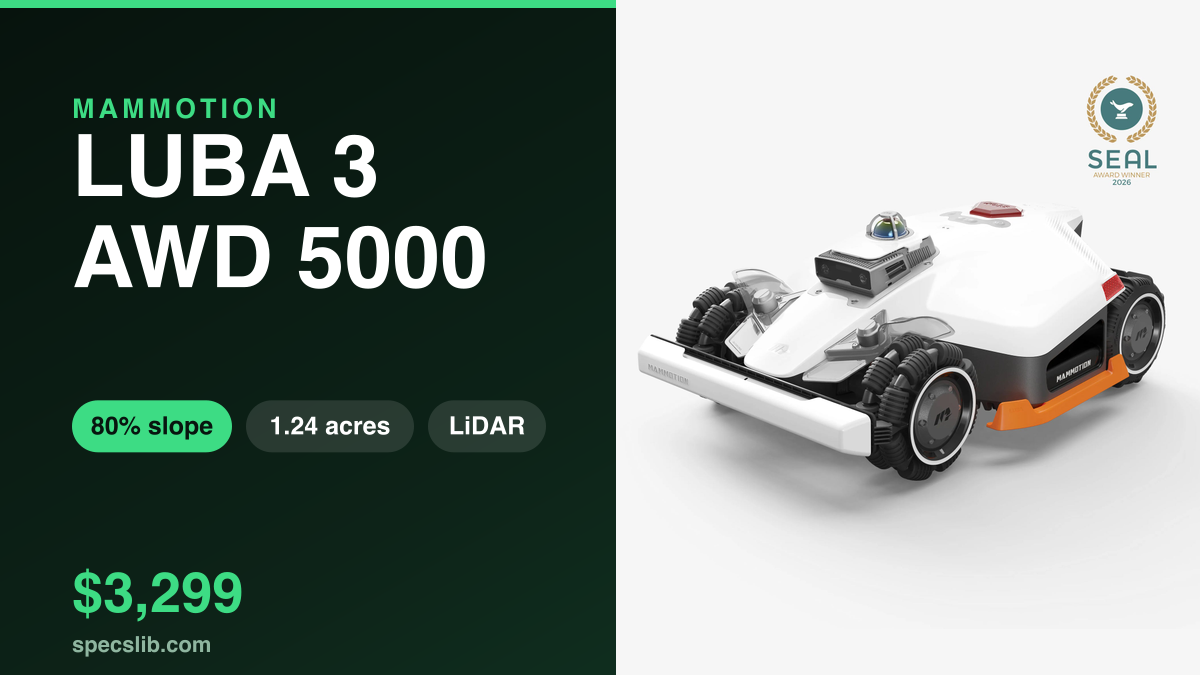
What this is. We have not mowed a lawn with a LUBA 3 AWD. This is not a hands-on review and it does not pretend to be one. It is a synthesis of every independent test of this mower we could find, cross-read against Mammotion’s own published figures. Where testers agree, we say so. Where they contradict each other, we say that too, because that disagreement is usually the most useful thing in the corpus.
Reading thirteen independent tests of the same machine produces something no single test can: you find out which criticisms are one reviewer’s bad luck and which ones every tester hits. Testers who have never read each other, working on different lawns, converging on the same fault is about as close to proof as this category gets. On the LUBA 3 AWD, four faults come back again and again. That convergence is the story.
Claimed versus observed
| Specification | Mammotion claims | What testers measured |
|---|---|---|
| Runtime (5000, 15 Ah) | 215 min | 190 to 200 min in dense grass, close to 200 on flat ground |
| Runtime (3000) | 150 min | diverges: 120 min measured by testsieger.de, 175 min confirmed by heimwerker-test.de, detail on the 3000 spec sheet |
| Max slope | 80% (38.7°) | held, and exceeded: cleared a measured 71% without hesitation, one tester ran a 45° (100%) bank with minimal slippage on wet ground |
| Edge distance | 5 cm | around 6 cm against tall edges despite an edge-approach mode (up to 4 passes on the 3000 per TechRadar) that never gets the mower to actually touch the wall or fence |
| Weight | 19 kg | heavy enough to mark soft ground, plus turf scuffing at turning points |
The slope figure deserves a note, because it is unusual. Manufacturers routinely publish optimistic slope ratings. Here, multiple independent testers found the mower met or beat its own claim, including on wet turf. If your lawn is the reason you are reading this, that is the number that matters and it appears to be honest.
The four things that come back in test after test
1. Edges are the weak point, and nobody disagrees. Several testers measured roughly 6 cm of clearance against tall edges; even the edge-approach mode available on the 3000 (up to 4 passes per TechRadar) never gets the mower to actually touch the wall or fence. Others called the edge finish “less accomplished than competitors”. Not one review we read defended it. You will be finishing edges by hand, or with a strimmer, on a mower that costs $3,299. For context, the ECOVACS GOAT A3000 LiDAR PRO carries a dedicated trimmer head that mows to the boundary, at $800 less.
2. It leaves marks on the lawn. Three independent tests describe this differently and clearly mean the same thing. One attributes it to the 19 kg weight on soft ground. Another reports turf damage at turning points appearing after ten days or more of use, a consequence of skid steering. A third calls the omni wheels “aggressive on wet grass”. Three symptoms, one cause: a heavy four-wheel machine that pivots by skidding. Any one of those reports alone would be anecdote. Together they are a design trait.
3. The transition off a slope is harder than the slope. Several testers noted that the mower handled steep ground confidently but struggled at the sharp break where a slope meets flat ground. If your garden has a hard edge at the bottom of a bank rather than a gentle run-out, that is the spot to watch.
4. The app splits testers. Several describe zone management as fiddly for first-time users, or note missing practical settings; a June 2026 video from an owner reports problems introduced by a firmware update. But it’s not a unanimous finding: on the 3000 variant, TechRadar scores it 4/5 for functionality (“comprehensive but could do with a tweak or two”), and another tester calls it the best of any brand he’s used. Worth checking case by case rather than treating as an established design flaw.
Two things only one source flagged
Treat these as leads rather than established facts, since they lack corroboration:
- Fibrous plant matter wrapping around the wheels. One hands-on test reported creepers and thin vines tangling in the wheels, requiring manual clearing. Plausible given the wheel design, but we found it in one source only.
- Elevated standby power draw. Reported once, never repeated elsewhere. Minor in absolute terms, but relevant if you leave the mower docked for weeks.
What the corpus does not cover
Being explicit about the gaps matters more than filling them with guesses:
- No multi-season data. The oldest tests date from spring 2026. Nobody has reported on blade wear, battery degradation or winter storage on this generation.
- Service is a real question outside the US. Testers in France flagged that support is entirely remote, with no repair network in the country. On a machine at this price, that is a genuine consideration.
- Battery replacement remains unsettled. testsieger.de, on the 3000, calls it technically user-removable, though without a clean click system; no other source confirms or contradicts this, and our own spec sheet lists it as non-replaceable.
- An independent noise measurement now exists on the 3000: testsieger.de measured 60 dB with a sound meter at 1 m, against the 56 dB Mammotion claims - no equivalent measurement on the other variants.
- The 1500 variant now has its own independent test: testit.de (Germany), which confirms the three variants (1500/3000/5000) share the same navigation, cutting deck and app - only battery capacity, maximum area, zone count and charge time differ between them; detail on the 1500 spec sheet.
Who should buy it, based on the evidence
The case is narrow but strong. If your lawn has real slopes, mature trees or broken ground, the LUBA 3 AWD is the machine the corpus supports: the Tri-Fusion navigation stack works, obstacle detection was praised specifically (traffic cones, tennis balls and a garden hose all correctly avoided in hands-on testing), and the slope rating is honest.
If your lawn is flat and your priority is a clean finish along walls and beds, the evidence points the other way. Every tester found the same edge weakness, and that will not be fixed by firmware.
See the full specification sheet with every figure sourced, or the side-by-side against the ECOVACS A3000 LiDAR PRO.