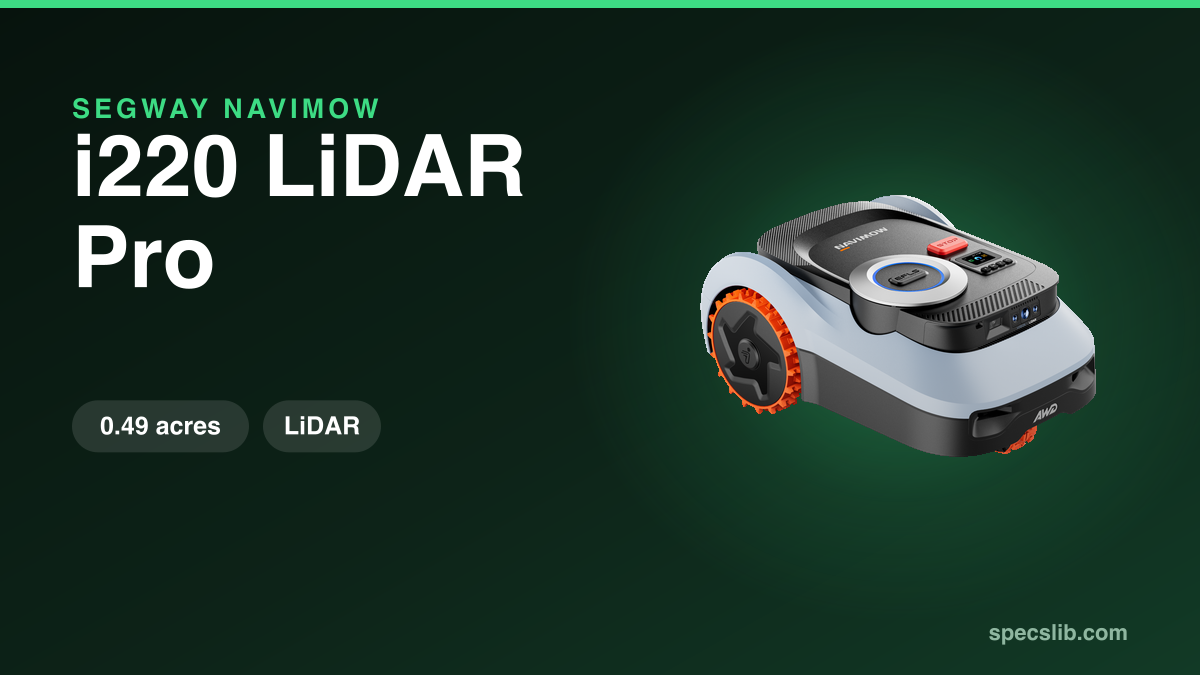
What this is. We have not mowed a lawn with a Navimow. This is not a hands-on review. It is a synthesis of every independent test of these mowers we could find, cross-read against what Segway publishes and against each other. What we found is less “the manufacturer hides everything” and more “nobody, including Segway’s own page, agrees on the numbers.”
We keep a specification database of 80 robot mowers, and we leave a field empty when we cannot pin a figure to the right product with a verifiable source, rather than filling it with an estimate. That rule produces a ranking nobody sets out to make: Segway Navimow leaves more fields empty than any other brand we track, and on its i210 and i220 LiDAR Pro flagships (list €1,599 and €1,999), that is not for lack of trying.
The official product page states the lawn area, the slope rating and, as a hero-image badge rather than a spec-sheet line, a noise figure. It also states, correctly and specifically for these two models, mowing area per charge: 195 m² for the i210, 470 m² for the i220. Beyond that, nothing: no battery capacity, no runtime, no charge time, no weight, no cutting width. The page does carry an FAQ that looks like it answers the battery question, “what is the battery capacity and charging time of the Navimow i2 LiDAR series?”, but it names three different models, i208/i215/i220 LiDAR, none of which is the i210 or i220 LiDAR Pro actually sold on that page. Segway sells a separate, cheaper “i2 LiDAR” line (no “Pro”) on its own page with those exact models, and its own FAQ answer is misfiled onto the Pro page.
What we could and could not confirm
More than a dozen third-party sites quote a battery capacity, runtime, charge time and cutting width for the i210/i220 LiDAR Pro. We checked the ones we could reach directly, and the honest result is: five usable hands-on sources for the i210 (updated August 24, 2026, detail below), two for the i220 (updated August 21, 2026, see below), and several that do not hold up.
Five hands-on reviews of the i210 LiDAR Pro publish spec tables that match down to the decimal. TechRadar, Basic Tutorials, PC-WELT, PCtipp.ch and cedric.fm each tested a unit named explicitly “i210 LiDAR Pro” / “i210E LiDAR Pro” and all publish: 22 cm cutting width, a 5.1 Ah battery, 75 minutes of mow time per charge, 90 minutes to charge, and coverage of 195 m² per charge (Basic Tutorials and PC-WELT each separately give a slightly lower real-world range in use, around 65-75 minutes and 175-195 m², close but not identical to the table figure). All five tables also match on weight (17.35 kg) and dimensions (655 x 445 x 289 mm), to the decimal. That level of agreement across five different outlets, in five different languages, reads less like five independent measurements than like one Segway press kit reproduced verbatim: none of the five claims to have weighed, measured or timed these figures themselves (only PC-WELT’s own weight measurement and PCtipp.ch’s own 58 dB noise measurement are genuinely the tester’s own). None of it is manufacturer-published, so it stays out of our spec table below; we no longer present it as field corroboration, only as a widely circulated press figure.
Two reviews add genuinely independent real-world measurements. On its own lawn of just 170 m², using the app’s “Precision Mowing” setting, TechRadar reports the i210E twice failed to finish in one charge, returning for an 80-minute top-up with about 4% of the lawn left and 15% battery remaining. TechRadar itself explains that Segway’s “up to 1,000 m²” figure applies to a full 24-hour mowing cycle with recharge stops in between, not a single charge, which makes its own result consistent rather than alarming. Basic Tutorials’ own spec table complicates that reading, though: separate from the 195 m²-per-charge figure, it lists a distinct “daily output” of 1,700 m²/24h, almost double what you’d compute from 195 m²/charge over a 90-minute recharge cycle across 24 hours. None of the five sources reconciles the two figures; neither do we. PCtipp.ch adds a second useful independent measurement: on its own property, it deliberately pushes the mower beyond the claimed 55% slope to over 70%, where it still climbs with good grip in a straight line, but a lift-safety sensor stops the mow out of caution when turning (a drive slip control setting in the app can push this limit further).
EasyLawnMowing also handled a unit, but its own account disagrees with itself: its written impressions state an 18 cm cutting width, while a separate comparison table on the same page states 22 cm for both the i210 and i220, alongside a mowing area figure labelled “recommended area” rather than area per charge. We are not treating that table as a further confirmation of anything. cedric.fm’s own article disagrees with itself too: it gives two different durations for manual mapping on a 500 m² property comparable to its own (about 15 minutes in one place in the article, 30 to 40 minutes in another), and reports good traction on its own slopes, which it states as “35-40°”, well beyond the 29° its own spec table lists as this same mower’s maximum, with no explanation for the gap.
Update, August 21, 2026: two hands-on i220 reviews now exist. Maniaques.fr (France) and Teknofilo (Spain) each tested an i220 LiDAR Pro on their own property in June 2026, and independently report a 22 cm cutting width, a figure that still appears nowhere on the manufacturer’s official page but that two independent reviewers now confirm, unlike the EasyLawnMowing comparison table cited above (10 Ah, roughly 180 minutes of runtime, roughly 115 minutes to charge, 22 cm), which remains unconfirmed for the i220 specifically. Neither Maniaques.fr nor Teknofilo presents its 22 cm figure as an instrument measurement, so it stays out of our spec table, consistent with our rule of never filling a spec from test data even when testers converge. Battery, runtime and charge time for the i220 remain unconfirmed by any hands-on test. See our i220 LiDAR Pro sheet for both reviews in detail.
A few more sources round out the picture:
- A UK retailer page for the i220E LiDAR states outright that it has not tested the unit yet (“lab testing due Spring 2026”), while listing a 45% slope rating that contradicts the 55% Segway states for the Pro line: two signs it is describing yet another SKU.
- PCWorld did test an “i210”, but it is not the i210 LiDAR Pro covered above. Verified August 24, 2026: the reviewer explicitly describes the unit as two-wheel drive (“two-wheel drive will serve you well,” “it doesn’t have four-wheel drive”), while all five i210 LiDAR Pro reviews describe three-wheel all-wheel drive (Xero-Turn AWD). This is the same trap already flagged below for the non-Pro i220 LiDAR: Segway sells a cheaper, non-AWD “i210 LiDAR” alongside the “i210 LiDAR Pro”. PCWorld tests the former; removed from the list of usable sources for the latter.
- A number we initially mistook for an independent measurement of the i220 (10 Ah, 210 min runtime, 120 min charge) turned out to be Segway’s own official figures for the i220 LiDAR, the non-Pro model on a separate page: same brand, same number “220”, a different and cheaper machine.
So: cutting width, battery, runtime and charge time for the i210 LiDAR Pro are reproduced identically by five third-party sources, a level of agreement that reads more like a shared press kit than five independent measurements, and none of it appears on Segway’s official page; for the i220 LiDAR Pro, only cutting width (22 cm) now rests on two agreeing third-party sources (Maniaques.fr, Teknofilo), with battery, runtime and charge time still unconfirmed. Noise (59 dB) and area per charge (195 m² for the i210, 470 m² for the i220) are the two figures Segway states directly.
What the tests actually praise
The record-keeping is messy, but the engineering reviews well.
Navigation is the strong point, consistently. The LiDAR Pro line fuses LiDAR, network RTK and camera vision, and testers describe the result as precise and orderly, with accurate mapping and no antenna to site. On the earlier i-series, VisionFence recognises objects like trees and adds them to the map on its own, cutting to within about 10 cm of a trunk.
It is quiet. This comes up across the range, not only in the 59 dB figure.
Setup is genuinely easy. Assist Mapping builds the virtual boundary automatically, and the entry models are described as easy to install and well suited to small, flat suburban lawns.
Where it does not fit
Slopes. This is the clearest limit in the corpus. The i105 and i110 are rated 30%, the LiDAR Pro line 55%. Against the 80% of a Mammotion LUBA 3 AWD or a Dreame A3 AWD Pro, that is a different class of garden. Testers are explicit that properties with dense tree cover, slopes over 20% or complex layouts will struggle with the entry models.
Area. The i105 tops out at 500 m² in our data, the i110 at 1,000 m². These are suburban lawns, not estates, and the range is priced accordingly.
What the corpus does not cover
No independent long-term data on this generation, and nothing published on blade wear or battery degradation. The i205 AWD, on Segway’s other wire-free line, does now have two independent hands-on tests on our own i205 AWD spec sheet: reliable obstacle detection, an uncut edge strip, and per-charge coverage measured well below what Segway claims. Its sibling, the i208 AWD, shares the same chassis per one of those tests but has no dedicated hands-on review of its own yet.
Our read
If your lawn is flat, suburban and you value quiet operation with a setup that takes an afternoon, the Navimow LiDAR Pro line’s navigation is among the better implementations available, on the strength of what independent testers actually did verify.
But we would flag the record-keeping itself as a buying consideration, not a detail. A mower whose cutting width, battery, runtime and charge time are absent from its own manufacturer’s page, and where one of the most-quoted “specs” circulating for it online turns out to belong to a cheaper sibling model, has not been documented the way a mower at this price should be. Two figures check out straight from Segway, noise and area per charge; for the rest, the i210 has five third-party sources reproducing the same figures (likely one shared press kit, not five measurements), plus two genuinely independent real-world measurements: a field test suggesting the 1,000 m² rating means a 24-hour cycle rather than a single charge, and a deliberate slope run past the claimed 55% to over 70%; and the i220 now has two agreeing third-party sources on cutting width, with no confirmation yet on battery, runtime or charge time.
We have written to Segway asking for the missing specifications, and for a fix to the FAQ pointing at the wrong product line. If they answer, this page and our i210 and i220 spec sheets will be updated with the figures attributed to them, and we will say so here.