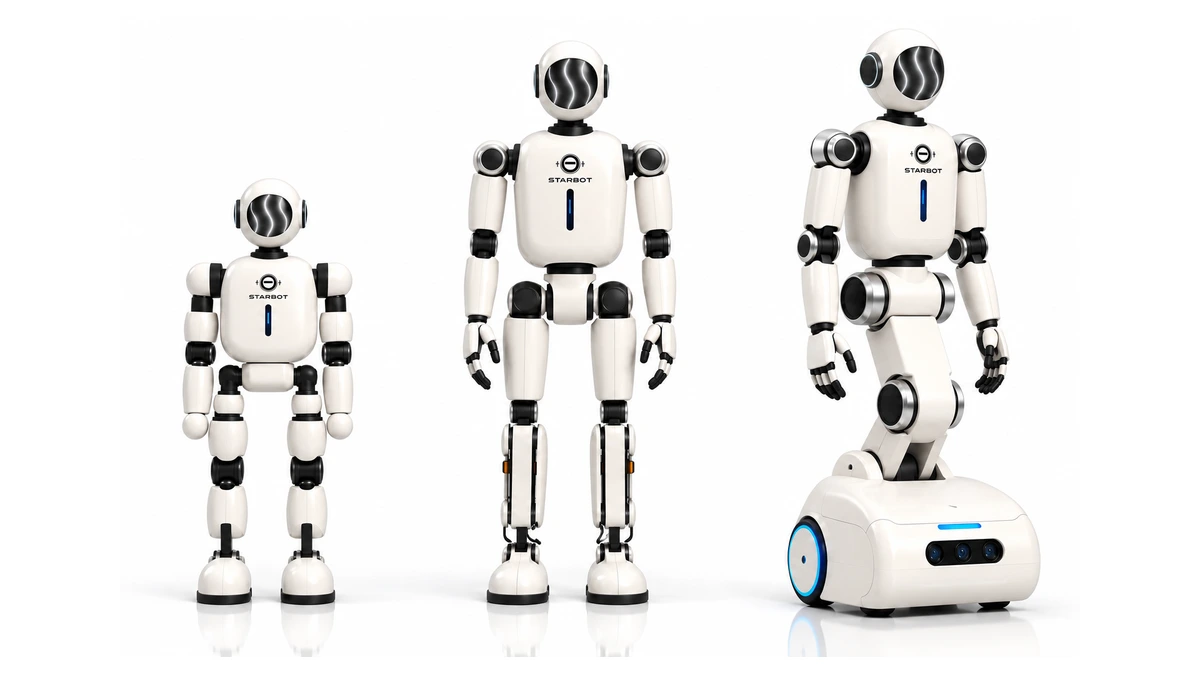
In a significant market shift for physical artificial intelligence and accessible robotics, California-based startup StarBot Robotics has officially opened commercial orders for Spark, a compact bipedal humanoid robot engineered specifically for youth education, university research, and independent AI developers.
Priced at a standard retail tier of $7,999 with an introductory early-bird launch price of $5,999 for the first 100 confirmed reservations ($200 refundable deposit), Spark represents North America’s first mass-produced developer humanoid priced under $10,000. Crucially, StarBot emphasizes that Spark is designed and 100% manufactured in the United States, emerging directly from the incubation ecosystem at the University of California, Santa Barbara (UCSB) led by founder and CEO Yong Wang.
Breaking the Hardware Cost Barrier in Embodied AI
Until now, the physical AI market has faced a severe accessibility divide. On one end, enterprise bipedal platforms from Figure, Boston Dynamics, and Agility Robotics command enterprise lease rates or five-figure pilot budgets. On the other end, sub-$20,000 developer hardware has been dominated by Chinese manufacturers such as Unitree (with the G1 at $16,000) and Booster Robotics (with the T1).
StarBot Spark directly challenges this dynamic by providing a compliant, lightweight bipedal platform built specifically to move robotics education out of simulated screen environments and onto physical classroom desks and laboratory floors.
Kinematics, Power, and Actuation Architecture
Standing approximately 90 centimeters (3 feet) tall and weighing 16 kilograms (35 pounds), Spark balances physical stability with desktop-friendly portability:
- 22 Degrees of Freedom (DOF): The kinetic chain integrates 10 articulated joints in the lower limbs (5 DOF per leg, enabling fluid dynamic walking, omnidirectional turns, and lateral weight transfer), 6 DOF in the dual arms (3 DOF per arm for reaching and gesturing), 4 DOF across the actuated grippers, and 2 DOF in the neck and waist for head pitch and torso orientation.
- Actuation System: High-efficiency brushless DC (BLDC) motors paired with planetary gear reductions, absolute magnetic encoders, and embedded current feedback loops to ensure compliant joint interaction.
- Power Architecture: An onboard 24V lithium-ion battery system delivering up to 3 hours of continuous runtime on mixed walking and interaction cycles, backed by a 40-minute fast-charging protocol via external DC connection.
- Perception and Expressive Interface: Wide-angle RGB-D depth perception camera integrated above an expressive animated facial head display, providing clear visual status feedback during student interaction and autonomous navigation.
Open Software Stack: NVIDIA Isaac Sim to Real-World Python SDK
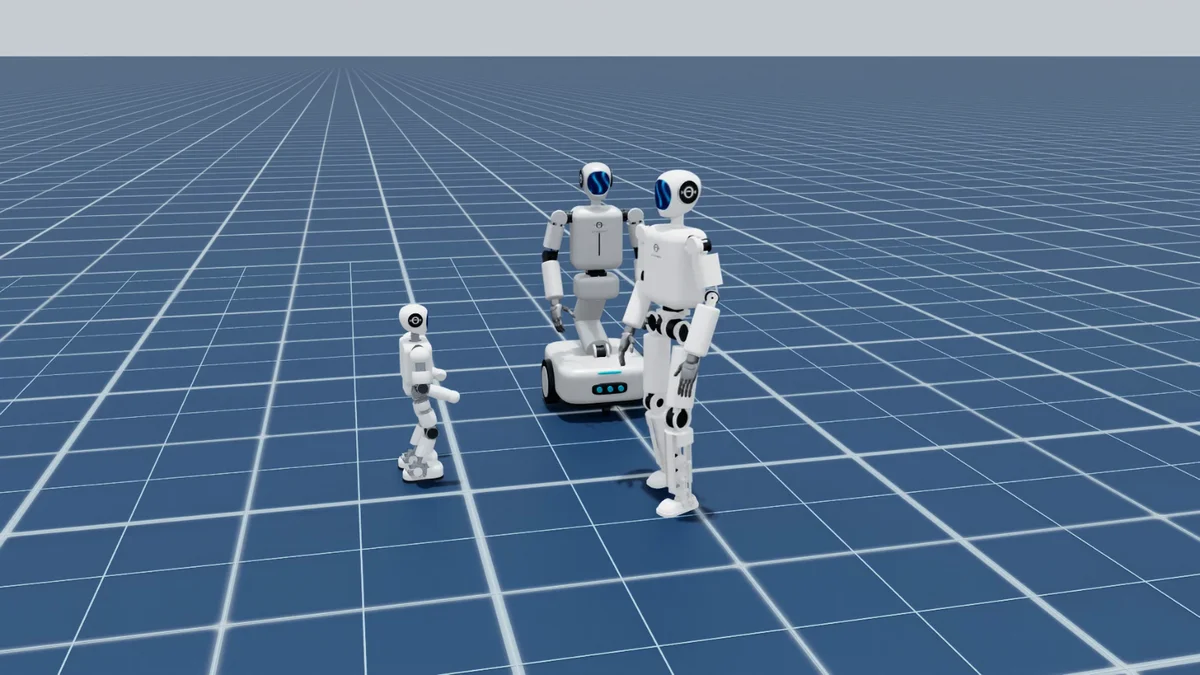
A core differentiator for Spark is its software architecture. Rather than locking educators and developers into proprietary closed ecosystems, StarBot built Spark on a complete Sim-to-Real reinforcement learning pipeline powered by NVIDIA Isaac Sim.
Dynamic walking policies, posture recovery, and terrain balance algorithms are trained at scale in photorealistic physics simulation before being deployed directly to onboard edge hardware. Developers receive native access to open-source Python and ROS2 (Robot Operating System) APIs, allowing direct reading of joint positions, velocities, and motor torque telemetry at high frequencies.
Engineering Comparison: Sub-$20,000 Developer Humanoids
| Technical Metric | StarBot Spark | Unitree G1 | Booster Robotics T1 |
|---|---|---|---|
| Manufacturer | StarBot Robotics (USA) | Unitree Robotics (CN) | Booster Robotics (CN) |
| Height / Weight | 90 cm / 16 kg | 127 cm / 35 kg | 115 cm / 28 kg |
| Degrees of Freedom (DOF) | 22 DOF | 23 to 43 DOF | 22 DOF |
| Runtime / Battery | 3.0 hours (24V) / 40 min charge | ~2.0 hours (9000 mAh) | ~1.5 hours (24V) |
| Perception Hardware | RGB-D Depth Camera + Face Display | 3D LiDAR + RealSense D435i | Depth Camera + Ultrasonic |
| Sim-to-Real Pipeline | NVIDIA Isaac Sim + Python/ROS2 | Isaac Gym + Unitree SDK | Isaac Gym + Custom ROS |
| Manufacturing Base | Santa Barbara, California (USA) | Hangzhou, Zhejiang (China) | Beijing (China) |
| Starting Price | $5,999 ($7,999 MSRP) | $16,000 (Base) | ~$12,500 |
| SpecsLib Analysis | View Spark Profile | View G1 Profile | View T1 Profile |
Explore our comprehensive head-to-head engineering duel: StarBot Spark vs Unitree G1.
The Multi-Platform Strategy: From Classroom to Hospitality
Spark forms the entry point of StarBot’s broader robotics hardware roadmap:
- StarBot Spark: 90 cm bipedal platform dedicated to youth STEM learning, student competitions, and developer algorithms ($5,999 introductory).
- StarBot Astra: A 152 cm (5 feet), 34 kg (75 lbs) full-scale humanoid research platform featuring 23 full-body degrees of freedom tailored for university laboratories and advanced embodied AI experiments.
- StarBot Flex: A 175 cm (5 feet 9 inches) foldable wheeled humanoid designed for real-world service workflows in commercial facilities.
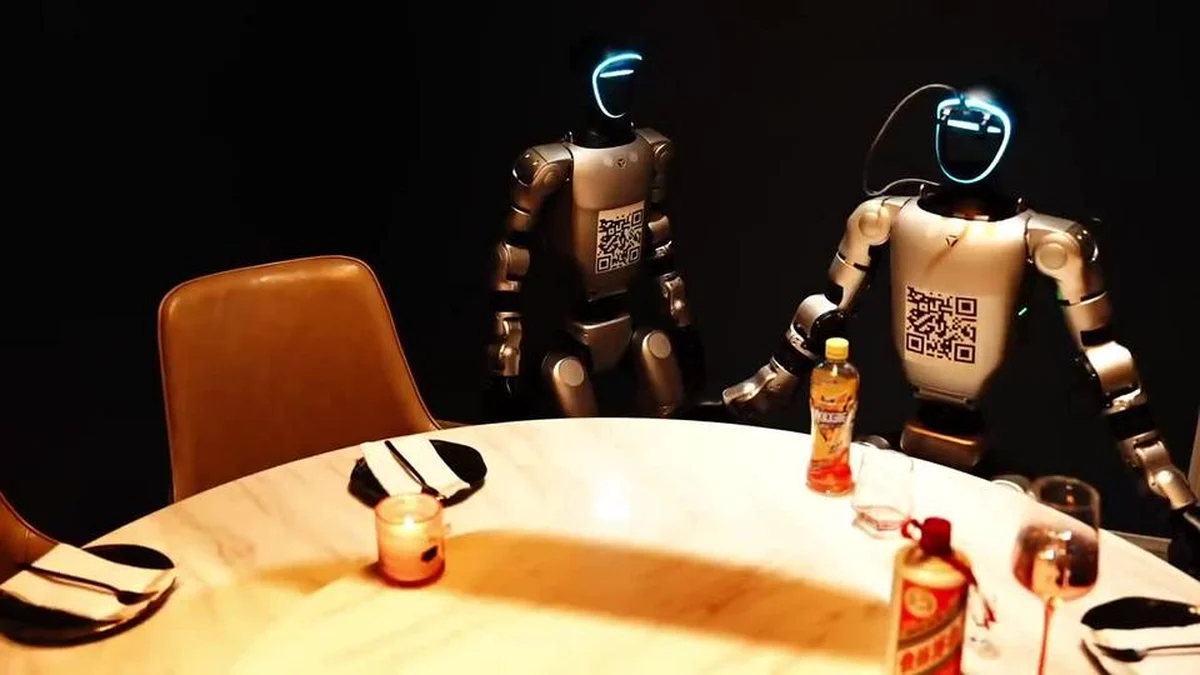
- StarBot Nova: First-generation commercial service humanoid equipped with dual 7-DOF manipulation arms, already validated in active California restaurant operations.
Availability and Market Outlook
StarBot has commenced taking $200 refundable deposits on its official website, with introductory units starting shipping in early 2027.
By proving that an American manufacturer can produce a fully articulated 22-DOF bipedal humanoid with Isaac Sim reinforcement learning under the $8,000 mark, StarBot Spark opens a critical new chapter in physical artificial intelligence: democratizing embodied hardware access for the next generation of engineers.