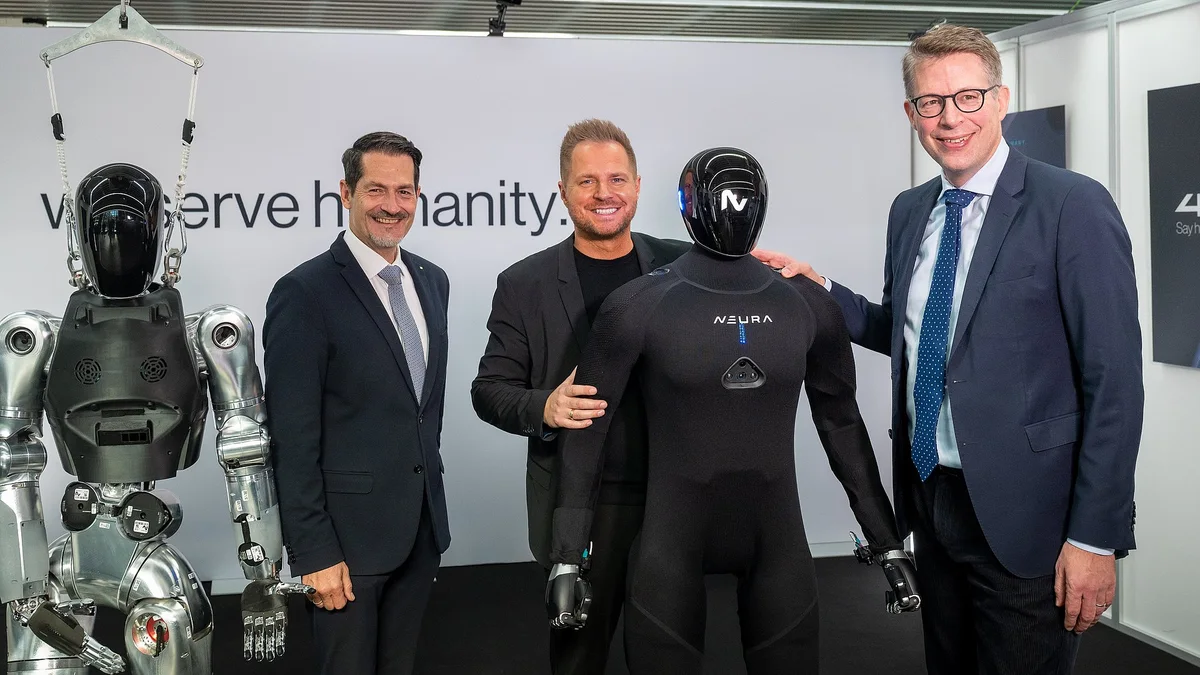
On October 22, 2026, the Munich Institute of Robotics and Machine Intelligence (TUM MIRMI) at the Technical University of Munich and German cognitive robotics unicorn NEURA Robotics officially inaugurated the TUM RoboGym (powered by NEURA) at the LabCampus innovation center near Munich Airport. Built with an initial joint investment of roughly €17 million, the 2,300-square-meter facility represents Europe’s largest dedicated scientific training and research facility for Physical AI (embodied artificial intelligence).
To mark the opening, NEURA Robotics CEO David Reger, TUM President Prof. Dr. Thomas F. Hofmann, and Bavarian Science Minister Markus Blume formally unveiled the 4NE1 Gen 4, the fourth-generation iteration of NEURA’s flagship cognitive humanoid robot engineered specifically for serial production and multi-shift industrial validation.
Solving the Physical AI Data Bottleneck
While frontier multimodal Large Language Models (LLMs) scale effortlessly on billions of web pages and video tokens, robotics faces a fundamental physical data bottleneck. True autonomous dexterity cannot be learned from passive YouTube clips or synthetic rigid-body simulations alone: contact dynamics, friction coefficients, micro-slippage, mechanical backlash, and cable compliance require dense, high-frequency physical interaction datasets.
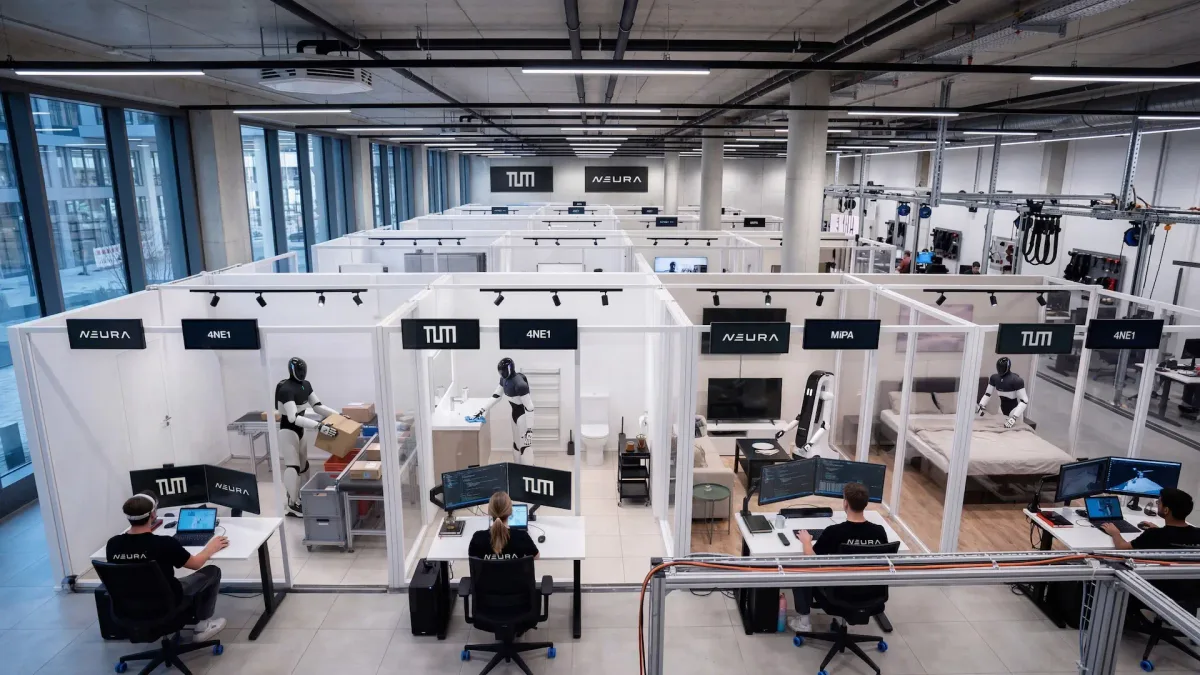
The TUM RoboGym directly solves this data scarcity by running 48 modular training cells housing approximately 100 humanoid, mobile, and collaborative robots. In each cell, human robot trainers demonstrate specialized workflows (including mechanical part assembly, CNC machine tending, precision tool guidance, shelf stocking, and carton folding) using motion-capture sensor suits (such as Xsens) and haptic data gloves (MANUS).
These human trajectories are synchronized with multi-view RGB-D camera streams, joint torque telemetries, and tactile skin feedback. Once verified, the recordings feed into a curated, cloud-connected data lake within NEURA’s proprietary Neuraverse ecosystem, enabling continuous self-supervised training and reinforcement learning loops across distributed robot fleets.
4NE1 Gen 4: 20% Lighter with Black Textile Cobot Skin
Debuting alongside the RoboGym infrastructure, the NEURA 4NE1 Gen 4 introduces significant structural refactoring over its Gen 3 prototype predecessor:
- Chassis Mass Reduction: Overall operating weight drops by approximately 20%, bringing the 1.80-meter humanoid from 80 kg down to 64 kg. This lower inertia markedly improves dynamic balance recovery, reduces joint actuator thermal strain, and expands operational battery runtime up to 6 hours.
- Integrated Sensor Skin in Black Textile: Rather than exposed metallic cowlings, the Gen 4 is encased in a custom black textile skin embedded with non-contact capacitive proximity sensors and high-resolution artificial tactile arrays. This enables true ISO collaborative robotics (cobot) compliance: the humanoid decelerates or stops automatically before making accidental contact with human colleagues.
- 55 Degrees of Freedom: The kinematic skeleton retains 55 active degrees of freedom, including two 12-DOF dexterous 5-finger hands equipped with sub-millimeter tactile sensor tips capable of delicate gripping and bimanual tool coordination.
- Neuron AI Engine: Local inference is powered by NEURA’s proprietary Neuron AI multimodal foundation model. Built on a unified Perception-Language-Action (PLA) architecture, Neuron AI processes 3D vision, torque feedback, audio cues, and temporal working memory directly on edge compute without relying on external cloud latency during closed-loop execution.
Academic Rigor Meets Industrial Ecosystem
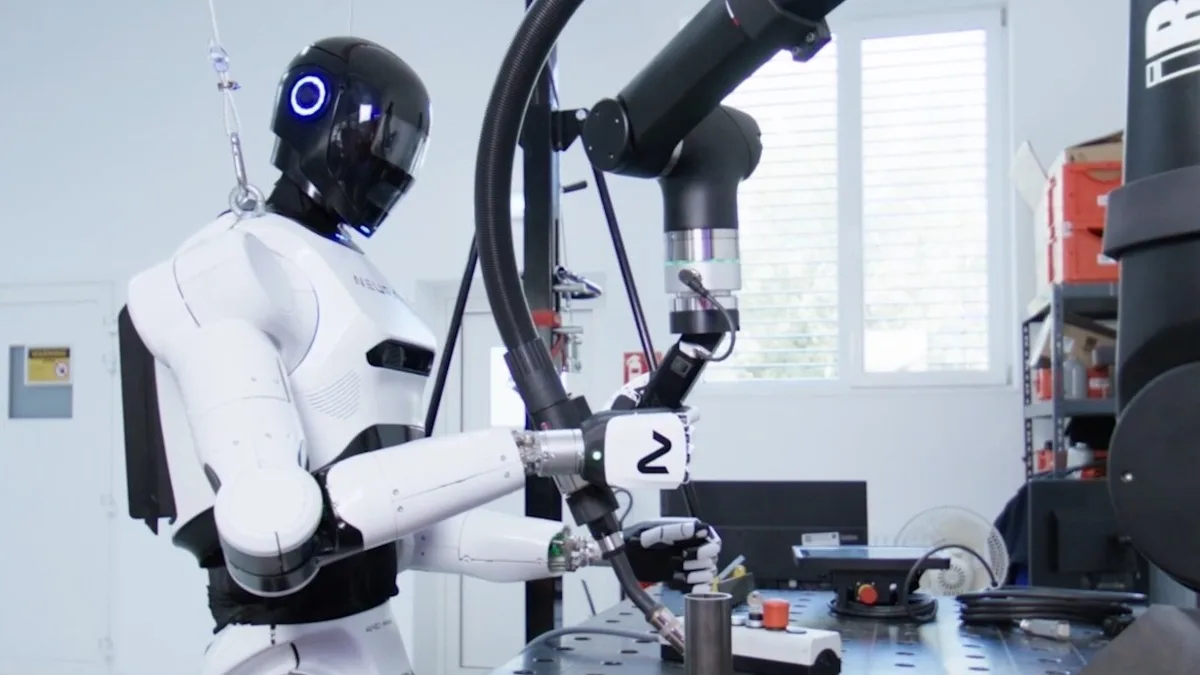
The TUM RoboGym is scientifically directed by Prof. Lorenzo Masia (Executive Director of TUM MIRMI) with Prof. Achim J. Lilienthal serving as Scientific Coordinator. Unlike purely academic laboratories, the facility is designed from day one as an open innovation platform bridging university research with commercial factory deployment:
- Training as a Service (TaaS): Starting in mid-2026, enterprise partners from automotive, intralogistics, aerospace, and medical engineering will supply real-world assembly fixtures and domain-specific work instructions to the gym. Robot trainers will generate custom policy weights, allowing companies to validate humanoid deployments before purchasing hardware.
- Standardized Benchmarking: TUM researchers will establish open physical benchmarks for dexterity, sim-to-real transfer fidelity, and collaborative safety compliance, addressing the lack of industry-wide validation metrics in humanoid robotics.
- Global Gym Network: NEURA Robotics intends to replicate the Munich Airport facility blueprint across an international network of NEURA Gyms, with subsequent sites planned in the United States, Asia, and RWTH Aachen University.
European Robotics in the Global Humanoid Landscape
The opening of the TUM RoboGym and the launch of the 4NE1 Gen 4 highlight Germany’s accelerating push in physical AI. Within Europe, NEURA’s cognitive software stack and hardware ecosystem position it in direct dialogue with Munich-based Agile Robots, whose Agile ONE SN recently showcased automotive logistics piloting at Audi Ingolstadt.
On the international stage, the TUM RoboGym serves as Europe’s direct counterweight to Silicon Valley training pipelines, such as Tesla’s planned 10,000-unit “Optimus Academy” and Figure AI’s factory learning cells at BMW Spartanburg.
You can inspect the full mechanical kinematic parameters and actuator specifications on the NEURA 4NE1 technical profile or evaluate how German collaborative engineering compares against American and Chinese platforms in our head-to-head duels:
- Compare NEURA 4NE1 vs Agile ONE SN
- Compare NEURA 4NE1 vs Figure 02
- Compare NEURA 4NE1 vs Tesla Optimus Gen 2
- Compare NEURA 4NE1 vs Boston Dynamics Atlas
Explore the broader embodied AI ecosystem and emerging bipedal platforms in our dedicated humanoid robot hub.